
July 31, 2009


Speaking of Lies- "Nazis would have been proud"

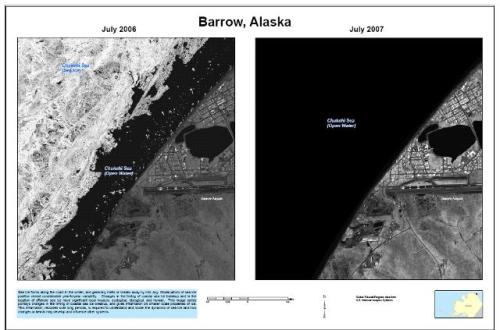
...We will show in this post that this is a hideous piece of lies and propaganda. It is very revealing since not only does it show the biased propagandizing of the Guardian/Observer stable, but also demonstrates the crude and shameless progagandizing of the Obama Administration (which also confirms the case made in the post All who hate Me love Death that Obama was dissembling when he claimed that he wouldn’t interfere with science). We will show in this post, with additional evidence from the air and the ground, that the satellite pictures have been deliberately selectively cropped and chosen for maximum propaganda effect to mislead the public (and politicians, no doubt). Put on the finishing touches about a Bush conspiracy and Obama’s openness and you are home and dry with something the Nazis would have been proud of.
Even the University of Alaska, Fairbanks felt compelled to comment:
Annual break-up of landfast sea ice off the coast of Barrow, Alaska receivedIn other words, all they show is that one year differs from another and no trend can be inferred. In the nicest possible way, this says that someone is up to no good here by distorting the science. Shame on the US Geological Survey for being prepared to become the mouthpiece of propaganda.....
international media attention in July 2009 after the USGS made available high
resolution-satellite imagery that show inter-annual variability in coastal ice
conditions…However, unlike suggested by some, comparing summer ice conditions in July 2006 and July 2007 is not sufficient evidence to verify a trend


...Since these are both from July of the same year, then two satellite images taken in ‘July’ of different years suddenly look perfectly ordinary and expected, don’t they? We would find the same with all sorts of other phenomena that happen once a year – such as the blossoming of cherry trees in April: we can find them in blossom or not in blossom at different times of the month in any given year, or in different states of blossom on the same date or on different dates within the same month in different years......
read entire article here
More...
Lies, More Lies and Global Warming Statistics

FROM-Hurricane Valley Journal
By Randy Parker, CEO, Utah Farm Bureau Federation
People are beginning to recognize the Waxman-Markey cap-and-trade bill before Congress will increase energy costs, hurt our economy and likely do precious little, if anything, to reduce global warming.
Tom Tripp, a Utah magnesium specialist and member of the Intergovernmental Panel on Climate Change (IPCC) recently spoke about global warming to a statewide gathering of farmers and ranchers in Provo at the Farm Bureau Mid-year conference. Tripp, along with 2,000 members of the IPCC shared the 2007 Nobel Peace Prize with former Vice President Al Gore.
“Despite what you hear in the media, there is no scientific consensus regarding global warming.” Tripp said. “The atmospheric data is not overwhelming and even with increased levels of carbon dioxide it is still only a miniscule portion of the atmosphere. If there are warming trends today, man may not be the prime suspect. For instance, 700 years ago global warming halted the Ancestral Pueblo civilization and it probably wasn’t caused by SUVs,” he noted.
We all use and enjoy the benefits of carbon based energy. It is the affordable foundation of our health, wealth, standard of living and quality of life.
Bottom-line, the current cap-and-trade debate is about increasing the cost of energy in America to reduce use. In Utah, 90 percent of our electrical power comes from coal-based energy production. Waxman-Markey will increase your power bill by 50 – 100 percent. Imagine July in Utah and you can only afford to set your air conditioner at 85 degrees. Rural citizens use 58 percent more energy that urban residents. Cap-and-trade could further isolate them from health care and other critical services.
Increasing energy costs will hurt Utah and America’s farm and ranch families and could damage our nation’s future food security. Less than 1.5 million farmers and ranchers feed 300 million Americans and another 150 million globally. Food production is heavily energy intensive requiring electricity, fuel and fertilizer for planting, cultivating, irrigating, milking, harvesting, transporting and processing. For Americans to continue enjoying the safest, most abundant and affordable food in the world will require access to reasonably priced energy. Do Americans want to rely on China, India or Mexico to meet our most basic need?
The Waxman-Markey climate bill passed by the U.S. House of Representatives was an embarrassment to America’s public policy process and what the Founding Fathers envisioned in the Constitution. The 1,200-page bill narrowly passed on a 219-212 vote, only after 300 pages were added at 3:00 a.m. the morning of the House vote, a combination of political backroom deals and arm-twisting by House Speaker Nancy Pelosi. Before voting, do you really think any member of Congress read the bill?
Government picking winners and losers through carbon rationing or restricting successful energy technologies will ultimately damage America’s free enterprise system and will weaken our global leadership. Starting new businesses or expanding existing ones will be more difficult in a carbon-constrained, cap-and-trade economy. Increased energy costs will ultimately reduce the use of coal and oil, but what energy source will plug the hole?
The scientific community is split on recent global temperature trends. In the 1970s, a cooling of the planet led to scientific concerns of another ice age. The 1990s warm up and former Vice President Al Gore’s factually misleading “Inconvenient Truth” focused attention on anthropogenic global warming. Declining temperatures since 2002 have the alarmists morphing the global warming crisis into climate change, claiming both sides of the man-caused debate.
Is carbon fraud the white-collar crime of the future? Or should we all take comfort that Gore and Wall Street’s Goldman Sachs are already lined up to manage the American ‘market-based carbon trading system?’ As Wall Street companies prepare to trade the ‘thin air’ be aware climate criminals are already cashing in globally on carbon credits and trading schemes.
Waxman-Markey provides U.S. dollars to foreign countries to purchase carbon credits for avoided deforestation and tree plantings. Money to be made from questionable practices or illicit carbon markets coupled with American companies desperately needing credits to offset emissions will be irresistible to organized crime.
Imposing unilateral cap-and-trade legislation that disarms our economy or places us at a competitive disadvantage in global trade makes no sense and is ‘a fool’s errand.’ The burgeoning populations and economies of China, the world’s premier carbon dioxide emitter, and India have both said no to emissions mandates.
Politically, Waxman-Markey supporters see the carbon credits to be sold by the federal government as the most significant revenue-generating proposal of our time and provides for a redistribution of America’s wealth and resources.
America needs to do all we can to expand our energy portfolio. Continued reliance on Middle East oil does not make sense, and we all want clean air. Americans interest in energy independence and clean air should not be confused with a radical climate change agenda and costly cap-and-trade policy.
More...
By Randy Parker, CEO, Utah Farm Bureau Federation
People are beginning to recognize the Waxman-Markey cap-and-trade bill before Congress will increase energy costs, hurt our economy and likely do precious little, if anything, to reduce global warming.
Tom Tripp, a Utah magnesium specialist and member of the Intergovernmental Panel on Climate Change (IPCC) recently spoke about global warming to a statewide gathering of farmers and ranchers in Provo at the Farm Bureau Mid-year conference. Tripp, along with 2,000 members of the IPCC shared the 2007 Nobel Peace Prize with former Vice President Al Gore.
“Despite what you hear in the media, there is no scientific consensus regarding global warming.” Tripp said. “The atmospheric data is not overwhelming and even with increased levels of carbon dioxide it is still only a miniscule portion of the atmosphere. If there are warming trends today, man may not be the prime suspect. For instance, 700 years ago global warming halted the Ancestral Pueblo civilization and it probably wasn’t caused by SUVs,” he noted.
We all use and enjoy the benefits of carbon based energy. It is the affordable foundation of our health, wealth, standard of living and quality of life.
Bottom-line, the current cap-and-trade debate is about increasing the cost of energy in America to reduce use. In Utah, 90 percent of our electrical power comes from coal-based energy production. Waxman-Markey will increase your power bill by 50 – 100 percent. Imagine July in Utah and you can only afford to set your air conditioner at 85 degrees. Rural citizens use 58 percent more energy that urban residents. Cap-and-trade could further isolate them from health care and other critical services.
Increasing energy costs will hurt Utah and America’s farm and ranch families and could damage our nation’s future food security. Less than 1.5 million farmers and ranchers feed 300 million Americans and another 150 million globally. Food production is heavily energy intensive requiring electricity, fuel and fertilizer for planting, cultivating, irrigating, milking, harvesting, transporting and processing. For Americans to continue enjoying the safest, most abundant and affordable food in the world will require access to reasonably priced energy. Do Americans want to rely on China, India or Mexico to meet our most basic need?
The Waxman-Markey climate bill passed by the U.S. House of Representatives was an embarrassment to America’s public policy process and what the Founding Fathers envisioned in the Constitution. The 1,200-page bill narrowly passed on a 219-212 vote, only after 300 pages were added at 3:00 a.m. the morning of the House vote, a combination of political backroom deals and arm-twisting by House Speaker Nancy Pelosi. Before voting, do you really think any member of Congress read the bill?
Government picking winners and losers through carbon rationing or restricting successful energy technologies will ultimately damage America’s free enterprise system and will weaken our global leadership. Starting new businesses or expanding existing ones will be more difficult in a carbon-constrained, cap-and-trade economy. Increased energy costs will ultimately reduce the use of coal and oil, but what energy source will plug the hole?
The scientific community is split on recent global temperature trends. In the 1970s, a cooling of the planet led to scientific concerns of another ice age. The 1990s warm up and former Vice President Al Gore’s factually misleading “Inconvenient Truth” focused attention on anthropogenic global warming. Declining temperatures since 2002 have the alarmists morphing the global warming crisis into climate change, claiming both sides of the man-caused debate.
Is carbon fraud the white-collar crime of the future? Or should we all take comfort that Gore and Wall Street’s Goldman Sachs are already lined up to manage the American ‘market-based carbon trading system?’ As Wall Street companies prepare to trade the ‘thin air’ be aware climate criminals are already cashing in globally on carbon credits and trading schemes.
Waxman-Markey provides U.S. dollars to foreign countries to purchase carbon credits for avoided deforestation and tree plantings. Money to be made from questionable practices or illicit carbon markets coupled with American companies desperately needing credits to offset emissions will be irresistible to organized crime.
Imposing unilateral cap-and-trade legislation that disarms our economy or places us at a competitive disadvantage in global trade makes no sense and is ‘a fool’s errand.’ The burgeoning populations and economies of China, the world’s premier carbon dioxide emitter, and India have both said no to emissions mandates.
Politically, Waxman-Markey supporters see the carbon credits to be sold by the federal government as the most significant revenue-generating proposal of our time and provides for a redistribution of America’s wealth and resources.
America needs to do all we can to expand our energy portfolio. Continued reliance on Middle East oil does not make sense, and we all want clean air. Americans interest in energy independence and clean air should not be confused with a radical climate change agenda and costly cap-and-trade policy.
More...
Blurry World

FROM-Jennifer Marohasy
Models Blur Science and Advocacy: A Note from Ian Read
MANY mainstream media science, economic and environmental journalists are not sufficiently trained to be aware of the limitations of models when they present climate-modelled output computated projections not only as data but also advocate this output as supposed proof of the threat posed by anthropogenic global warming, particularly with regard to runaway or catastrophic climate change. This disjunct between the scientific and media presentation when contained within the paradigm of advocacy represents a threat to the integrity and falsifiability of science.
Science seeks the truth in knowledge; (some) media advocacy seeks to propagandise this knowledge. The impact is reinforced if a climate scientist/modeller is directly quoted as an expert, further blurring the line between science and advocacy. This has societal repercussions as the science of anthropogenic global warming (AGW) and the perceived impact of runaway or catastrophic climate change is so model-dependent that the citizenry is not always able to differentiate between the science and advocacy – the implications of which, as regards policy development in term of climate change mitigation, are likely to have a profound effect on society.
Climate models are used, in part, to determine future climate change scenarios related to anthropogenic global warming (AGW) and are described by the Intergovernmental Panel on Climate Change (IPCC) as “mathematical representations of the climate system, expressed as computer codes and run on powerful computers.”
Furthermore, the IPCC states that climate models:
“Are derived from fundamental physical laws (such as Newton’s laws of motion), which are then subjected to physical approximations appropriate for the large-scale climate system, and then further approximated through mathematical discretization. Computational constraints restrict the resolution that is possible in the discretized equations, and some representation of the large-scale impacts of unresolved processes is required (the parametrization problem).”
In other words a climate model is a numerical model or simplified mathematical representation of the Earth’s climate system, or parts thereof. It includes data from real world observations and creates parameters or variables for the unresolved or unknown processes.
The ability of a model to simulate interactions within the climate system depends on not only the level of understanding of the physical, geophysical, chemical and biological processes that govern the climate system but on how accurately these processes are expressed as algorithms within the model, and how closely they represent real-world data. These models do contain some well-established science but they also contain implicit and explicit assumptions, guesses, and gross approximations, referred to as parameters (the parametrization problem mentioned above), mistakes in any of which can invalidate the model outputs when compared to real world observations. In other words computer models are just concatenations of theoretical calculations; as such they do not constitute evidence.
More...read entire article here
Revealed! -Why there is global warming

Sea Level Rise Research Grant Available
WASHINGTON, July 23 -- The U.S. Commerce Department's National Oceanic & Atmospheric Administration has one discretionary grant opportunity for research to develop modeling and mapping tools to unders . . .
More...
July 30, 2009
Examiner: Hot on the Left-Cold on the Right

FROM-Seattle Examiner
Global warming: Seattle area swelters under highest temps in 118 years!
July 29, 2009 was one for the record books in Seattle, Washington as the Emerald City (known for its rainy climate) and surrounding areas struggled to deal with history making high temperatures. Seattle and Redmond reached 103, Olympia hit 104, Vancouver got 107, and Bellevue clocked in at a blistering 108 degrees. ....
....So, what else is in store for the Pacific Northwest? How bad will that region get clobbered by climate change?.....
entire article here
FROM- Louisville Examiner
Global Warming Alert: Coldest July in Louisville history
Down at Al Gore’s home in Music City, cool weather has broken a previous low temperature for July 21 in Nashville that was set when Rutherford B. Hayes was president. When the temperature at the National Weather Service station dipped to 58 degrees at 5:30 a.m. on Tuesday, it wiped out the previous record low for the date of 60 degrees, which was set in 1877....
Interested Participants
Another of the countless distortions of reality in the global warming debate comes from this article in Politico. "Ad blitz targets lawmakers on climate change bill"
Are we to believe that the targeting of politicians for not voting for Waxman-Markey by Environmental Defense Fund is somehow not the campaigning of a special interest?
'Holden, Souder and Tiberi voted against the House version of climate change legislation that was narrowly approved earlier this summer, and the ads accuse them of caving to special interests.The $150,000 campaign includes radio, television, newspaper and online advertising. And the Environmental Defense Fund hopes to raise more money to expand the campaign to more congressional districts.'
If the congressmen were to change their vote or Senators vote differently due to the campaign by EDF, wouldn't that be caving to special interest too? Or are special interest only defined as those who appose your point of view? The hypocrisy of the environmental movement know no bounds.
read article here
More...
July 29, 2009
"Notable Quotes"

"...humans are doing just what the other animals are doing: modifying and consuming their surroundings in order to thrive. The deniers curiously assert that all other forms of life on the planet have the ‘right’ to do this – except humans."
source
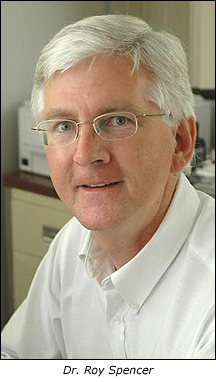
Roy Spencer
More...
Carbomatoes
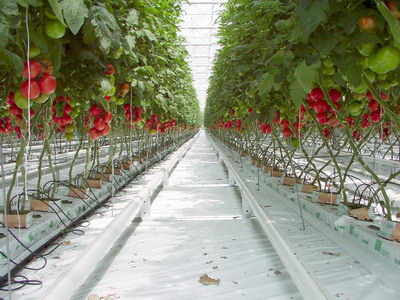
Reading this from over at Gore Lied it occurred to me as I am sure it has others, that a great deal of money could be made off this. The link to the Guardian story ,"Not under our backyard, say Germans, in blow to CO2 plans" shows just how good a job the green nuts have done demonizing this essential element to life.
However there is an opportunity here. If I were rich I would buy a large track of remote land and offer to store this vile gas (for a fee of course). Sort of like a nuclear waste dump for this scourge of the world. I would then use the fees from the storage to build massive greenhouses where I would grow all natural organic tomatoes fed by this nasty carbon dioxide and sell them to all the green nut-jobs who love everything natural-and are willing to pay for it.
More...
However there is an opportunity here. If I were rich I would buy a large track of remote land and offer to store this vile gas (for a fee of course). Sort of like a nuclear waste dump for this scourge of the world. I would then use the fees from the storage to build massive greenhouses where I would grow all natural organic tomatoes fed by this nasty carbon dioxide and sell them to all the green nut-jobs who love everything natural-and are willing to pay for it.
More...
"Notable Quotes"

"Let’s now examine another successful prediction of mine. In March, 2008 at the first Heartland climate conference in New York, I predicted that Solar Cycle 24 would mean that it would not be a good time to be a Canadian wheat farmer. Lo and behold, the Canadian wheat crop is down 20% this year due to a cold spring and dry fields. "
source
David Archibald
More...
POWER TO THE PEOPLE

Letters to the Editor and other People Speak
Via Tom Nelson
FROM-Des Moines Register
Don't listen to alarm on global warming
It is interesting that we haven't heard specifics about global warming lately. This is because the last few years have been cool. The folks sounding the alarm have become expert in lying with statistics based on unscientific data. We never read articles by the few scientists not afraid of attacks by the environmental lobby. Government employees know well that their jobs are at risk if they publicly disagree with the sky-is-falling logic.
This climate-change nonsense will dwarf the ethanol boondoggle occurring in Iowa. The ethanol story is basically this: We are only about five years from making ethanol a viable product. Problem is, they have been telling the same story for over 20 years. Sounds like the global-warming stories.
The July 9 essay by Burns H. Weston and Daniel P. Schramm borders on arrogance ("Begin Writing a Better History; Approve, Pass Climate Bill"). They say there is "no doubt" world disasters will occur in less than 40 years. They go on telling us what will occur without offering any proof. If all this warming is going to occur, there must be some advantages. My propane bill has to go down a bit.
The sad thing is Al Gore and others just like him are going to cause our society irreparable harm. Let us hope that cooler heads prevail.
- Richard L. Powell, Grimes
More...
IMAGE OF THE DAY-Over the shoulder
I predict future happiness for Americans if they can prevent the
government from wasting the labors of the people under the pretense of taking care of them.
Thomas Jefferson

Chinese State Councilor Dai Bingguo, left, with U.S. Energy Secretary Steven Chu at a signing ceremony at the State Department for a memorandum of understanding on climate change, energy and the environment.
government from wasting the labors of the people under the pretense of taking care of them.
Thomas Jefferson
Chinese State Councilor Dai Bingguo, left, with U.S. Energy Secretary Steven Chu at a signing ceremony at the State Department for a memorandum of understanding on climate change, energy and the environment.

July 28, 2009
Cheeseburgers for sanity

Over at the Climate Science site (the UK one not the Roger Pielke Sr one) he has a link to this site called Climate Justice Fast, as in not eat. Evidently as a protest they figure if they can get enough people not to eat starting on November 1st, the folks going to Copenhagen will take notice and save the planet.
I guess these people must be really worried not to eat but if they really wanted to help the carbon dioxide situation they ought to get like minded individuals to stop breathing until the problem went away.
Regardless in an attempt to help them in their cause I have decided that on November 1st I will eat a cheeseburger. If enough like minded indviduals join me we could put a serious dent in the cattle population thus reducing methane concentrations in the atmosphere which as we know is 20 times more potent as a greenhouse gas than CO2.
I figure this would not only be a far better solution to the problem than starving myself, but would also have a larger consensus amongst the general population, with the possible exception of India.

More...
I guess these people must be really worried not to eat but if they really wanted to help the carbon dioxide situation they ought to get like minded individuals to stop breathing until the problem went away.
Regardless in an attempt to help them in their cause I have decided that on November 1st I will eat a cheeseburger. If enough like minded indviduals join me we could put a serious dent in the cattle population thus reducing methane concentrations in the atmosphere which as we know is 20 times more potent as a greenhouse gas than CO2.
I figure this would not only be a far better solution to the problem than starving myself, but would also have a larger consensus amongst the general population, with the possible exception of India.
More...
Alarm on Global Warming is New?

FROM- Chattabox
New Report Sounds the Alarm on Global Warming
ChattahBox)—A new study on global warming is predicting an alarming rise in temperatures over the next five-years that should put an end to global warming deniers who point to periods of cooler weather, as evidence that human influences play no role in climate change
The study was conducted by Judith Lean, of the US Naval Research Laboratory, and David Rind, of Nasa’s Goddard Institute for Space Studies. Their research analyzed several combined factors to assess global warming, human influences such as CO2, heating from the sun; volcanic activity and the El Niño southern oscillation.
The study shows that the relatively stable temperatures experienced around the globe for the past seven years are the results of the downward phase of the 11-year solar cycle combined with weak El Niño events. But that is all about to change, setting off a period of accelerated global warming at a more rapid pace.
With the advent of a new El Niño warm spell ahead and an expected increase in solar activity, temperatures could reach a new high of 150 percent of the rate predicted by the UN’s Intergovernmental Panel on Climate Change.
The study will be published in Geophysical Research Letters.
In the Name of Global Warming

FROM-American Thinker
By Don Blankenship
In the name of global warming, politicians in Washington, DC are threatening to pass so called Cap and Trade legislation that will handicap our economy and force more American jobs offshore.
Many business groups and leaders are convinced that the best way to advocate against Cap and Trade legislation is not to challenge the science of global warming. They believe that although global warming is not a fact that the "scientific debate" is over. These business elites say that only the "political science" remains. They say it's a "political reality." They also say global warming is a "religion" and that the faith of those who believe in it cannot be changed.
But say what they will, "global warming" is neither a reality nor a religion. It is instead a "superstition." A reality is something that actually exists. Global warming has not existed for at least 7 years. Even the U.S. Environmental Protection Agency's internal memos say it does not exist, and so do increasing numbers of noted scientists. A religion is a belief in a supernatural being, a system of faith or worship. Obviously, global warming does not fit this definition.
A "superstition" is a fear founded on irrational feelings and marked by credulity -- i.e. a willingness to believe in the improbable or the marvelous. It should be easy for even members of our Congress to understand that no projection of future world temperatures is a scientific reality. Even they can't be that credulous ... or can they? More...
What (other than extremely credulous) could you call a member of Congress who believes that by lowering the standard of living of 5% of the world's population (that includes you, me, and everyone else living in America) that the Congress -- by passing a law -- can reduce the temperature of the earth or lower sea levels? Simple common sense, not conflicted science is required to know better.
Only superstitious, credulous, and pompous politicians would even consider voting for such a bill ... sight unseen! You would have to first be irrational and have unfounded fears of something that doesn't exist; you would then have to be prone to believe in the highly improbable -- and then vain enough to believe you can change the climate system of the earth, even while most of the rest of the world is fully enjoying the benefits of carbon use.
Americans should be gravely concerned that Congress might act to deal with a superstitious belief and willfully and knowingly cost Americans their jobs, increase household utility bills, and increase worldwide toxic pollutants that are being released into the atmosphere. Yes, increase pollutants in the name of the environment by transferring more jobs and industrial activity to heavily polluting countries like China that don't even have an EPA. Additionally, it is naïve to believe that these countries will follow our lead on CO2 reductions since they have not done so for other truly polluting emissions.
The reality is that credulous political elites (whose personal ideology is to transfer wealth not only within classes of American citizens, but from America to foreign countries) will impede domestic energy production and fund countries and technologies that threaten America's homeland security.
But the political elites are only one group that is willing to damage America's economic strength and homeland security in support of Cap and Trade. Another group is the business elite. In the case of big businesses, it is not the grip of a medieval superstition, nor is it credulity driving, that is driving them. Instead it is what motivates most business people: profit and fear of government retaliation. Or maybe worse: hope for government favoritism. In fact, global warming - i.e., Cap and Trade - is a giant Ponzi scheme in the making that will make Madoff look like the tip of an advancing Alpine glacier.
Neither wind farms nor solar panels have any hope of effectively (cost effectively) displacing coal, nuclear, or natural gas as the primary energy sources for American electricity. Compelling America's workers to sacrifice more for the cap-and-trade falsehood is simply cruel and irresponsible.
Borrowing money from the largest polluting country in the world (China) to reduce a non-pollutant in order to address a superstition, to create a profit for multi-national companies that happen to be listed on the New York Stock Exchange (making most of their profits overseas) is an evil and cruel abomination. Politicians and business persons who participate in such a scheme, for whatever reason, are insensitive and represent a risk to the American way of life.
Anyone -- politicians, business persons, labor union leaders, journalists, teachers, environmentalists or a U.S. President -- that desires the best for America and its people will oppose Cap and Trade. Anyone who desires American prosperity, energy independence, homeland security, an improved environment, jobs and a future for our children will not be superstitious or complacent. They will not resort to trickery or seek an illicit profit. Instead, they will use a cost versus benefit evaluation based on real-world data to achieve true environmental and economic improvements.
Business people and politicians should be Americans first. They must use real science, truth, reality, and love for their country oppose to "Cap and Trade." If they do not, future American generations will consider them what they will have been - unmindful, unscrupulous, and uncaring. Going forward, we all owe our employees, our neighbors, our children, our constituents and all Americans nothing less than our best and honest effort to find the right answers to real pressing and critical challenges. Global warming is not the challenge of our time. Even if it were, Cap and Trade is the wrong answer.
President Reagan was man enough to label "evil" when he saw it. Madoff's Ponzi scheme was described by a judge as "evil." The Cap and Trade scheme, if passed, will be many times more "evil."
Conversely, a true worldwide effort to regulate and reduce particulate, sulfur and other pollutants on a cost benefit basis in developing countries would provide a real and significant improvement to the world's environment, without empty sacrifices of American lives and liberties. The choice between the two possibilities should not be difficult, even for the U.S. Congress. It incorporates, after all, their oath of office to protect Americans from enemies foreign and domestic, and to defend the constitution.
Don Blankenship is CEO of Massey Energy.
"a structure for dialogue"

You have to love a story like this from Reuters "U.S. and China sign memorandum on climate change". The entire story could be summed up with this one line from the State Department spokesman Ian Kelly:
"It is not an agreement per se for each side to commit themselves to some particular target. It sets a structure for dialogue,"
I guess this means they are going to bring interpreters to future meetings.
Since the most transparent administration in American history is not releasing the actual memorandum of understanding that was signed, it probably means that some stimulus money is going to find its way to Peking.
Have no fear though. Our The Nobel Prize Winning Secretary of Energy Steven Chu weighed in:
"Today's agreement ... sets the stage for what I hope will be many years of cooperation,"I hear he is in top level secret talks to paint Tibet white....with American workers....Union only.
More...
Exporting fudged ice

Below are excerpts from an article in the Toronto Star - "Arctic's 'canary in a coal mine' " I thought it was fascinating for both the honesty of the scientist quoted and the absolute lack of any scientific proof of "climate change".
The first excerpt is about one of the main purpose of this well funded mission is intended to investigate, plankton:
As you can see we are not yet in any danger of this canary. But don't worry there is reason to panic as the writer makes sure to tell us:
Despite the fact that what they are investigating isn't a problem "concern builds", if not the plankton. Perhaps the next scientist will explain why we should be concerned:
Seemed to show? Please do explain.
Well jeez making global conclusions from incomplete data doesn't seem like a smart idea to me either, might want to tell some of your colleagues about that- but it gets better:
So what have we learned. The plankton that would be a harbinger of disaster is not present, the data from submarines was misinterpeted,the thin ice is the result of shifting winds not melting, and the modellers are fudging in order to get the results they want before they die. Got to love this scientific proof! Not to mention the canary.
So in the end what is the conclusion of this article:
But not above ALGORE'S pay grade he'll tell you what it means "WE'RE GOING TO FRY, if we don't drown first"
More...
The first excerpt is about one of the main purpose of this well funded mission is intended to investigate, plankton:
"If a Pacific species was established in the Arctic, this would really be news," he says. "But we have not detected this yet. What could happen in this scenario is that, if the invader out-competes the native species, this could lead to fundamental changes in ecosystem function
As you can see we are not yet in any danger of this canary. But don't worry there is reason to panic as the writer makes sure to tell us:
As concern builds over rising temperatures, the once ice-bound Northwest Passage is opening up to scientists eager to get a better look at what is happening to a region thought to be most vulnerable to early damage from climate change.
Despite the fact that what they are investigating isn't a problem "concern builds", if not the plankton. Perhaps the next scientist will explain why we should be concerned:
When the Soviet Union collapsed, and relations between Washington and Moscow warmed, the U.S. military was less worried about potential enemies knowing where its subs had been and declassified the ice data. It seemed to show the ice was thinning dramatically.
Seemed to show? Please do explain.
"Nobody really quite noticed the submarines were running across the outside edges of the Canadian archipelago," the islands scattered across Canada's Far North, "where for all we know, the ice was getting thicker," Eert says.
"The ice doesn't stay constantly thick over the whole area. It moves around. So if you take measurements only in one spot, and make global conclusions from that, you might be going wrong."
Well jeez making global conclusions from incomplete data doesn't seem like a smart idea to me either, might want to tell some of your colleagues about that- but it gets better:
After years of reports that vast areas of Arctic ice are melting as the seawater below, and air above, warm up, scientists have discovered that dramatic changes in the past three years are the result of shifting winds, perhaps caused by climate change .
Enormous amounts of ice have "been exported from the Arctic," driven by winds that are shifting as the climate changes, which pushed the ice into ocean currents that delivered it to the North Atlantic, Eert says.
"The multi-year ice in the polar pack didn't melt in the Arctic Ocean,'' she says. "It moved out and what's left in the Arctic is thinner than it was."
That doesn't mean some Arctic ice isn't disappearing altogether, just that the process is not as simple as some reports suggest, Eert says.
Old ice that has shifted south from Greenland may have a counter-effect on the climate, which is just one of the many pieces of a very complex jigsaw puzzle that scientists are trying to piece together as they attempt to predict the effects of global warming.
"The guys who are running the long-term climate models have a tough problem," Eert says. "They're looking at really long time scales, and as result they can't look at a lot of details for each year.
"In order to get the results before you die, you have to fudge some things. And what they fudge is the small-scale stuff. But it turns out that probably the small-scale stuff is important and fudging it gives you wrong answers."
So what have we learned. The plankton that would be a harbinger of disaster is not present, the data from submarines was misinterpeted,the thin ice is the result of shifting winds not melting, and the modellers are fudging in order to get the results they want before they die. Got to love this scientific proof! Not to mention the canary.
So in the end what is the conclusion of this article:
The latest maps show above-normal concentrations of ice across a huge region in western Hudson Bay and James Bay, while some areas farther north have less ice than usual. Deciding what that all means is above Pelland's pay grade
But not above ALGORE'S pay grade he'll tell you what it means "WE'RE GOING TO FRY, if we don't drown first"
More...
"A carbon protection racket"

"Europe pays poor countries not to harm the climate, and the House bill would do the same. Most markets, however, pay for "goods," not for stopping "bads." In the private sector, we call a market for not doing harm a "protection racket." By offering to pay protection money – by buying offset credits – we invite the protection-racket way of thinking into the realm of international negotiations."
FROM- The Christian Science Monitor
Berkeley, Calif. - If your neighbors were making a terrible racket, would you offer to pay them to stop?
Of course not.
Sure, they'll stop today. But they'll soon be clamoring for more payments.
One of the major features of the Waxman-Markey cap-and-trade bill – the ambitious climate change legislation recently passed by the House – offers just such payments. It pays polluting countries not to pollute. And, as with the noisy neighbor, this will just encourage a continuing racket.
Here's the story: India has offered to cap its greenhouse-gas emissions – but only at a level 10 times higher than its own emission rate. China will not accept a cap at all, and at the Major Economies Forum on July 9, China and India even blocked setting a target for world emissions in 2050. This trend confirms that other developing countries will also stick with their anti-cap positions, leaving half the world's emissions unchecked and growing far faster than emissions from the industrialized nations.
The Waxman-Markey bill was supposed to remedy this problem by providing US leadership, which poor nations would follow by accepting caps. But this hope ignored the inequities of caps and ignored the bill's offer of an estimated $13 billion a year – growing to $83 billion annually in 2050 – to buy "international offset credits" from developing countries.
Such offset purchases encourage poor countries not to accept caps. Global cooperation requires a reversal in US climate policy toward developing countries. We must reward cooperation rather than the lack of it.
Buying offset credits pays emitters in developing countries to emit "less than they would have emitted." But implementing a cap cuts back on what "they would have emitted," and reduces their profits from selling offsets.
The House bill did not create this offset problem. The European Union's cap-and-trade scheme has long allowed European companies to buy UN-certified offset credits instead of cutting their own emissions. As Stanford researchers Michael W. Wara and David G. Victor found over a year ago, Europe's offset purchases have not drawn developing countries into "substantial limits on emissions," but have, "by contrast, rewarded them for avoiding exactly those commitments." As a result of this perverse incentive, Europe's cap-and-trade market is considering rules to ban the purchase of UN offset credits from major developing countries.
One of the offset schemes that Europe might ban involves a type of chemical plant found, among other places, in China. While dumping a notorious greenhouse gas into the atmosphere, the plant's owners suggest to the UN that the plant could incinerate the gas instead – if the owners were allowed to sell offsets. The particular gas emitted is 11,700 times worse than carbon dioxide, so naturally the UN agrees that the owners can sell 11,700 tons of emission offsets for every ton of gas incinerated. With offsets worth about $15 a ton, the profits have been enormous.
By purchasing such offsets, Europe pays poor countries not to harm the climate, and the House bill would do the same. Most markets, however, pay for "goods," not for stopping "bads." In the private sector, we call a market for not doing harm a "protection racket." By offering to pay protection money – by buying offset credits – we invite the protection-racket way of thinking into the realm of international negotiations.
For example, if China had committed to even a weak cap or carbon tax, it would have curbed its horrendous chemical-plant emissions. But instead, the Chinese and others have allowed these emissions to continue and have offered to protect the world from them – for a price.
There's nothing wrong with contributing funds to fight climate change in poor countries. They have done little to harm the climate. But our contributions should reward those who commit to join us in the fight. Although China and India are not likely to reconsider caps, there is still hope for a policy that rewards cooperation. Top economists, from N. Gregory Mankiw on the right to Joseph E. Stiglitz on the left, have long recommended a carbon tax as far better than a cap.
Poor countries reject effective caps because they limit their per-person emissions to far less than our own. But carbon taxes lack this offensive inequality. So China, India, and others might well commit to taxing carbon, especially if given some assistance for doing so.
With half the world rejecting caps, we must change course. First, remove the foreign offsets from the Waxman-Markey bill. They cost us dearly and only work against us. Then, devise a policy to reward those who commit to join us. Offering to be the "mark" for a global protection racket is no way to lead the world toward climate stability.
Steven Stoft is an economist and author of "Carbonomics: How to Fix the Climate and Charge It to OPEC" and "Power System Economics." He has worked on energy policy for over 20 years. Daniel Kirshner was a senior economic analyst at the Environmental Defense Fund, where he worked on state and federal energy policies for 26 years.
More...
July 27, 2009
POWER TO THE PEOPLE
Letters to the Editor and other People Speak
FROM-Niagara Gazette
COLUMN: The summer of ’09: what global warming?
By Bob Confer
The family and I were supposed to go on vacation in northern Saskatchewan in mid-June. A few days before we were to fly out, we received a phone call from the camp’s owner, who said we’d have to postpone the trip. The lake was covered by four feet of ice!
So, we went there a couple of weeks back. Not surprisingly, the lake still had mammoth sheets of ice floating on it July 11. Mind you, this was not the tundra. It’s a lake that’s normally ice-free by the end of May.
That delay to the start to the summer is reminiscent of what has happened on the home front. After a lengthy, very cold winter, most Western New Yorkers were suffering from cabin fever and looking forward to getting outside and enjoying those oh-so-few months of sun and warmth. For many, 2009 has been a real letdown. Our summer has often seemed nonexistent and just a run-off of our spring. By any standard it has been unusually cool with nippy nights and temperate days.
Personally, you won’t hear me complaining about 50-degree sleeping weather or daytime highs around 70, but most folks don’t dig that. Professionally, though, I don’t either; it’s hurting my business. Those who find it a little too frigid haven’t opened their swimming pools or invested in a hot tub, which in turn has prevented Confer Plastics from selling the products they need to enter those watery retreats from the summer heat. Day-in and day-out, we hear from pool and spa professionals in the Northeast and Midwest that this has been one of the coldest summers in recent memory. Because of that, our pool/spa-related sales are down about 7 percent versus last year.
Our industry is not alone in a loss that is independent of the slow economy. Outdoor-dining venues have taken a beating. Summer retail sales hit such lows that stores began discounting weeks earlier than they normally would.
These are not just anecdotal references about the state of the environment. The statistics can back them up.
The Buffalo-Niagara region had only 6 days of 80-degree heat by mid-July when almost 20 of them are typical by that point in time. Atlantic City had its third-wettest June ever, which was the Northeast’s coldest in 27 years. Even the usually-balmy Southwest had its coldest June in 42 years.
This trend hasn’t ended, either. July weekly temps in the upper Midwest were 10 degrees below average. Canada’s temperatures have been well below normal since December and gardeners and farmers in central Alberta actually had to deal with frost a week and a half ago.
This weather is definitely not normal.
The press, the environmentalists, the Left, Al Gore ... they all knew it would be abnormal. But, even so, they were wrong. Dead wrong. This year’s climate trend has been the exact opposite of what the global warming alarmists have been calling for. We were supposed to be facing deadly heat and droughts. Instead, we’re looking at lower temps and lots of rainfall throughout North America.
This year’s cool weather hasn’t been the only tell-tale sign of their errors. Remember Hurricane Katrina? Wasn’t that storm supposed to usher in a new era of relentless and deadly storms? Hurricane seasons have been downright tame since then.
This general cooling is comforting in a way. For starters, it’s nice to know the environment isn’t taking a beating and heading down a never-ending path of overheating and absolute destruction. And, secondly, it has shown that I and other naysayers (often deemed “idiots” by the Green people) have been right all along: Global warming is not the gospel, it’s a flawed belief.
Most people in Middle America are practical souls and have never fully believed in the nonsense and fear mongering of the Inconvenient Truth and its zombie-like following in academia and the media. But, sadly, policy-makers aren’t so logical and have tuned-out the not-so-hot real world. They continue to believe in the questionable science of Gore’s doomsday prophecy while pushing for equally-cartoonish and oppressive regulations such as CAFE and Cap-and-Trade.
I think that before they go any further with such laws they need to get out of the Capitol Building and spend some time in the great outdoors. Then, we’ll see what they really think about global warming.
Bob Confer is a Gasport resident and vice president of Confer Plastics Inc. in North Tonawanda.
More...
A tanning booth for Al?

This kind of reinforces what everyone knows, as a general rule a warmer climate is better for life and biodiversity than cold weather.
FROM- Science Alert
Heat may speed up evolution
Mammal species living in the tropics are evolving faster than their counterparts living in cooler environments, according to research carried out by New Zealand researchers.
It had previously been assumed that rates of genetic change in warm-blooded animals were independent of climate.
The new study demonstrates that DNA evolution occurs substantially faster in mammal species living in warmer environments relative to those living in cooler environments.
Led by AUT University evolutionary biologist Len Gillman, the team was also made up of researchers from the School of Biological Sciences at the University of Auckland, including Dr Shane Wright, whose earlier work was highly influential in establishing differing evolution rates between plants in different climates.
In this and previous work, Wright’s research has been supported by Ngā Pae o te Māramatanga, the Māori Centre of Research Excellence.
Gillman says the rate of evolution was markedly different, and over prolonged evolutionary periods of time, this difference in evolutionary rate might account for the enormous accumulation of biodiversity in warmer areas like the tropics.
“The results show that species occupying warmer climates have almost 50 per cent more DNA evolution relative to those in cooler climates. These results come from pairs of species generally living in close proximity to each other so we would expect the effect to be far more pronounced over continental and global scales.”
Gillman’s research has also identified potential negative evolutionary consequences of scarce basic resources related to available energy supply.
Australasian marsupials in the study showed less significant increases in their rates of evolution when compared to their counterparts living in cooler climates and it is thought that this might be linked to the drought conditions in the warmer environments of Australia.
Gillman says there are indications that the slowed rates of evolution may be due to periods of hibernation or inactivity of animals living in cooler environments.
“Earlier research we carried out identified faster rates of DNA evolution in plants living in tropical regions but other scientists did not believe that climate could possibly have any bearing on mammal evolution given their constant body temperatures.”
“These results provide support for the hypothesis that high tropical species richness is caused by faster rates of evolution and speciation in warmer climates.”
The study, which is the largest of its kind, involved a comprehensive global data set that included 260 mammal species, from 10 orders and 29 families.
The research findings of Len Gillman and Shane Wright have today been published internationally in the Royal Society’s biological research journal Proceedings B.
More...
Heat may speed up evolution
Mammal species living in the tropics are evolving faster than their counterparts living in cooler environments, according to research carried out by New Zealand researchers.
It had previously been assumed that rates of genetic change in warm-blooded animals were independent of climate.
The new study demonstrates that DNA evolution occurs substantially faster in mammal species living in warmer environments relative to those living in cooler environments.
Led by AUT University evolutionary biologist Len Gillman, the team was also made up of researchers from the School of Biological Sciences at the University of Auckland, including Dr Shane Wright, whose earlier work was highly influential in establishing differing evolution rates between plants in different climates.
In this and previous work, Wright’s research has been supported by Ngā Pae o te Māramatanga, the Māori Centre of Research Excellence.
Gillman says the rate of evolution was markedly different, and over prolonged evolutionary periods of time, this difference in evolutionary rate might account for the enormous accumulation of biodiversity in warmer areas like the tropics.
“The results show that species occupying warmer climates have almost 50 per cent more DNA evolution relative to those in cooler climates. These results come from pairs of species generally living in close proximity to each other so we would expect the effect to be far more pronounced over continental and global scales.”
Gillman’s research has also identified potential negative evolutionary consequences of scarce basic resources related to available energy supply.
Australasian marsupials in the study showed less significant increases in their rates of evolution when compared to their counterparts living in cooler climates and it is thought that this might be linked to the drought conditions in the warmer environments of Australia.
Gillman says there are indications that the slowed rates of evolution may be due to periods of hibernation or inactivity of animals living in cooler environments.
“Earlier research we carried out identified faster rates of DNA evolution in plants living in tropical regions but other scientists did not believe that climate could possibly have any bearing on mammal evolution given their constant body temperatures.”
“These results provide support for the hypothesis that high tropical species richness is caused by faster rates of evolution and speciation in warmer climates.”
The study, which is the largest of its kind, involved a comprehensive global data set that included 260 mammal species, from 10 orders and 29 families.
The research findings of Len Gillman and Shane Wright have today been published internationally in the Royal Society’s biological research journal Proceedings B.
More...
'Global warming made it less cool'

FROM-Climate Depot
Climate Fear Promoters Try to Spin Record Cold and Snow: 'Global warming made it less cool'
Climate Fear Promoters Try to Spin Record Cold and Snow: 'Global warming made it less cool'
By Marc Morano
Switch from warning of 'climate crisis' to 'global warming made it less cool'
Climate Depot Editorial
The year 2009 is proving to be a yet another very inconvenient year for the promoters of man-made global warming fears. As the “year without a summer” continues, the U.S. in July alone has broken over 3000 cold temperature records, and global temps have fallen .74F since Gore's film “An Inconvenient Truth” was released in 2006. In addition, meteorologists are predicting more record cold and snow this winter. (See: Brisk July portends 'heavy snowfalls and bitter cold this winter along Eastern Seaboard')
But man-made climate fear promoters have finally constructed an explanation for the recent record cold temperatures.
The explanation? According to climate activists: “Global warming made it less cool.”
It appears the global warming fear movement has gone from predictions that we face a "climate crisis" and we are all going to die to their new slogan: "Global warming made it less cool."
The environmental activist group Union of Concerned Scientists declared “Global warming made it less cool.” Brenda Ekwurzel, of the Union of Concerned Scientists, claimed in a July 24, 2009 letter to the editor in the Washington Post that “2008 was a cooler year, but global warming made it less cool.”
Let's consider the Union of Concerned Scientists' claim that “global warming made it less cool.”..... read entire article here
"Notable Quotes"

"Those who know they are right have no reason to stifle debate because they realize that all opposing arguments will ultimately be overcome by fact. Yet those who champion massive taxes and spending to fight climate change, for example, do not seem to understand that. If science is on their side, then why should they care who is against them? "The debate is over" is a line that's used only by those who realize they would never win a debate.
In the end, it is not the debate itself, but those preventing it that are truly un-American. Honest listening and, more important, honest questioning is the foundation of the American experiment."
source
 Glenn Beck
More...
Making sauerKraut(s)

via-Insta Pundit
Germany is phasing out nuclear power plants before the end of their useful lives, building more coal electric plants, and will make Germans pay thru the nose for expensive offshore wind electric power.
It was the revival of Kohl’s center-right Christian Democratic Union party under Chancellor Angela Merkel that delivered the concessions needed to kick-start the offshore-wind industry. In 2006 Merkel’s government—a coalition that also included the Social Democrats and the Christian Social Union—made power-grid operators responsible for running cables to offshore farms. That shaved about one-fifth off the average cost of a project. And last year Merkel improved the revenue side of the ledger, boosting the offshore tariff to 0.15/kWh (US $0.21/kWh).
The German government had to increase the payment to offshore wind operators in order to get enough investors to put up money to build offshore wind farms. Opposition to closer offshore facilities forced the wind farms into deeper water which drove up costs.
To put that 21 cents per kwh producers price in perspective at the time of this writing Americans on average are paying residential retail prices at 11.28 cents per kwh on average. The 21 cents per kwh that grid operators will pay will get marked up to higher residential retails prices to pay for distribution and billing costs.
But that cost number for wind electric is even worse than that. Wind is not dispatchable power. You can't order it up when you want it in response to demand spikes. You get it when the wind blows and you don't get it when the air is still. Electric power generators that can ramp up in response to demand spikes normally gets sold for a higher price than baseload power (like a nuclear power plant that runs all the time). But baseload power is at least there when the demand is greatest just like it is there when demand is least. By contrast, wind isn't as reliable as baseload power. So that 21 cents per kwh wholesale for an undependable power source is a really high price to pay.
More...
Obama: Cooperation with China Key to Avoid ‘Ravages’ of Climate Change

FROM-WSJ
Rarely, if ever, are Yao Ming and Mencius quoted in the same speech. President Obama turned to both reknowned Chinese philosophers today to kick off the big U.S.-China summit in Washington.
More...
As promised, energy and the environment take high priority—second only to fixing the global financial system. Mr. Obama put it in stark terms: “Will the need for energy breed competition and climate change, or will we build partnerships to produce clean power and to protect our planet?”
But was there anything of substance? Mr. Obama stressed the need for both countries to work together on clean energy and energy efficiency. They’ve already announced joint projects in both areas. He also urged the U.S. and China to work together to make sure the global climate talks in Copenhagen don’t collapse into farce.
But one phrase in particular will probably lead to some between-the-lines readings: “And the best way to foster the innovation that can increase our security and prosperity is to keep our markets open to new ideas, new exchanges, and new sources of energy,” Mr. Obama said.
Is that a reference to the spat over “carbon tariffs” the House included in the Waxman-Markey bill, and which President Obama, the Senate, China, and pretty much the rest of the world are so worked up about?
Or is that a reference to the spat over how to share clean technology with developing nations without weakening intellectual-property provisions? Poor countries want lots of new technology, but the people that make that stuff worry they’ll be thrown under the bus in the name of the global climate fight.
By the way, Mencius has another gem that seems custom-crafted for the looming impasse at the Copenhagen climate talks: “Let men decide firmly what they will not do, and they will be free to do vigorously what they ought to do.”
"it is cold in Russia"

Russia WANTS Global Warming
FROM-The Buisness Insider
The United States--from politicians to plebes, and all in between--are transfixed with India and China's refusals to get on board with our plans to cut back on carbon emissions.
For sure, each nation is important, but we should all be focusing a similar amount of attention on Russia, writes Tom Zeller at the New York Times.
Without Russia, a global climate pact is probably impossible. And sadly for cap and trade fans, there is no reason for Russia to sign up, based strictly on economic terms.
Russia is the number two exporter of oil, and the number one exporter of natural gas. The amount of energy it uses per GDP is double the U.S., and the country is on course to emit more CO2 per person than the U.S. in the next 20 years.
Aside from the potential economic damage that's comes with cutting emissions, there's a bigger reason to doubt Russian commitment to climate change, says Brad Plummer.
The country wants global warming because it is cold in Russia.
The National via TNR: It might seem impolitic to embrace what many regard as a looming global catastrophe. But this has not stopped the Russians. In September 2003, none other than Vladimir Putin signalled his approval, noting that global warming would help Russians "save on fur coats and other warm things". More recently, Rinat Gizatullin, a spokesman for the Natural Resources Ministry, told the BBC: "We are not panicking. Global warming is not as catastrophic for us as it might be for some other countries. If anything, we'll be even better off. As the climate warms, more of Russia's territory will be freed up for agriculture and industry."
Earlier this year, Alexander Bedritsky, head of Russia's state weather centre, issued a public statement noting that "the heating season will be reduced, and this is a positive factor for us as it will allow us to economise on fuel". The weather centre estimated that Russians could save as much as 10 per cent on heating bills by 2050. Vladimir Zhirinovsky, the ultranationalist Duma deputy who is widely believed to be close to the Kremlin and who speaks for millions of like-minded Russians, has publicly pined for the day when global warming takes its toll on the West, gloating that London will be submerged by the Thames and "Britain will have to give freedom to Scotland and Wales and Northern Ireland". ...
Enthusiasm for global warming in Russia, if that's the right way to put it, goes beyond simple household concerns or national economic interests. For the Russians, who regard the Arctic as essentially their rightful territory, shrinking ice floes will ease access to the bounty of natural resources around the polar ice cap, including large reserves of oil, gas, gold, diamonds, nickel and tungsten.
More...
"Notable Quotes"

"His band of angry young men would find Gore where once they found Marx....
....The word evil is used advisedly. Both the green and red positions are infused with overpowering religiosity. Dissenters from the consensus are shunned apostates. Professor Ian Pilmer, the Australian geologist and climate change sceptic, could not find a publisher for his book Heaven and Earth, which questions the orthodoxy about global warming. He is the subject of hate mail and demonstrations. It is entirely immaterial whether he is right or wrong. An environment that stifles his right to a voice is worse than one that is overheating.
source
More...
POWER TO THE PEOPLE
Letters to the Editor and other People Speak
FROM-Denver Post
Global warming worriers need to go nuclear
By John Dendahl
Sen. Mark Udall claims he's worried about global warming. He wants human production of carbon dioxide radically reduced. Ditto his wife, Maggie Fox, who runs Alliance for Climate Protection, founded by Al Gore with money from his global warming horror flick.
Here we have an inside-outside Udall family partnership working the Senate for votes for the ruinous cap-and-trade legislation President Obama wants.
I wrote to ask Udall's positions on carbon — regulate as a pollutant, cap emissions by statute and/or international treaty — the whole arsenal in this campaign against the economy and American sovereignty.
While awaiting a reply, I sent another note inquiring about nuclear energy, since that choice has several attractions. Among those are a half-century safety record unequaled by any major industry in history, zero carbon emissions, low operating expenses, no dependence on bad guys for fuel — and continuous output 2 4/7.
Udall's reply is boilerplate that any clerk could have sent back to me by return mail, rather than taking six weeks. As members of Congress have claimed ever since the Arab oil embargo in 1974, Udall wants a "comprehensive energy plan." In addition to generous portions of New Energy Economy fantasy, Udall would include "responsible onshore and offshore drilling for oil and natural gas . . . [and] safely expanding nuclear power."
The devil's in the caveats. What offshore drilling would Udall consider "responsible"? What does "safely" mean in the context of expanding industrial safety's crème de la crème?
This apple didn't fall far from the tree. Read on.
Preserving the myth that radioactive waste cannot be safely disposed has been a major goal of organized "environmentalists" for decades. When the federal government nearly 40 years ago commenced study of a geologic repository in southern New Mexico's bedded salt, Big Enviro was there to say no. Nonetheless, the study progressed and the proposed Waste Isolation Pilot Plant (WIPP) was supported well by New Mexico's 1970s congressional delegation. Then, in 1982, Santa Fe elected Democrat Bill Richardson to the U.S. House.
Santa Fe is about 300 "crow-flight" miles from WIPP, but only about 30 from Los Alamos, where waste destined for WIPP — like that from Denver's Rocky Flats — had been in temporary storage for up to 40 years. Despite his district's need for WIPP, Richardson quickly became a strident opponent, in puzzling contrast to strong support from WIPP's neighbors and their representative in the House.
Naturally, Richardson hid behind public safety. Only slightly smirking, he could tell a reporter, "I'm for WIPP — as long as it's 100 percent safe." Since there's no such thing as "100 percent safe," the statement was a straight-out lie to cover Richardson's pandering to Big Enviro.
As the battles wore on, Udall's father, Morris Udall, D-Ariz., then chairman of the House Interior Committee, gave Richardson a veto over public lands legislation needed for WIPP. The congressional foot-dragging effected by Richardson and Udall Père probably delayed WIPP by five years, added hundreds of millions to its cost, and increased public safety not one iota.
Now cut to the present. WIPP operations commenced in 1999, ironically while Richardson was Bill Clinton's secretary of energy. Its fine safety record is consistent with the industry's, for both its construction and operations.
Surprise! Radioactive waste can be safely transported and disposed.
Democratic U.S. senators from Colorado have a poor record on energy. Former Sen. Tim Wirth, who now sits at Ted Turner's United Nations Foundation, said in 1997, "We've got to ride the global warming issue. Even if the theory of global warming is wrong, we will be doing the right things in terms of economic policy and environmental policy." And just what would those right things be? World government, maybe?
When Wirth, Udall, Gore and the rest of the global warming crowd become true advocates of super-safe, non-carbon-emitting, unmatchably reliable nuclear power, I'll stop dismissing them as liars very likely covering a hidden agenda.
John Dendahl, a Rocky Mountain Foundation senior fellow, is a retired business executive. He resides in Littleton.
More...
"a certain corruption within the climate science community"
FROM-Quadrant On Line
by Richard Lindzen
Resisting climate hysteria
A Case Against Precipitous Climate Action
The notion of a static, unchanging climate is foreign to the history of the earth or any other planet with a fluid envelope. The fact that the developed world went into hysterics over changes in global mean temperature anomaly of a few tenths of a degree will astound future generations. Such hysteria simply represents the scientific illiteracy of much of the public, the susceptibility of the public to the substitution of repetition for truth, and the exploitation of these weaknesses by politicians, environmental promoters, and, after 20 years of media drum beating, many others as well. Climate is always changing. We have had ice ages and warmer periods when alligators were found in Spitzbergen. Ice ages have occurred in a hundred thousand year cycle for the last 700 thousand years, and there have been previous periods that appear to have been warmer than the present despite CO2 levels being lower than they are now. More recently, we have had the medieval warm period and the little ice age. During the latter, alpine glaciers advanced to the chagrin of overrun villages. Since the beginning of the 19th Century these glaciers have been retreating. Frankly, we don’t fully understand either the advance or the retreat.
For small changes in climate associated with tenths of a degree, there is no need for any external cause. The earth is never exactly in equilibrium. The motions of the massive oceans where heat is moved between deep layers and the surface provides variability on time scales from years to centuries. Recent work (Tsonis et al, 2007), suggests that this variability is enough to account for all climate change since the 19th Century. Supporting the notion that man has not been the cause of this unexceptional change in temperature is the fact that there is a distinct signature to greenhouse warming: surface warming should be accompanied by warming in the tropics around an altitude of about 9km that is about 2.5 times greater than at the surface. Measurements show that warming at these levels is only about 3/4 of what is seen at the surface, implying that only about a third of the surface warming is associated with the greenhouse effect, and, quite possibly, not all of even this really small warming is due to man (Lindzen, 2007, Douglass et al, 2007). This further implies that all models predicting significant warming are greatly overestimating warming. This should not be surprising (though inevitably in climate science, when data conflicts with models, a small coterie of scientists can be counted upon to modify the data. Thus, Santer, et al (2008), argue that stretching uncertainties in observations and models might marginally eliminate the inconsistency. That the data should always need correcting to agree with models is totally implausible and indicative of a certain corruption within the climate science community
It turns out that there is a much more fundamental and unambiguous check of the role of feedbacks in enhancing greenhouse warming that also shows that all models are greatly exaggerating climate sensitivity. Here, it must be noted that the greenhouse effect operates by inhibiting the cooling of the climate by reducing net outgoing radiation. However, the contribution of increasing CO2 alone does not, in fact, lead to much warming (approximately 1oC for each doubling of CO2). The larger predictions from climate models are due to the fact that, within these models, the more important greenhouse substances, water vapor and clouds, act to greatly amplify whatever CO2 does. This is referred to as a positive feedback. It means that increases in surface temperature are accompanied by reductions in the net outgoing radiation – thus enhancing the greenhouse warming. All climate models show such changes when forced by observed surface temperatures. Satellite observations of the earth’s radiation budget allow us to determine whether such a reduction does, in fact, accompany increases in surface temperature in nature. As it turns out, the satellite data from the ERBE instrument (Barkstrom, 1984, Wong et al, 2006) shows that the feedback in nature is strongly negative -- strongly reducing the direct effect of CO2 (Lindzen and Choi, 2009) in profound contrast to the model behavior. This analysis makes clear that even when all models agree, they can all be wrong, and that this is the situation for the all important question of climate sensitivity.
According to the UN’s Intergovernmental Panel on Climate Change, the greenhouse forcing from man made greenhouse gases is already about 86 % of what one expects from a doubling of CO2 (with about half coming from methane, nitrous oxide, freons and ozone), and alarming predictions depend on models for which the sensitivity to a doubling for CO2 is greater than 2C which implies that we should already have seen much more warming than we have seen thus far, even if all the warming we have seen so far were due to man. This contradiction is rendered more acute by the fact that there has been no statistically significant net global warming for the last fourteen years. Modelers defend this situation by arguing that aerosols have cancelled much of the warming, and that models adequately account for natural unforced internal variability. However, a recent paper (Ramanathan, 2007) points out that aerosols can warm as well as cool, while scientists at the UK’s Hadley Centre for Climate Research recently noted that their model did not appropriately deal with natural internal variability thus demolishing the basis for the IPCC’s iconic attribution (Smith et al, 2007). Interestingly (though not unexpectedly), the British paper did not stress this. Rather, they speculated that natural internal variability might step aside in 2009, allowing warming to resume. Resume? Thus, the fact that warming has ceased for the past fourteen years is acknowledged. It should be noted that, more recently, German modelers have moved the date for ‘resumption’ up to 2015 (Keenlyside et al, 2008).
Climate alarmists respond that some of the hottest years on record have occurred during the past decade. Given that we are in a relatively warm period, this is not surprising, but it says nothing about trends.
Given that the evidence (and I have noted only a few of many pieces of evidence) strongly implies that anthropogenic warming has been greatly exaggerated, the basis for alarm due to such warming is similarly diminished. However, a really important point is that the case for alarm would still be weak even if anthropogenic global warming were significant. Polar bears, arctic summer sea ice, regional droughts and floods, coral bleaching, hurricanes, alpine glaciers, malaria, etc. etc. all depend not on some global average of surface temperature anomaly, but on a huge number of regional variables including temperature, humidity, cloud cover, precipitation, and direction and magnitude of wind. The state of the ocean is also often crucial. Our ability to forecast any of these over periods beyond a few days is minimal (a leading modeler refers to it as essentially guesswork). Yet, each catastrophic forecast depends on each of these being in a specific range. The odds of any specific catastrophe actually occurring are almost zero. This was equally true for earlier forecasts of famine for the 1980's, global cooling in the 1970's, Y2K and many others. Regionally, year to year fluctuations in temperature are over four times larger than fluctuations in the global mean. Much of this variation has to be independent of the global mean; otherwise the global mean would vary much more. This is simply to note that factors other than global warming are more important to any specific situation. This is not to say that disasters will not occur; they always have occurred and this will not change in the future. Fighting global warming with symbolic gestures will certainly not change this. However, history tells us that greater wealth and development can profoundly increase our resilience.
In view of the above, one may reasonably ask why there is the current alarm, and, in particular, why the astounding upsurge in alarmism of the past 4 years. When an issue like global warming is around for over twenty years, numerous agendas are developed to exploit the issue. The interests of the environmental movement in acquiring more power, influence, and donations are reasonably clear. So too are the interests of bureaucrats for whom control of CO2 is a dream-come-true. After all, CO2 is a product of breathing itself. Politicians can see the possibility of taxation that will be cheerfully accepted because it is necessary for ‘saving’ the earth. Nations have seen how to exploit this issue in order to gain competitive advantages. But, by now, things have gone much further. The case of ENRON (a now bankrupt Texas energy firm) is illustrative in this respect. Before disintegrating in a pyrotechnic display of unscrupulous manipulation, ENRON had been one of the most intense lobbyists for Kyoto. It had hoped to become a trading firm dealing in carbon emission rights. This was no small hope. These rights are likely to amount to over a trillion dollars, and the commissions will run into many billions. Hedge funds are actively examining the possibilities; so was the late Lehman Brothers. Goldman Sachs has lobbied extensively for the ‘cap and trade’ bill, and is well positioned to make billions. It is probably no accident that Gore, himself, is associated with such activities. The sale of indulgences is already in full swing with organizations selling offsets to one’s carbon footprint while sometimes acknowledging that the offsets are irrelevant. The possibilities for corruption are immense. Archer Daniels Midland (America’s largest agribusiness) has successfully lobbied for ethanol requirements for gasoline, and the resulting demand for ethanol may already be contributing to large increases in corn prices and associated hardship in the developing world (not to mention poorer car performance). And finally, there are the numerous well meaning individuals who have allowed propagandists to convince them that in accepting the alarmist view of anthropogenic climate change, they are displaying intelligence and virtue For them, their psychic welfare is at stake.
With all this at stake, one can readily suspect that there might be a sense of urgency provoked by the possibility that warming may have ceased and that the case for such warming as was seen being due in significant measure to man disintegrating. For those committed to the more venal agendas, the need to act soon, before the public appreciates the situation, is real indeed. However, for more serious leaders, the need to courageously resist hysteria is clear. Wasting resources on symbolically fighting ever present climate change is no substitute for prudence. Nor is the assumption that the earth’s climate reached a point of perfection in the middle of the twentieth century a sign of intelligence.
References:
Barkstrom, B.R., 1984: The Earth Radiation Budget Experiment (ERBE), Bull. Amer. Meteor. Soc., 65, 1170–1185.
Douglass,D.H., J.R. Christy, B.D. Pearsona and S. F. Singer, 2007: A comparison of tropical temperature trends with model predictions, Int. J. Climatol., DOI: 10.1002/joc.1651
Keenlyside, N.S., M. Lateef, et al, 2008: Advancing decadal-scale climate prediction in the North Atlantic sector, Nature, 453, 84-88.
Lindzen, R.S. and Y.-S. Choi, 2009: On the determination of climate feedbacks from ERBE data, accepted Geophys. Res. Ltrs.
Lindzen, R.S., 2007: Taking greenhouse warming seriously. Energy & Environment, 18, 937-950.
Ramanathan, V., M.V. Ramana, et al, 2007: Warming trends in Asia amplified by brown cloud solar absorption, Nature, 448, 575-578.
Santer, B. D., P. W. Thorne, L. Haimberger, K. E. Taylor, T. M. L. Wigley, J. R. Lanzante, S. Solomon, M. Free, P. J. Gleckler, P. D. Jones, T. R. Karl, S. A. Klein, C. Mears, D. Nychka, G. A. Schmidt, S. C. Sherwood, and F. J. Wentz, 2008: Consistency of modelled and observed temperature trends in the tropical troposphere, Intl. J. of Climatology, 28, 1703-1722.
Smith, D.M., S. Cusack, A.W. Colman, C.K. Folland, G.R. Harris, J.M. Murphy, 2007: Improved Surface Temperature Prediction for the Coming Decade from a Global Climate Model, Science, 317, 796-799.
Tsonis, A. A., K. Swanson, and S. Kravtsov, 2007: A new dynamical mechanism for major climate shifts, Geophys. Res. Ltrs., 34, L13705, doi:10.1029/2007GL030288
Wong, T., B. A. Wielicki, et al., 2006: Reexamination of the observed decadal variability of the earth radiation budget using altitude-corrected ERBE/ERBS nonscanner WFOV Data, J. Climate, 19, 4028–4040.
Richard S. Lindzen is the Alfred P. Sloan Professor of Atmospheric Sciences at Massachusetts Institute of Technology
by Richard Lindzen
Resisting climate hysteria
A Case Against Precipitous Climate Action
The notion of a static, unchanging climate is foreign to the history of the earth or any other planet with a fluid envelope. The fact that the developed world went into hysterics over changes in global mean temperature anomaly of a few tenths of a degree will astound future generations. Such hysteria simply represents the scientific illiteracy of much of the public, the susceptibility of the public to the substitution of repetition for truth, and the exploitation of these weaknesses by politicians, environmental promoters, and, after 20 years of media drum beating, many others as well. Climate is always changing. We have had ice ages and warmer periods when alligators were found in Spitzbergen. Ice ages have occurred in a hundred thousand year cycle for the last 700 thousand years, and there have been previous periods that appear to have been warmer than the present despite CO2 levels being lower than they are now. More recently, we have had the medieval warm period and the little ice age. During the latter, alpine glaciers advanced to the chagrin of overrun villages. Since the beginning of the 19th Century these glaciers have been retreating. Frankly, we don’t fully understand either the advance or the retreat.
For small changes in climate associated with tenths of a degree, there is no need for any external cause. The earth is never exactly in equilibrium. The motions of the massive oceans where heat is moved between deep layers and the surface provides variability on time scales from years to centuries. Recent work (Tsonis et al, 2007), suggests that this variability is enough to account for all climate change since the 19th Century. Supporting the notion that man has not been the cause of this unexceptional change in temperature is the fact that there is a distinct signature to greenhouse warming: surface warming should be accompanied by warming in the tropics around an altitude of about 9km that is about 2.5 times greater than at the surface. Measurements show that warming at these levels is only about 3/4 of what is seen at the surface, implying that only about a third of the surface warming is associated with the greenhouse effect, and, quite possibly, not all of even this really small warming is due to man (Lindzen, 2007, Douglass et al, 2007). This further implies that all models predicting significant warming are greatly overestimating warming. This should not be surprising (though inevitably in climate science, when data conflicts with models, a small coterie of scientists can be counted upon to modify the data. Thus, Santer, et al (2008), argue that stretching uncertainties in observations and models might marginally eliminate the inconsistency. That the data should always need correcting to agree with models is totally implausible and indicative of a certain corruption within the climate science community
It turns out that there is a much more fundamental and unambiguous check of the role of feedbacks in enhancing greenhouse warming that also shows that all models are greatly exaggerating climate sensitivity. Here, it must be noted that the greenhouse effect operates by inhibiting the cooling of the climate by reducing net outgoing radiation. However, the contribution of increasing CO2 alone does not, in fact, lead to much warming (approximately 1oC for each doubling of CO2). The larger predictions from climate models are due to the fact that, within these models, the more important greenhouse substances, water vapor and clouds, act to greatly amplify whatever CO2 does. This is referred to as a positive feedback. It means that increases in surface temperature are accompanied by reductions in the net outgoing radiation – thus enhancing the greenhouse warming. All climate models show such changes when forced by observed surface temperatures. Satellite observations of the earth’s radiation budget allow us to determine whether such a reduction does, in fact, accompany increases in surface temperature in nature. As it turns out, the satellite data from the ERBE instrument (Barkstrom, 1984, Wong et al, 2006) shows that the feedback in nature is strongly negative -- strongly reducing the direct effect of CO2 (Lindzen and Choi, 2009) in profound contrast to the model behavior. This analysis makes clear that even when all models agree, they can all be wrong, and that this is the situation for the all important question of climate sensitivity.
According to the UN’s Intergovernmental Panel on Climate Change, the greenhouse forcing from man made greenhouse gases is already about 86 % of what one expects from a doubling of CO2 (with about half coming from methane, nitrous oxide, freons and ozone), and alarming predictions depend on models for which the sensitivity to a doubling for CO2 is greater than 2C which implies that we should already have seen much more warming than we have seen thus far, even if all the warming we have seen so far were due to man. This contradiction is rendered more acute by the fact that there has been no statistically significant net global warming for the last fourteen years. Modelers defend this situation by arguing that aerosols have cancelled much of the warming, and that models adequately account for natural unforced internal variability. However, a recent paper (Ramanathan, 2007) points out that aerosols can warm as well as cool, while scientists at the UK’s Hadley Centre for Climate Research recently noted that their model did not appropriately deal with natural internal variability thus demolishing the basis for the IPCC’s iconic attribution (Smith et al, 2007). Interestingly (though not unexpectedly), the British paper did not stress this. Rather, they speculated that natural internal variability might step aside in 2009, allowing warming to resume. Resume? Thus, the fact that warming has ceased for the past fourteen years is acknowledged. It should be noted that, more recently, German modelers have moved the date for ‘resumption’ up to 2015 (Keenlyside et al, 2008).
Climate alarmists respond that some of the hottest years on record have occurred during the past decade. Given that we are in a relatively warm period, this is not surprising, but it says nothing about trends.
Given that the evidence (and I have noted only a few of many pieces of evidence) strongly implies that anthropogenic warming has been greatly exaggerated, the basis for alarm due to such warming is similarly diminished. However, a really important point is that the case for alarm would still be weak even if anthropogenic global warming were significant. Polar bears, arctic summer sea ice, regional droughts and floods, coral bleaching, hurricanes, alpine glaciers, malaria, etc. etc. all depend not on some global average of surface temperature anomaly, but on a huge number of regional variables including temperature, humidity, cloud cover, precipitation, and direction and magnitude of wind. The state of the ocean is also often crucial. Our ability to forecast any of these over periods beyond a few days is minimal (a leading modeler refers to it as essentially guesswork). Yet, each catastrophic forecast depends on each of these being in a specific range. The odds of any specific catastrophe actually occurring are almost zero. This was equally true for earlier forecasts of famine for the 1980's, global cooling in the 1970's, Y2K and many others. Regionally, year to year fluctuations in temperature are over four times larger than fluctuations in the global mean. Much of this variation has to be independent of the global mean; otherwise the global mean would vary much more. This is simply to note that factors other than global warming are more important to any specific situation. This is not to say that disasters will not occur; they always have occurred and this will not change in the future. Fighting global warming with symbolic gestures will certainly not change this. However, history tells us that greater wealth and development can profoundly increase our resilience.
In view of the above, one may reasonably ask why there is the current alarm, and, in particular, why the astounding upsurge in alarmism of the past 4 years. When an issue like global warming is around for over twenty years, numerous agendas are developed to exploit the issue. The interests of the environmental movement in acquiring more power, influence, and donations are reasonably clear. So too are the interests of bureaucrats for whom control of CO2 is a dream-come-true. After all, CO2 is a product of breathing itself. Politicians can see the possibility of taxation that will be cheerfully accepted because it is necessary for ‘saving’ the earth. Nations have seen how to exploit this issue in order to gain competitive advantages. But, by now, things have gone much further. The case of ENRON (a now bankrupt Texas energy firm) is illustrative in this respect. Before disintegrating in a pyrotechnic display of unscrupulous manipulation, ENRON had been one of the most intense lobbyists for Kyoto. It had hoped to become a trading firm dealing in carbon emission rights. This was no small hope. These rights are likely to amount to over a trillion dollars, and the commissions will run into many billions. Hedge funds are actively examining the possibilities; so was the late Lehman Brothers. Goldman Sachs has lobbied extensively for the ‘cap and trade’ bill, and is well positioned to make billions. It is probably no accident that Gore, himself, is associated with such activities. The sale of indulgences is already in full swing with organizations selling offsets to one’s carbon footprint while sometimes acknowledging that the offsets are irrelevant. The possibilities for corruption are immense. Archer Daniels Midland (America’s largest agribusiness) has successfully lobbied for ethanol requirements for gasoline, and the resulting demand for ethanol may already be contributing to large increases in corn prices and associated hardship in the developing world (not to mention poorer car performance). And finally, there are the numerous well meaning individuals who have allowed propagandists to convince them that in accepting the alarmist view of anthropogenic climate change, they are displaying intelligence and virtue For them, their psychic welfare is at stake.
With all this at stake, one can readily suspect that there might be a sense of urgency provoked by the possibility that warming may have ceased and that the case for such warming as was seen being due in significant measure to man disintegrating. For those committed to the more venal agendas, the need to act soon, before the public appreciates the situation, is real indeed. However, for more serious leaders, the need to courageously resist hysteria is clear. Wasting resources on symbolically fighting ever present climate change is no substitute for prudence. Nor is the assumption that the earth’s climate reached a point of perfection in the middle of the twentieth century a sign of intelligence.
References:
Barkstrom, B.R., 1984: The Earth Radiation Budget Experiment (ERBE), Bull. Amer. Meteor. Soc., 65, 1170–1185.
Douglass,D.H., J.R. Christy, B.D. Pearsona and S. F. Singer, 2007: A comparison of tropical temperature trends with model predictions, Int. J. Climatol., DOI: 10.1002/joc.1651
Keenlyside, N.S., M. Lateef, et al, 2008: Advancing decadal-scale climate prediction in the North Atlantic sector, Nature, 453, 84-88.
Lindzen, R.S. and Y.-S. Choi, 2009: On the determination of climate feedbacks from ERBE data, accepted Geophys. Res. Ltrs.
Lindzen, R.S., 2007: Taking greenhouse warming seriously. Energy & Environment, 18, 937-950.
Ramanathan, V., M.V. Ramana, et al, 2007: Warming trends in Asia amplified by brown cloud solar absorption, Nature, 448, 575-578.
Santer, B. D., P. W. Thorne, L. Haimberger, K. E. Taylor, T. M. L. Wigley, J. R. Lanzante, S. Solomon, M. Free, P. J. Gleckler, P. D. Jones, T. R. Karl, S. A. Klein, C. Mears, D. Nychka, G. A. Schmidt, S. C. Sherwood, and F. J. Wentz, 2008: Consistency of modelled and observed temperature trends in the tropical troposphere, Intl. J. of Climatology, 28, 1703-1722.
Smith, D.M., S. Cusack, A.W. Colman, C.K. Folland, G.R. Harris, J.M. Murphy, 2007: Improved Surface Temperature Prediction for the Coming Decade from a Global Climate Model, Science, 317, 796-799.
Tsonis, A. A., K. Swanson, and S. Kravtsov, 2007: A new dynamical mechanism for major climate shifts, Geophys. Res. Ltrs., 34, L13705, doi:10.1029/2007GL030288
Wong, T., B. A. Wielicki, et al., 2006: Reexamination of the observed decadal variability of the earth radiation budget using altitude-corrected ERBE/ERBS nonscanner WFOV Data, J. Climate, 19, 4028–4040.
Richard S. Lindzen is the Alfred P. Sloan Professor of Atmospheric Sciences at Massachusetts Institute of Technology
Subscribe to:
Posts (Atom)