Pages

Showing posts with label arctic ice. Show all posts

May 21, 2014

Global warming’s ice cube fantasy


 Are Scientists who do not use scientific principles to reach conclusions really scientists?

global warming
Natural ice cube l Photo Credit Wiki Commons
Let me propose a science experiment, don’t worry you don’t actually have to perform the experiment, this is the best kind of science, you can do it in your mind using only good old common sense. First take two identical ice cubes outside and place one in the sun and one in the shade, which will melt faster? Technically they are both in the same air temperature the sunshine hitting the surface of the ice is not air temperature.
Everyone knows that the ice-cube in the sun is going to melt much faster than the one in the shade. Just for kicks and giggles I actually performed this experiment. At the time that I sacrificed my two ice cubes to science it was a clear sunny day and my digital thermostat said it was 86 degrees Fahrenheit outside. Both cubes were placed on the same surface, grass. The cube in the sun melted, in just over 21 minutes. The cube in the shade however held on for 37 minutes. Of course you knew this would be the case because you have common sense.
Let’s take our common sense experiment a little further. Let’s take two more imaginary ice cubes and place one in a refrigerator where the temperature is probably around 36 degrees. How long would it take that ice-cube to melt? Well my test cube is still in my fridge after 48 hours and looks like it will be there for longer than I care to wait to write this article.  Do I even need to mention what happens to an ice-cube in a freezer or will we all just stipulate that without the sun beating down on it that ice kept below freezing will not melt.
So let’s review, ice above freezing temperatures melts faster in the sun than ice melts in the same temperature without sun.  Ice near freezing temperature without sun melts very slowly but with sun will melt faster. Ice below freezing will not melt without the sun, period.  Childish review of the known properties of ice but I think necessary when reviewing modern climate cult narratives.
Now check out the graph below which I will explain in more detail after you have looked at it for a minute, or skipped it and gone to the text below.  Unlike the NSA I have no way of monitoring your compliance.
Arctic Temperatures Daily Mean Temperatures North of 80 degree North (2013). from DMI Center for Ocean and Ice
Arctic Temperatures
Daily Mean Temperatures North of 80 degree North (2013). from DMI Center for Ocean and Ice
This is a graph from the Danish Meteorological Institute of last years temperatures above 80 degrees North latitude which is considered the high Arctic.  Being a scientific institution and all the DMI measures temperatures in Kelvin (K) but to make it simple for us lay people they put a blue line at 273.5 K which is the freezing mark (32 degF).  To further identify what we are talking about,  235 degrees Kelvin is the same as -36.67 degrees fahrenheit, or very, very cold.
The green line is the average temperature for this region between the years 1958-2002. Before I get into deeper “scientific” analysis I would have you note that in 2013 the summer months in this northern most Arctic region were much colder than “normal.” If you look at the  charts going back to the beginning of the series in 1958 few years were as cold as it was this past summer in the “Polar Circle.”  Perhaps this is why the “polar vortex” which attacked the United States this winter was so cold? What you will also note is that there are actually very few days where the temperature, even in a normal year, reach above freezing. In an average year about 90 days are above freezing and despite global warming in 2014 there were less than half that number!  This all means that, on average, for 270 days a year this region is below freezing where ice will not melt unless exposed to the sun. Remember though the Sun is not directly causing global warming “man-made” CO2 is, or so the story goes.

March 16, 2011

97 Ships Stuck in Ice Near St. Petersburg


FROM-Moscow Times

ST. PETERSBURG — Icebreakers have been called in to free dozens of ships that became trapped in ice in the Gulf of Finland near St. Petersburg last week.

The administration of St. Petersburg's port said at least 97 ships were still waiting for help on Tuesday, down from 160 ships two days ago.

The eastern Gulf of Finland has not seen such thick ice since 1992, according to the Federal of Sea and River Transportation Agency. In some places the ice is more than a meter thick.

Most of the trapped ships are cargo vessels, but some are passenger ferries. Many have been trapped for at least several days.
Among the ships freed over the weekend was a ferry that had been stuck for six days with 12 people on board, including a pregnant woman. The ferry runs between a port near St. Petersburg and the Kaliningrad region.

The Princess Maria ferry running between St. Petersburg and the Finnish capital, Helsinki, has been suspended since March 9, but was due to resume its operation on Wednesday, ferry operator St. Peter Line said.

The federal agency said 10 icebreakers, including the nuclear-powered Vaigach based in Murmansk, were leading the ships to open water in caravans.

Andrei Kovalyov of Rosmorport, a state company overseeing seaports, said passenger ferries and ships with hazardous cargo were being given priority.

He said the situation could improve within three weeks if weather conditions were favorable.

February 10, 2011

But how long can Polar Bears tread water?

FROM-The Register

No 'tipping point' for Arctic sea ice - latest science

Polar cap would be back 2 yrs after an ice-free summer

By Lewis Page

OK, so the floating Arctic ice cap appears to be shrinking. Catastrophe if it goes on, right? As white ice reflects heat into space, past a certain point more and more heat will not be reflected, more and more ice will melt. Past such a "tipping point", the ice cap would never recover - it would vanish completely, taking with it the ice cover of Greenland which would cause huge rises in sea levels and Biblical flooding worldwide.

Not so much, according to the latest research by German climate scientists. It seems that even in the case of a completely ice-free summer with the sun shining down onto an unprotected Arctic Ocean 24 hours a day (as it does in summer time up there), the heat absorbed by the sea would not be enough to permanently remove the ice cap. It would recover, in fact, within two years: there is no tipping point.

According to Steffen Tietsche, a polar ice expert at the Max Planck Institute for Meteorology in Hamburg, this is because removal of ice works two ways. It lets the sun's rays warm the ocean beneath more strongly, but it also lets heat escape from the sea more easily. Thus, following an ice-free summer the Arctic will shed the extra heat fast due to the lack of its usual igloo-like ice blanket. Soon it will be so cold that the ice will reappear.

Tietsche and his colleagues write:

We examine the recovery of Arctic sea ice from prescribed ice-free summer conditions in simulations of 21st century climate in an atmosphere–ocean general circulation model. We find that ice extent recovers typically within two years.
The excess oceanic heat that had built up during the ice-free summer is rapidly returned to the atmosphere during the following autumn and winter, and then leaves the Arctic partly through increased longwave emission at the top of the atmosphere and partly through reduced atmospheric heat advection from lower latitudes. Oceanic heat transport does not contribute significantly to the loss of the excess heat.

Our results suggest that anomalous loss of Arctic sea ice during a single summer is reversible, as the ice–albedo feedback is alleviated by large-scale recovery mechanisms. Hence, hysteretic threshold behavior (or a “tipping point”) is unlikely to occur during the decline of Arctic summer sea-ice cover in the 21st century.

Details of the full paper in Geophysical Research Letters can be read here.

So the gradual decline in ice extent seen in recent decades may continue, but even if a very hot summer seriously eats away at the sea ice - even so much as to completely melt it all - it will recover; there will be no sudden disaster this century.

Meanwhile down at the south pole the sea ice around Antarctica is actually increasing. The ice there has been covering another 100,000 square km more sea each decade for the last 30 years, despite the well-publicised losses of ice shelf in the Western Antarctic

January 23, 2010

Dead batteries melt ice


In my morning reading I come across two articles which as often happens in the realm of the AGW literature, seem to be at odds with each other.

One is a story from the UK Telegraph "Pen Hadow admits battery was the problem on Arctic climate change expedition" A story of the problems encountered during this intrepid explorer's adventures this past year for the insurance industry and Prince Charles. The travails of "explorer" Hadow and his battery problems are not what interest me but this often repeated claim which we hear ad nausea in the media.


But he insisted the trek was still a success as the team managed to take
hundreds of measurements of the sea ice using a traditional drill. The average
thickness of ice floes was 1.77 metres, suggesting the ice sheet is now largely
made up of first year ice rather than "multiyear" ice that will have built up
over time. Cambrige University scientists who analysed the data said it proved global warming is happening faster than ever and the Arctic could be largely ice free within a decade.


Putting side the absolute farce of the expedition and their "readings" one wonders how the highlighted sentence can be true if the second article is also true.


From Watts Up With That? this morning we read "Arctic temperatures above 80°N are the lowest in six years"

According to the Danish Meteorological Institute, Arctic temperatures are
currently below 238K (-35.15 degrees Celsius or -31.27 degrees
Fahrenheit)
That is more than five degrees below normal (the green line) and
the lowest reading since 2004. The slope of decline has also recently been quite
sharp, dropping from 252K on January 1, a drop of 14 degrees in 22 days

And they provide us with these nifty charts to show us the recent trends:


and a slightly longer view:


Now call me skeptical-please, but what in the recent temperature record would cause any legitimate scientist to conclude that
"global warming is happening faster than ever and the Arctic could be largely ice free within a decade."

It has always been my understanding that when it gets colder the likelihood is that more ice will form rather than melt but then again I don't have dead batteries to investigate the phenomena.

More...


January 5, 2010

"The Other Side Of The Story"


This Episode brought to you by WORLD CLIMATE REPORT


Lessons of the Ice


We have all heard over and over that the icecaps are melting, glaciers are retreating, and sea level is rising as ice around the world turns to liquid water. We have covered this topic many times in our essay series, but we revisit the ice issue given two recent and important publications in the science literature.


The first article of interest is in the prestigious Journal of Climate written by two atmospheric and earth scientists from Canada. The title of the article is “A five-year record of summer melt on Eurasian Arctic ice caps”, and we never thought we would have much interest in the piece given its five-year time frame. We were wrong.

Sharp and Wang were concerned with summer melt for the Arctic sub-regions shown in the map below, and they used satellite-based “scatterometer” data to assess the rates of melt in the study area. It is a complicated story, but basically, when liquid water is present in near-surface layers of snow and firn (compact snow), there is a sharp reduction in microwave backscatter received by the satellite. More basic, but similar, measurement techniques have been used since 1973 to estimate melt activity from satellites, and the methods appear to work with reasonable accuracy. For most of the Sharp and Wang article, maps and tables are presented for their five-year 2000-2004 study period, and the results are impressive.


Figure 1. Map of the Arctic showing the locations of Svalbard (A), Novaya Zemlya (B), Severnaya Zemlya (C), the Queen Elizabeth Islands (D), and Greenland (E) relative to the major Arctic Ocean current systems (from Sharp and Wang, 2009).

A section in the article entitled “Longer-term context” is where the action is for us! Sharp and Wang determined the relationship between 850 mb temperatures (atmospheric temperatures about 5,000 feet above sea level) and annual and June-August melt season duration. The results were excellent for the June – August period with correlation coefficients between temperature and snow melt duration ranging from 0.91 to 0.95 for various sub-regions shown on the map. Next, they used the known 850 mb temperatures from 1948-2005 to estimate melt duration in over the past six decades. To our surprise, they conclude “If we consider all discrete 5-yr periods (pentads) between 1950 and 2004, the 2000–04 pentad has the second longest mean predicted melt duration on Novaya Zemlya (after 1950–54), and the third longest on Svalbard (after 1950–54 and 1970–74) and Severnaya Zemlya (after 1950–54 and 1955–59).”

We cannot help but notice that the time of greatest melting was the pentad from 1950 to 1954. Is that curious or what? The Earth warmed from 1910 to the mid-1940s, cooled from mid-1940s to the mid-1970s, warmed from the mid-1970s to the late 1990s, and has not warmed or cooled over the most recent decade. The 1950 to 1954 pentad with the longest melt seasons happens to have occurred during a time of global cooling. The same can be said for the 1955-1959 and 1970-1974 pentads with long melt seasons. The 2000-2004 pentad has seen relatively large melt duration periods, but to suggest that it was caused by global warming is not consistent with the largest melt duration values occurring during a time of global cooling.

Next up, Indian geologist Ravinder Kumar Chaujar of the Wadia Institute of Himalayan Geology published a recent paper in Current Science of interest to us at World Climate Report. Chaujar investigated the retreats and advances of the Chorabari glacier located near the long-standing Kedarnath Temple in the Himalayan region. The author notes that “Two wall engravings of writings/poems dated AD 650 and 850, on the back boundary wall of the temple, discuss the beauty of the Kedarnath temple. There is no mention about snow/ice/glaciers in them. These findings suggest that there was no glacier during that period around the temple.” These dates precede the Medieval Warm Period and remind us that modern day glaciers in the region have certainly come and gone many times in the past, long before anyone could blame humans for glacial retreats.

But the warmth ended, and as stated by Chaujar, “We consider that glaciations in the region started during the mid-14th century, i.e. the beginning of the Little Ice Age”. The Chorabari glacier advanced at this time, and it appears to have gone through periods of advances and retreats. As the glacier would advance, it would bulldoze rocks at its terminus, and there would be no chance of lichens establishing themselves in the active rock zone. However, once the glacier would retreat, the rocks would be left behind, and lichens could then be established. A variety of lichenometric techniques are available to date when the lichens began to grow, and those dates would indicate when the glacier began to retreat. Chaujar determined that the retreat began 258 years ago; around 1748 AD warming at regional and possibly global scales caused the melting. However, we read “After the peak of the Little Ice Age, recession of the glacier was followed by its three major stages of advance and retreat as indicated by the four loops of terminal and lateral moraines of the glacier.”

Two major lessons come from this study. One, any argument that the Medieval Warm Period and Little Ice Age were confined to Europe is clearly not supported by the evidence from the Himalayan region. Two, glaciers have advanced and retreated many times in the past with absolutely no connection to humans and/or the atmospheric concentration of greenhouse gases. To suddenly pronounce that glaciers are responding to human activities seems to disregard their behavior during periods when human activities certainly had no impact whatsoever.

Glaciers around the world are generally experiencing a melt period at present and there is evidence of melting occurring in the Arctic. However, as seen in the Chaujar and Sharp and Wang articles, there is a lot more to the story when it comes to linking global warming to melting ice.

References:

Chaujar, R.K. 2009. Climate change and its impact on the Himalayan glaciers – a case study on the Chorabari glacier, Garhwal Himalaya, India. Current Science, 96, 703-708.

Sharp, M., and L. Wang. 2009. A five-year record of summer melt on Eurasian Arctic ice caps. Journal of Climate, 22, 133-145.


More...


October 7, 2009

"Sure is quiet out there"


FROM-World Climate Report


Antarctic Ice Melt at Lowest Levels in Satellite Era

Where are the headlines? Where are the press releases? Where is all the attention?

The ice melt across during the Antarctic summer (October-January) of 2008-2009 was the lowest ever recorded in the satellite history.

Such was the finding reported last week by Marco Tedesco and Andrew Monaghan in the journal Geophysical Research Letters:

A 30-year minimum Antarctic snowmelt record occurred during austral summer 2008–2009 according to spaceborne microwave observations for 1980–2009. Strong positive phases of both the El-Niño Southern Oscillation (ENSO) and the Southern Hemisphere Annular Mode (SAM) were recorded during the months leading up to and including the 2008–2009 melt season.


Figure 1. Standardized values of the Antarctic snow melt index (October-January) from 1980-2009 (adapted from Tedesco and Monaghan, 2009).

The silence surrounding this publication was deafening.


It would seem that with oft-stoked fears of a disastrous sea level rise coming this century any news that perhaps some signs may not be pointing to its imminent arrival would be greeted by a huge sigh of relief from all inhabitants of earth (not only the low-lying ones, but also the high-living ones, respectively under threat from rising seas or rising energy costs).

But not a peep.

But such is not always the case—or rather, such is not ever the case when ice melt is pushing the other end of the record scale.

For instance, below is a collection of NASA stories highlighting record high amounts of melting (or in most cases, simply higher than normal amounts in some regions) across Greenland in each of the past 3 years, as ascertained by Marco Tedesco (the lead author of the latest report on Antarctica):

NASA Researcher Finds Days of Snow Melting on the Rise in Greenland

“In 2006, Greenland experienced more days of melting snow and at higher altitudes than average over the past 18 years, according to a new NASA-funded project using satellite observations….”

NASA Finds Greenland Snow Melting Hit Record High in High Places

“A new NASA-supported study reports that 2007 marked an overall rise in the melting trend over the entire Greenland ice sheet and, remarkably, melting in high-altitude areas was greater than ever at 150 percent more than average. In fact, the amount of snow that has melted this year over Greenland is the equivalent of more than twice the surface size of the U.S…”

Melting on the Greenland Ice Cap, 2008

“The northern fringes of Greenland’s ice sheet experienced extreme melting in 2008, according to NASA scientist Marco Tedesco and his colleagues.”

And lest you think that perhaps NASA hasn’t had any data on ice melt across Antarctica in past years, we give you this one:

NASA Researchers Find Snowmelt in Antarctica Creeping Inland

“On the world’s coldest continent of Antarctica, the landscape is so vast and varied that only satellites can fully capture the extent of changes in the snow melting across its valleys, mountains, glaciers and ice shelves. In a new NASA study, researchers [including Marco Tedesco] using 20 years of data from space-based sensors have confirmed that Antarctic snow is melting farther inland from the coast over time, melting at higher altitudes than ever and increasingly melting on Antarctica’s largest ice shelf.”


But this time around, nothing, nada, zippo from NASA when their ice melt go-to guy Marco Tedesco reports that Antarctica has set a record for the lack of surface ice melt (even more interestingly coming on the heels of a near-record low ice-melt year last summer).

So, seriously, NASA, what gives? If ice melt is an important enough topic to warrant annual updates of the goings-on across Greenland, it is not important enough to elucidate the history and recent behavior across Antarctica?

(These are not meant as rhetorical questions)

Reference

Tedesco M., and A. J. Monaghan, 2009. An updated Antarctic melt record through 2009 and its linkages to high-latitude and tropical climate variability. Geophysical Research Letters, 36, L18502, doi:10.1029/2009GL039186.

More...


September 5, 2009

B.O.B. Presents


Best Of the Blogs


Roger Pielke Jr.'s Blog:Climate Forecast "Out Of Kilter"


Arctic ice proves to be slippery stuff


The extent of the sea-ice is now half a million square kilometres more than it was this time last year, says Christopher Booker.
FROM-UK Telegraph

BBC viewers were treated last week to the bizarre spectacle of Mr Ban
Ki-moon standing on an Arctic ice-floe making a series of statements so laughable that it was hard to believe such a man can be Secretary-General of the UN. Thanks to global warming, he claimed, "100 billion tons" of polar ice are melting each year, so that within 30 years the Arctic could be "ice-free". This was supported by a WWF claim that the ice is melting so fast that, by 2100, sea-levels could rise by 1.2 metres (four feet), which would lead to "floods affecting a quarter of the world".

Everything about this oft-repeated item was propaganda of the silliest kind. Standing 700 miles from the Pole, as near as the stubbornly present ice would allow his ship to go, Mr Ban seemed unaware that, although some 10 million square kilometres (3.8 million square miles) of sea-ice melts each summer, each September the Arctic starts to freeze again. And the extent of the ice now is 500,000 sq km (190,000 sq m) greater than it was this time last year – which was, in turn, 500,000 sq km more than in September 2007, the lowest point recently recorded (see the Cryosphere Today website). By April, after months of darkness, it will be back up to 14 million sq km (5.4 million sq m) or more.

Mr Ban seems equally unaware that, even if all that sea-ice were to melt, this would no more raise sea-levels than a cube of ice melting in a gin and tonic increases the volume of liquid in the glass. If he is relying for his "100 billion tons" on land ice melting in Antarctica and Greenland, he should note that much of their ice sheets are growing rather than shrinking. His "100 billion tons" is fantasy.

Similarly worthy of the Booker Prize for fiction was WWF's claim that sea levels might rise by four feet (twice the most extreme guess by those UN computer models), let alone the ludicrous claim that this would flood "a quarter of the world". But Mr Ban was indulging in this childish publicity stunt for the same reason the BBC, the Royal Society and others have lately been banging on about various mad schemes for "climate engineering", such as putting up vast mirrors in space to keep out the sun's rays or lining our motorways with artificial trees to suck deadly CO2 out of the air, to be taken away and buried in holes in the ground.

Why are they all going off their heads like this, in emulation of the "projector" that Gulliver met on his travels, in the Academy of Lagado, who had designed a scheme for extracting sunbeams from cucumbers? It is because they are desperately trying to whip up alarm over global warming before December's planned "climate treaty" in Copenhagen, when all evidence suggests that they are not going to get the successor to the Kyoto Protocol they want.

The countries of the developing world, led by China, India, Russia and Brazil, continue to insist that, since global warming is all the fault of the already developed countries of the West, it is up to the West to cut its CO2 emissions by 80 per cent, while the rest of the world is allowed to catch up. Some, such as China, are prepared to make token emission cuts, but only so long as they are compensated by the West to the tune of trillions of pounds a year. As some of the gloomier warmists admit, Copenhagen looks to be a dead duck.

According to Government figures, however, we in Britain are already committed to spending, under the Climate Change Act, £18 billion every year between now and 2050 on this nonsense – daft light bulbs (see below), electricity blackouts and all. In other words, we are only beginning to see some of the nastier consequences of this crazy make-believe, based on nothing more substantial than the kind of gibberish we got last week from Mr "Light Bulb" Ban and the BBC.


More...


July 28, 2009

Exporting fudged ice


Below are excerpts from an article in the Toronto Star - "Arctic's 'canary in a coal mine' " I thought it was fascinating for both the honesty of the scientist quoted and the absolute lack of any scientific proof of "climate change".

The first excerpt is about one of the main purpose of this well funded mission is intended to investigate, plankton:


"If a Pacific species was established in the Arctic, this would really be news," he says. "But we have not detected this yet. What could happen in this scenario is that, if the invader out-competes the native species, this could lead to fundamental changes in ecosystem function

As you can see we are not yet in any danger of this canary. But don't worry there is reason to panic as the writer makes sure to tell us:

As concern builds over rising temperatures, the once ice-bound Northwest Passage is opening up to scientists eager to get a better look at what is happening to a region thought to be most vulnerable to early damage from climate change.

Despite the fact that what they are investigating isn't a problem "concern builds", if not the plankton. Perhaps the next scientist will explain why we should be concerned:


When the Soviet Union collapsed, and relations between Washington and Moscow warmed, the U.S. military was less worried about potential enemies knowing where its subs had been and declassified the ice data. It seemed to show the ice was thinning dramatically.

Seemed to show? Please do explain.

"Nobody really quite noticed the submarines were running across the outside edges of the Canadian archipelago," the islands scattered across Canada's Far North, "where for all we know, the ice was getting thicker," Eert says.

"The ice doesn't stay constantly thick over the whole area. It moves around. So if you take measurements only in one spot, and make global conclusions from that, you might be going wrong."

Well jeez making global conclusions from incomplete data doesn't seem like a smart idea to me either, might want to tell some of your colleagues about that- but it gets better:


After years of reports that vast areas of Arctic ice are melting as the seawater below, and air above, warm up, scientists have discovered that dramatic changes in the past three years are the result of shifting winds, perhaps caused by climate change .


Enormous amounts of ice have "been exported from the Arctic," driven by winds that are shifting as the climate changes, which pushed the ice into ocean currents that delivered it to the North Atlantic, Eert says.

"The multi-year ice in the polar pack didn't melt in the Arctic Ocean,'' she says. "It moved out and what's left in the Arctic is thinner than it was."

That doesn't mean some Arctic ice isn't disappearing altogether, just that the process is not as simple as some reports suggest, Eert says.

Old ice that has shifted south from Greenland may have a counter-effect on the climate, which is just one of the many pieces of a very complex jigsaw puzzle that scientists are trying to piece together as they attempt to predict the effects of global warming.

"The guys who are running the long-term climate models have a tough problem," Eert says. "They're looking at really long time scales, and as result they can't look at a lot of details for each year.

"In order to get the results before you die, you have to fudge some things. And what they fudge is the small-scale stuff. But it turns out that probably the small-scale stuff is important and fudging it gives you wrong answers."


So what have we learned. The plankton that would be a harbinger of disaster is not present, the data from submarines was misinterpeted,the thin ice is the result of shifting winds not melting, and the modellers are fudging in order to get the results they want before they die. Got to love this scientific proof! Not to mention the canary.

So in the end what is the conclusion of this article:


The latest maps show above-normal concentrations of ice across a huge region in western Hudson Bay and James Bay, while some areas farther north have less ice than usual. Deciding what that all means is above Pelland's pay grade


But not above ALGORE'S pay grade he'll tell you what it means "WE'RE GOING TO FRY, if we don't drown first"
More...


June 27, 2009

Chill the Vikings won't be returning soon


FROM-The Migrant Mind

Greenland:Degree Days and the Lack of Warming

Greenland is melting, at least that is the headlines. Everyone in the global warming camp is quaking in their boots awaiting the great flood, foretold long ago by Algore the Magnificent.

Tonight we are going to look at the data for Greenland. There are only a few stations on Greenland which have any length at all. The longest is for Godthab Nuuk 64.17N 51.75W degrees. That record begins in 1866.

Now, if Greenland's temperature is warming, we should see it easily in the degree days above zero. Ice, of course can't melt if it is below zero. It can ablate, but ablation is not caused by global warming. So, if Greenland is warming we should see an increase in both the temperature and the number of days spent above zero deg C. The multiplication of temperature and days is called degree-days. Such calculations are used by electrical companies to estimate how much electricity will be needed for a given area. We can use it to see if there is an increase in degree-days over the past century in Greenland. Below is the degree-days for Godthab Nuuk, Greenland.....
read rest of article here

More...


June 19, 2009

"Ignorance of the NASA writers is on display"


FROM- The Migrant Mind

(excerpt from)

Being Colder Makes the Ice Melt


....NASA says there is no evidence for warming in the southern hemisphere. This is horse-hockey, ladies and gentlemen. Ignorance of the NASA writers is on display, but then, they do want to scare you into giving them your hard earned money in the form of taxes.


The interesting thing is that they are depending on models to tell them what the night time temperature is. All one can get from paleoclimatic information on the ground is indicators of average temperature. And all the indicators I have seen say the mean temperature was warmer by the 2-3 deg C seen in the map on the above referenced page. Those numbers are mean increases in temperature.

Let's look at the logic in the above statement that there is no evidence that Antarctica was warmer during the Climatic Optimum than today. It is sadly clear to me that people don't remember what they read on this blog from a few weeks back, nor do they look up data before responding to what is written.

If you do nothing else with this post read the bolded parts of the quotations below

From my post on March 23, 2009 here

The stability of floating ice shelves is an important indicator of ocean circulation and ice-shelf mass balance. A sub–ice-shelf sediment core collected during the Austral summer of 2000–2001 from site AM02 (69842.89S, 72838.49E) on the Amery Ice Shelf, East Antarctica, contains a full and continuous record of glacial retreat. The AM02 core site is ;80 km south of the floating ice shelf edge and contains a 0.5-m-thick Holocene surface layer of siliceous mud and diatom ooze of marine origin. Core data are supportive of sub– ice-shelf circulation models that predict the landward flow of oceanic water, and prove that the landward transport of hemipelagic sediments occurs beneath floating ice shelves over distances of at least ~80 km. An increase in sea-ice–associated diatom deposition in the upper part of the Holocene suggests that a major retreat of the Amery Ice Shelf to at least 80 km landward of its present location may have occurred during the mid-Holocene climatic optimum." Mark A. Hemer and Peter T. Harris, " Sediment core from beneath the Amery Ice Shelf, East Antarctica,"Geology; February 2003; v. 31; no. 2; p. 127–130, p. 127

How in the hell can NASA say that there is no evidence of the southern hemisphere being warmer when the Amery Ice Shelf was melted by 80 km during that period?

A question for NASA, if it was colder then than now, was it the cold that melted this ice cap? Utter illogic. The guy who wrote the NASA website ignored this evidence or didn't do sufficient research to know of it.

More...


June 4, 2009

A little arctic history says goodbye


Rest in peace to an American hero. By the way February is winter at the North Pole isn't it? Please read the entire article as he truly did live an amazing American life.


(excerpt from)
Vice Adm. James F. Calvert dies at 88


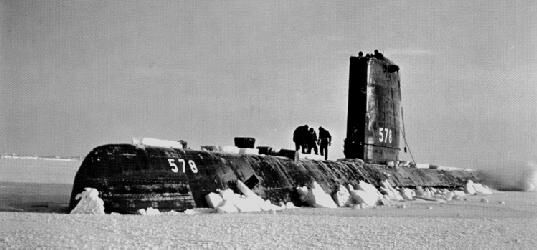
Calvert was the commanding officer of the nuclear-powered USS Skate from December 1957 to September 1959. The submarine became the first to surface at the North Pole in February 1959. Calvert wrote about the experience in a book titled "Surface At The Pole." The trip had been made to test how well a submarine could operate in the Arctic Ocean.

Battle said deciding when to surface through the Arctic ice was "a very tricky moment," because it was unclear what kind of damage the move would cause the submarine.

"It was a very dramatic moment when he decided to pick the spot and go for it," Battle said. "At the time, it was a major feat."
More...


June 3, 2009

Slip and slide ?


For those that have traveled much in North America what I am about to describe will have more meaning than those who have not, but I hope all can appreciate the scope of what I am trying to convey.

Imagine all of the United States including Alaska and throw in all the United states territorial waters. Add to his about half of Canada, let's say everything from Winnipeg westward. I doubt that is exactly half but this is just for visualization purposes.

Now imagine all that area pretty much covered in ice. I am not talking about skim ice on a puddle here, I'm talking serious deep glacier type ice. The kind of ice that if you live in Denver a mile high you are still buried almost a mile deep under ice. From San Diego to Portland Maine, from Miami to Anchorage, pretty much just ice. Oh it may not all be as deep as in Denver, but you would still be snow boarding in Malibu not surfing.

That is what Antarctica is, 14,000,000 sq kilometers of mostly ice. The thought of it melting ought to put the fear of Gore in you for sure. But think for a moment how likely is that to actually happen? Let me point out some reality of that actually happening.

I read a fascinating article from the BBC called
Origin of Antarctic ice revealed . A very interesting article about the scientific expedition which is taking radar images of the land under the Antarctic Ice Sheet. Reading it however I was once again reminded how absolutely disingenuous the entire alarmist version of global warming is. It makes me even wonder how not only people like Al Gore but more importantly so called scientist who promote the alarmist view can live with themselves. How a person knowing the actual dynamics of Antarctica could prostitute themselves to promote the fear mongering of sea level catastrophes caused by this remotest of possibilities in the name of science is beyond belief but not beneath contempt.

I will excerpt some passages from the article to make my point, but as I do remember the size and scope of what we are talking about here. To give you another mental picture I will excerpt a portion of the article, remembering that these scientific explorers are making there was across a vast white waste land of snow and ice:

Their radar revealed a landscape that, 14 million years ago, looked similar to the European Alps.
That is what they see through the ice below them, you could replace the Alps with the Rockies, that gives you an idea of the depth of the ice. Another mental picture here:

Dr Siegert said the research team was "very lucky" to see such a clear image of the underlying landscape. They discovered a whole valley system - with mountains at the edge of the survey region and the valley in the middle.


To put this in a bit more perspective, they are in tracked vehicles making their way across the vast white continent not unlike taking a trip from New Orleans to Seattle, the scenery somewhat less picturesque of course and fewer McDonald's. What they are recording would be similar to the area you could map on such a trip in North America, a very small fragment of the immense continent.

Now let's get to the gist of it:


By looking at ancient climate patterns, scientists have previously estimated that the East Antarctic ice sheet formed around 14 million years ago, burying and preserving the Gamburtsev mountain landscape under ice that is now up to 3km thick.

"You need a mean annual temperature of about 3C for the glaciers to form the way they did," Dr Siegert told BBC News.


"The mean annual temperature in this region now is -60 C. So we believe that these mountains are relics of [glacial erosion] in Antarctica before the ice sheet was in place."


Perhaps you get an idea of the insincerity of the alarmist view of melting ice sheets and rising sea levels when the current temperatures are over 60 degrees colder than what was necessary to start the ice growth. What is Antarctica as a whole like, annual temperature wise? There has been much debate about this lately whether temperatures are rising or not, but the fact is that if the ice is not going to melt, it really does not matter now does it? I'll just take an official map from NSIDC to give you an idea of what Antarctica annual temperatures are like, warming or not.


Look at those average annual mean temperatures, keeping in mind the preceding statement from Dr. Siegert "You need a mean annual temperature of about 3C for the glaciers to form the way they did"

How much would temperatures have to rise to even begin to have an affect on Antarctica? How can ice melt in an environment where the mean annual temperatures are far below the freezing point of water? It is absurd to even suggest that temperature increases of a couple of degrees centigrade are going to have any appreciable affect in such an environment. Of course the scientist have to point out the possible threat we face, well sort of:


He added that the findings provided an insight into the stability of the ice.


"It is a critical part of our Earth's system," said Dr Ferraccioli. "If the whole ice sheet collapsed, sea levels would rise by 60m."


There is that now popular scientific term "if". What he says about the stability of the ice sheets is interesting, since one of the alarmist positions is that the ice sheet could somehow slide into the sea or as he says collapse. The idea that such a vast ice sheet which is embedded into continental scale Alp like mountain ranges and valleys is somehow going to slide into the ocean is ludicrous. Imagine our make believe ice sheet over North America stretching across the terrain of the Rockies to the Appalachians suddenly sliding into the Gulf of Mexico, ridiculous. After 14 million years of ice formation we suddenly have continental slip and slide-right. Even if temperatures increased remarkably more than the most dire predictions of the science fiction fantasy world of the computer modellers, the vast majority of Antarctica would remain a frozen continent. The idea of a collapsing ice sheet in such an environment is not only beyond belief, it is irresponsible to even raise it as a possibility less alone promote it and use it a a tool to foster an agenda of fear.


"There's been a lot of climate change over the last 14 million years," Dr Siegert said. "And what we can say about this place in the middle of the Antarctic is that nothing has changed."

But, he warned, if levels of atmospheric carbon dioxide continued to rise, in around 1,000 years they will approach the same levels that existed "before there was persistent ice sheet in Antarctica".


"This puts the ice sheet into the context of global climate and what conditions are needed to grow an ice sheet," explained Dr Siegert. "The worrying thing is that we seem to be going back to carbon dioxide concentrations consistent with there being a lot less ice around."


So over the past 14 million years (since ice first began forming in Antarctica) we have experienced many climate changes, I would say that is an understatement. However during all these many climate changes the ice just kept on growing until we invented the internal combustion engine-remarkable. But if we don't do something soon or in around a 1000 years, we will have as much CO2 in the atmosphere as we did when there was no ice in Antarctica.

The little hitch in the get along though is that something amazing happens when a continent is at the bottom of the Earth, it goes a long time without much sun. This little detail insures a very cold environment, CO2 or no CO2.


Of course this line "The worrying thing is that we seem to be going back to carbon dioxide concentrations consistent with there being a lot less ice around." is only relevant if that nasty CO2 stuff raises the temperatures far beyond anything predicted so that a frozen continent is no longer frozen, with or without sun half the year. In which case we are all toast long before that anyway.


And they wonder why the more people know, the less people believe in this nonsense.


More...


"It's getting deep in here"


"Noah managed to survive the great flood. I think we will survive the minor flood even if it does occur. "

FROM- American Chronicle

Rising Waters or Rising Rhetoric?

Government, Inc., is in full stride on a broad front to reduce carbon emissions so the world will be safe from the rising oceans, at least so goes the theory. Of course those bright p0liticians in Washington assure us it is not a theory but an established scientific fact that carbon emissions will cause the temperatures to rise and that the ice caps will melt and inundate the low lying regions of the world. We are assuming that they are only talking about the ice caps on Greenland and Antartica. The floating ice at the North Pole and those at the South Polar region will not add one inch to the ocean level even if they did melt entirely since they are already in the water. (When you have a glass of iced tea and the ice cubes melt the level in the glass does not rise and the same is true with the floating ice caps.)

Let's think through some of these assumptions they are making even if we aren't blessed with PhD's in climatology. Firstly, it should be remembered that the ice caps on Greenland and Antartica comprise about 2% of the total water on the planet. Only 3% of all the water on earth is fresh water, 97% is in the oceans already. All of the ice in those two spots will not melt. Maybe quite a bit of it but not all of it. Unless the earth flips or its tilt is dramatically altered those regions will always be very very cold because they have little sunlight during their respective winters. Those regions will remain cold for eons and much of the ice will remain and there will be future snow falls to replenish some of the ice. The earth was at one time totally dry and nothing but volcanic action and deserts existed; that was caused by the turmoil deep within the earth itself, not from the atmosphere. If all of the ice melts it would be due to other factors than carbon emissions. Something dramatic would have occured to the geology of the earth or its configuration in the heavens. In that event carbon emissions would be the least of our worries. We would all be dead.

I would like some very hard data from the bright guys giving their estimate about how much of the ice will in fact melt if their predictions are corret. We should all be allowed to see their data and then their conclusions. If half the ice remains then we are talking about a 1% increase in the total volume of water in the oceans. But that over states the case because a certain percentage of that water would be in the form of water vapor. That increase in water vapor will add to the snow fall amounts somewhere. There will always be an area of the earth that will be cold because it is away from the Sun. But assume it is 1% then how will that affect the ocean levels around the world?

The earth is not perfectly round. It is egg shaped and furthermore the polar regions are flattened. Folks figured that out a few centuries ago before slide rules or computers were available. The distribution of the new water would not be evenly spaced everywhere on earth. Don't forget that the Moon has a tremendous influence on the oceans and the levels of them--ever heard of the tides? We also have to consider that for every action there is a reaction. As the volume of water was reduced on Greenland and Antartica the tremendous weight of that water would be reduced and those land masses would rise and I betcha there would be an offsetting deflection in the earth somewhere for that rise. That lowering of the earth's crust would take up at least some of the increased volume of water. That is basic geology and physics. I don't think carbon emissions will change those. Our crustal suface is only a few miles deep relative to the diameter of the earth. Mostly the interior is molten iron sloshing about. Thank goodness it does slosh about because that is what gives us our magnetic field which in turn is what protects us from the harmful radiations from the Sun; without that magnetic field we would die.

Assume the depth of the ocean off the Browery in New York Harbor is 100 feet right now. A 1% increase would be one foot. I don't think that would flood Manhattan. That assumption is based on a completely even distribution of the new melt water over the earth which is unlikely but a worse case scenario is ok. There would be some benefits too if the worst occurs. If great chunks of Greenland become ice free and the temperatures rise it would be ripe for food production as would a great many other areas of the world that were barren or ice bound. Siberia would become the new grain belt of the world.

I have an open mind on these matters but I want details, not conclusions and certainly not political posturing about this issue. What I don't like now is that is what we are getting. We are told temperatures are rising. Well, don't tell me that, show me the data. Is the temperature rising in Albany, Springfield, Arles, Munich, Darwin, etc.? What is the time period used? Lastly what is different about any rise in temperature this time that is different than those we have seen before. You historians will recall that the earth was quite warm during the Roman Empire days and the time of Jesus. All those people ran around with capes and togas. England at that time was one of the prime wine producing regions of the civilized world. Was it carbon emissions of that very small population that caused such a spike in temperatures then? I have questions. I learned long ago not to take as the gospel everything said by a pundit or a PhD with an agenda. Maybe they are right, maybe they are wrong. We are investing trillions and gambling our economy on those conclusions that I am not sure about.

Noah managed to survive the great flood. I think we will survive the minor flood even if it does occur.

More...


May 26, 2009

Just another surprise


If as this article from Mother Jones and the corresponding report states, 30% of the warming in the Arctic region is the result of soot rather than demonic CO2, where does that leave recent "unprecedented warming"? In addition the fact that soot is responsible for greater and accelerated ice melt, it makes one wonder how the scientific community can continue with a clear conscious to blame the Arctic sea ice melt on atmospheric CO2. So once again we have another example of the so called settled science being unsettled by new discoveries. The best and the brightest of the climate science community are regularly being surprised by what they don't know, it makes you wonder why they are surprised that fewer and fewer people trust what they say.

After all how often do we have tor read something like :"These fires weren't part of our standard predictions, they weren't in our models," before it dawns on them that the science community is not being all that scientific.

FROM-Mother Jones


Don't Burn the Crops


Want a quick recipe for reducing Arctic ice melt fast? Stop burning northern hemisphere farmlands and pasturelands.

New research finds that large-scale agricultural burning in Russia, Kazakhstan, China, the US, Canada, and the Ukraine is melting Arctic ice.

The big contributor: Spring burning, when farmers torch crop residues and brush to clear new land for crops and livestock. The black carbon soot produced by these fires flows north, warms the surrounding air, and absorbs solar energy when it falls on ice and snow.

How bad is the problem? Springtime burning may account for 30 percent of Arctic warming to date. The good news is there's an easy fix. Targeting these burns gets us a genuinely fast reduction in temperature over the Arctic. Plus we know how to control these pollutants right now. Just stop burning. Right now. Before the melting ice rewires the oceanic currents delivering us the climate we're used to.

The research is part of POLARCAT, an international effort to track the transport of pollutants into the Arctic from lower latitudes. Researchers were surprised to find 50 smoke plumes that analysis of satellite images revealed came from agricultural fires in Northern Kazakhstan and Southern Russia and from forest fires in Southern Siberia. The emissions from these fires far outweighed those from fossil fuels.

"These fires weren't part of our standard predictions, they weren't in our models," says Daniel Jacob, a professor of atmospheric chemistry and environmental engineering at Harvard.

Although global warming is largely the result of excess accumulation of carbon dioxide, the Arctic is highly sensitive to short-lived pollutants like black carbon. Forest fires, agricultural burning, primitive cookstoves, and diesel fuel are the primary sources of black carbon.

More...


May 17, 2009

Running out of time


FROM-Talking About Weather

Arctic Cooling Has Begun


What follows is the first guest post on Talking About The Weather. I chose Peter Taylor’s short essay on the Arctic out of respect for Peter’s research, his calm during intense debates, and the focus he brings to the issues. As Peter makes clear, those “banking” on rapid Arctic sea ice deterioration in the decades ahead seem to know very little about climate cycles. — Harold

I hope to be around in 2020, when some have suggested those of us on the sceptics’ side should have been vindicated, but I think we will prevail much sooner. The Arctic heat-wave of 1920-1940 is of course well-known to real Arctic climate scientists. I reviewed 32 temperature data sets for Arctic stations to 2004 some with very long records. In 2006 I could find only one with higher temperatures in 2004 than in the late 1930s or early 1940s – that was on the eastern


Fear-mongering regarding Arctic sea ice is the most acute of all that brought forward by global warming doomsayers. Image courtesy of the USGS.
coast of Greenland. Since then I have reviewed dozens of papers on surface air temperature, sea surface temperatures, ice-mass, glacier speeds and sea-ice, and all show a clear cyclic pattern of roughly 70 years. Some Greenland and Alaskan temperatures peaked in 2006-2008, but the pattern looks set to repeat.


The latest Arctic heat wave is not identical to the last – firstly it is higher, by maybe 20% in some places, and secondly, the hot-spots are different. But one thing is clear – it is driven by two distinctive factors – a 14% increase in clouds over

the North Pole and Beaufort Sea between 1980-2000, and the incursion of warm Atlantic water under the ice and into the Beaufort Gyre. The rapid summer ice loss is due to melting from above (infra red from the clouds) and below (warm Atlantic water).

The strength of the Beaufort Gyre determines how far Atlantic water penetrates the Arctic – when the Pacific Decadal Oscillation is warm and Alaskan Shelf winds are low, the gyre weakens and may reverse flow; when cold (as it has been since late 2006), the Alaskan interior cools, the winds strengthen and the gyre strengthens accordingly – there is a lag of a few years.

Thus, this domino effect from the Pacific will eventually reach the area between Greenland and Norway and summer sea-ice ought to return to the long-term norm (unless there really is a strong greenhouse element – which I can’t see it greater than the difference between this warm period and the last – ie about 20%) and unless there is an even steeper decline in global temperatures due to the quiet sun effect.

On the latter – there is a body of evidence that during quiet solar periods, the jetstream is shifted along with Arctic pressure systems that lead to blocking high pressure over Iceland – sending the jetstream further south and cooling western Europe. The eastern seaboard of the USA gets a little warmer, but the mid-West suffers late springs, dry summers, and bitter winters – not good for the breadbasket of the world!

We should get to see this play out over the next five years.

More...


May 14, 2009

Worried about the wrong Bear?


FROM-CNS NEWS
As UN Deadline Passes for Seabed Claims, Russia Gives Arctic Warning
As a deadline passed for countries to file claims with the United Nations for the right to exploit seabed beyond their coastlines, Russia hinted at the possibility of future conflict over energy reserves the resource-rich Arctic.

Russia’s new national security strategy, evidently released to coincide with Wednesday’s U.N. deadline, raised the prospect of war resulting from rivalry over oil and gas supplies.

“With the ongoing competition for resources, attempts to use military force to solve emerging problems cannot be excluded – and this might destroy the balance of forces on Russia’s and its allies’ borders," said the strategy, which evaluates potential security threats for the next decade.

Drawn up the Russia’s Security Council, a body that includes Prime Minister Vladimir Putin, the security strategy is the first of its kind published since 2000. President Dmitry Medvedev signed off on it on Tuesday.

Scientists contend that melting ice in the Arctic region and advances in drilling technology could open up access to massive oil and gas reserves.

A recently-released Kremlin document on Arctic policy until 2020 identifies Russia’s “Arctic zone” as “a national strategic resource base capable of fulfilling the socio-economic tasks associated with national growth.”

According to a translation provided by the American Foreign Policy Council, the document says the Arctic zone “is capable in large part of fulfilling Russia’s needs for hydrocarbon resources, aqueous biological resources, and other forms of strategic raw material.”

It also refers to the deployment of armed forces in the Arctic zone which are “capable of ensuring security under various military and political circumstances.”

Exactly where that Arctic zone stretches, however, remains in dispute.

Russia in December 2001 filed a claim with a U.N. body known as the Commission on the Limits of the Continental Shelf (CLCS) for a huge section of Arctic shelf, including the North Pole, arguing that an underwater ridge was an extension of the Eurasian continent.

The United States, Canada, Denmark and Norway contested the claim, and the CLCS asked Russia to submit further data.

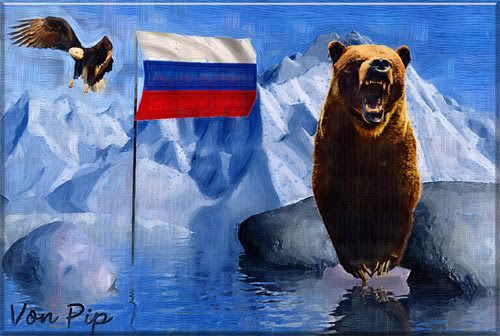
Moscow has declared itself ready to cooperate in the area with other interested nations, but in a provocative move dispatched scientists by mini-submarine in 2007 to plant a titanium Russian flag on the Arctic floor. The symbolic gesture sparked a sharp response from the Canadian government, with the then foreign minister saying it was reminiscent of “14th or 15th century” imperialism.

By Wednesday’s deadline for seabed claims, set by the 1982 U.N. Convention on the Law of the Sea (UNCLOS), 69 nations had filed submissions to the CLCS relating to various parts of the globe, including the Arctic. Countries have 10 years to file submissions from the date of their UNCLOS ratification, so some are not bound by this week’s cutoff.

The treaty recognizes exclusive economic zones (EEZ) stretching 200 nautical miles (about 230 miles) from a country’s coastline. The CLCS is tasked to establish the outer limits of the continental shelf beyond EEZs.

In their applications, states are required to submit data proving that the claimed areas are an extension of their territory. A body of experts in geology, geophysics and hydrography will determine the validity of the claims. Conflicting claims will be settled by international tribunals.

CLCS secretary Hariharan Pakshi Rajan said Wednesday the commission would hear presentations from 29 countries in August, and more next April.

He stressed that the issue was not one of extending national sovereignty, but of extending sovereign rights for the purposes of exploring and exploiting resources.

(Although the U.S. has not ratified UNCLOS – due to Republican opposition in Congress – it has been gathering data since 2001 to back its extended continental shelf claims, including data obtained during Arctic cruises in 2003, 2004, 2007 and 2008, according to the State Department. Secretary of State Hillary Clinton said during her confirmation hearings that ratifying UNCLOS would be a priority.)

After meeting last week with her Russian counterpart, Sergei Lavrov, Clinton said, without elaborating, that the Arctic was one of the areas on the expanding U.S.-Russian agenda “where we think it is in our interest to cooperate and it is in the interest of the world that the United States and Russia do so.”

‘Multi-polar world’


The security strategy released Wednesday said one of the government’s objectives was to make Russia “a world power, whose activity is aimed at maintaining strategic stability and mutually advantageous partnership in the conditions of a multi-polar world,” according to the ITAR-Tass news agency.

Apart from energy competition, it also identified rivalry in Central Asia, the expansion of NATO to accommodate aspiring members Georgia and Ukraine, and U.S. proposals for a missile defense shield in central Europe as other areas of potential friction in the coming years.

It says Russia wants a “fully fledged strategic partnership” with the U.S., but also maintains that its security is threatened by the policy of some countries “aimed at achieving military supremacy, primarily in nuclear forces.”

Pledging to “reset” relations with Moscow strained over missile defense, NATO enlargement and Russia’s war in Georgia last summer, President Obama earlier this year agreed with Medvedev to negotiate a new strategic arms reduction treaty. Obama is due to visit the Russian capital in July.


More...


May 8, 2009

"the beer in my cooler is much colder below the ice "


FROM-American Review

Media Propaganda and the Wilkins Ice Shelf Collapse

by Timothy Birdnow

The media is lying by omission to the public about the collapse of the Wilkins Ice Shelf in Antarctica.

Recent news stories have trumpeted the collapse of a chunk of the Wilkins Ice Shelf, and to hear the mainstream media tell it the Antarctic is melting away like butter down in south Texas. The collapse of Wilkins has been blamed-of course-on Anthropogenic Global Warming. The truth is that Antarctic ice is up considerably, and has been rising steadily.

Yet the MSM continues to push the propaganda (there is no other word for it) that Antarctic ice sheet collapses are a result of Global Warming, and this means we will witness a dramatic rise in sea levels as a result. The reality is that nothing can be further from the truth.

First, an ice shelf is not land ice; it floats on the sea. This is very important, because sea ice displaces as much water as it will add when melted. There is no change in sea levels when sea ice melts-only when land ice ends up in the sea.

Now, these Antarctic ice shelves frequently break up when they become too massive. I would like everyone to think of a tube of toothpaste; how do you get that toothpaste onto your brush? (I know, many of the liberals who read this blog doubtlessly do not use such artificial means to retain their teeth ) You SQUEEZE IT in the middle, and the paste squirts out the opening at the end. In many ways, that is how glaciers work; an increase in ice helps force the flow of glaciers. Granted, there has to be a certain amount of lubrication on the underside of the ice, and a warmer world may mean faster glacial flow, but if Global Warming is being driven by atmospheric CO2 then logic would dictate that the ground under a glacier would be the last place to warm; the beer in my cooler is much colder below the ice than is the beer above it-and that without any greenhouse gases to warm the upper part of the cooler box. It stands to reason that ice shelves would collapse if the interior ice on the continent is increasing.

But the ice in Wilkins isn`t glacial ice, but rather the result of snowfall. It does not require lubrication on the underside of glaciers, but rather simple snowfall and wave action to move them about.

Bear in mind that much of the ice loss in Antarctica is also around the Antarctic Peninsula, which has always been considerably warmer (relatively, of course) than the rest of the continent. More...

Now, it is important to understand what has been happening in the South Pacific; the ENSO (El Nino Southern Oscillation) has been very active, and this triggered the intense heat in Victoria and South Australia that was all the rage in global media. While Antarctica is garroted by the Antarctic Circumpolar Current which prevents heat transfer as in the Arctic, there will still be air movement and some convection.

At any rate, the media is breathlessly reporting that this recent collapse at Wilkins is “proof” of Global Warming. (a Google search for “collapse of the Wilkins ice shelf” produced 107,000 results, for instance. A search for “Antarctic ice disappearing” yielded 89,600 results, as well, despite the fact that the ice is growing.) Yahoo news has a classic example of such misleading reporting by a major news service. An article by Alister Doyle of Reuters (see Green-Yahoo.com) tells about the collapse of a section of the Wilkins ice shelf and, of course, blames Global Warming. There is no attempt whatsoever to balance the article; in fact, they do not even ask the expert they consulted (Angelika Humbert) if it is a result of Global Warming, but rather paraphrase another scientist from the Antarctic Survey who is willing to blame it on AGW.

Below is an excerpt from an interview with Angelika Humbert about what is happening at Wilkins:


Q:How would you put the recent break-up of the Wilkins Ice Shelf into the context of the break-up of other ice shelves along the peninsula over the past 30 years? Isn’t this the furthest south on the peninsula that an ice shelf has broken up?

A:It’s difficult to put it into context because the Wilkins is a very special kind of ice shelf. It consists mainly of ice that is formed by ACCUMULATION OF SNOWFALL (emphasis added). There’s not much glacier inflow. It has brine infiltration, which means it has a completely different crystalline ice matrix. It runs aground on the so-called ice rises. It has an extraordinarily large number of ice rises, which here destabilised the ice shelf and created failure zones. It’s quite difficult to compare that with the break-up events of other ice shelves along the peninsula.

And it’s also important not to confuse ice shelf disintegration with ice shelf break-up. What we’re seeing with the Wilkins Ice Shelf are break-up events. Ice shelf disintegration is a different process. The Larsen B Ice Shelf disintegrated in just a few days. And now with the Wilkins Ice Shelf we’re seeing break-up events, which always release large masses of ice, but the ice shelf is still there.

Q:How does the ice shelf grow to begin with?

A:You have inflow from glaciers. An ice shelf needs to have reasonable speed at which its advance can happen. But the Wilkins Ice Shelf is advancing at a very low speed, something like 60-90 metres per year. If 1,200 km2 were to break off, it would take a very long time for it to grow back.


You get the idea; there is no suggestion that this is a direct result of global warming. On the contrary, it is a result of other factors which may, or may not, be a result of GW-whether anthropogenic or natural.

It should be pointed out that these shelves collapse regularly; there is nothing unusual about that.

According to a piece in Ecoworld by Ed Ring:

“The assumption in all these stories that report on the Wilkins Ice Shelf, and other melting ice around the Antarctic Peninsula, is that global warming is the cause, and that they are representative of a general melt occurring throughout Antarctica. And if this were true, this would be alarming, since 90% of the world’s land based ice is in Antarctica. So is the ocean warming around Antarctica, and is Antarctica’s overall total mass decreasing?

The answer to both of these questions is almost certainly no. As this recent imagery from NOAA indicates, the southern ocean is actually colder than average. Except for a few areas directly south of the Indian Ocean, and in the area south of Patagonia and surrounding the Antarctic Peninsula, the rest of the ocean surrounding Antarctica - virtually all of the South Pacific and South Atlantic - is cooler than average. This data indicates no reason to believe ocean temperatures are causing overall loss of ice mass in the Antarctic; with the exception of the insignificant quantity of ice on the Antarctic Peninsula, they suggest the opposite.
post resumes below image

What about the ice mass of Antarctica? Along with land based ice, which can raise sea levels when melted into the ocean, another significant indicator of polar temperature is the extent of floating sea ice. As the above table prepared by researchers at the University of Illinois indicates, the actual sea ice surrounding Antarctica is well above average. The black line represents the last 12 months of sea ice area, based on satellite data. You can see the sea ice reached a peak of 15 million square kilometers around September, during the peak of the southern winter. You can see it dropped to a low of 2 million square kilometers in mid-February, at the height of the southern summer. Currently the sea ice surrounding Antarctica is 7 million square kilometers and rising. The red line, however, is what is significant, because the red line indicates whether or not the sea ice is above or below the historical norm. And as you can see, as of May 2009, Antarctic sea ice is about 1.0 million square kilometers above normal.

Just like last year, to assist in the research for this post I contacted Dr. Roger Pielke Sr., a climatologist at the University of Colorado whose blog www.climatesci.org is one of the most balanced forums and respected sources of technical information on global climate anywhere. In response to my inquiry, he wrote the following: “The sea ice around the continent is far above average (ref. UIUC). Also, note the colder than average sea surface temperatures around Antarctic (ref. NOAA). If the media is going to discuss the Wilkins Ice Shelf, they should also discuss this other data. The expansion of the sea ice coverage implies a cooling.”

Yet the media continue to report on Antarctica as if it were disintegrating before our very eyes. This is worse than slipshod or lazy reporting; one has to believe in incompetence on a breathtaking scale to believe this is accidental. No, what is happening is a willful, purposeful distortion of the events to the public.

Why are they doing this? It should be apparent that they have their own agenda, one they hope to stampede Americans into accepting (much like people were stampeded into accepting the TARP nationalization of the banking system) a new world order-one predicated on international regulation of industry and the American economic system. The absolute refusal to publish dissenting opinion smacks of the worst sort of propoganda from the Soviet heyday of Pravda.

This illustrates a desperate need for regime change in the American media. Barack Obama owes his election to a virtually unanimous backing of his candidacy by the old guard, who hid his disturbing skeletal matter in numerous closets so as not to queer his chances, and who continue to this day to cover for The One. Global Warming is just another such issue. Conservatives simply do not have the power to influence the public discourse in the manner that the MSM can, and so many-especially the young children who are having their heads filled with lies such as the above-fall into the trap of believing that Antarctica is melting like the Wicked Witch after Dorothy doused her, and are in a panic about what is at most a minor scientific debate.

Science-real science-is about facts and testable hypotheses. Anthropogenic Global Warming has failed that test repeatedly, yet it continues to be “settled science” to the forces of statism who use it as a tool. This science has become a pack of lies. Consider Michael Mann, the author of the infamous, now TWICE debunked “hockey stick graph” that was so influential in it`s day. Mann refused to give Steve McIntyre the data sets he used, and so McIntyre had to reverse engineer Mann`s approach both times. Consider Hansen`s Goddard Institute release of September temperature data as October data a while back-thus giving the impression that October was the warmest on record. Also consider the fraud perpetrated at Albany University by Climate Alarmist Professor Wei-Chyung Wang, who has been caught making up data (see Scientific Misconduct.blogspot.com) It seems that the Gang Green has a problem with the truth.

And why not, when the media will run interference for them? Al Gore`s movie is full of mistakes-which I suspect are intentional-yet the media helps to keep Gore from the hot seat. He refuses to debate on this issue, and the media with their motto “the public`s right to know” remains strangely silent.

The public`s confidence in the old guard media is shrinking faster than they claim those glaciers and ice shelves. Those of us who honor the truth need to consider hostile takeovers of the media, buying up shares and forcing regime change. Of course, BHO may beat us to it.

At least we can concentrate on the truth, and the truth is that AGW theory is a failure. No matter how the MSM tries to spin things, they cannot hide such truth.