Pages

Showing posts with label Spencer. Show all posts

August 7, 2010

Global Warming, R.I.P


FROM-American Thinker

By Claude Sandroff


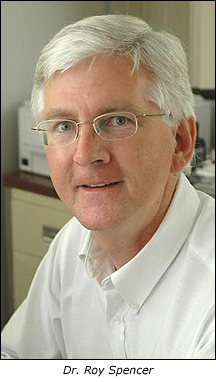
In a remarkable monograph, Roy W. Spencer presents hard evidence that 75% of the observed warming since the start of the 20th century is due to natural processes. He offers a detailed model describing how one of these processes, the Pacific Decadal Oscillation (PDO), operates in the real world. Most importantly, he demonstrates that anthropogenic global warming (AGW) is a minor contributor to a global climate largely insensitive to man-made CO2.


Thanks to this highly skilled climatologist and his The Great Global Warming Blunder: How Mother Nature Fooled The World's Top Climate Scientists, we can now taunt the often corrupt and overtly political planetary high priests with this: PDO means AGW is DOA.


Written in a style that should be attractive to both warming newcomers and scientists from other fields, the volume's appearance is not a welcome event for the world's strident purveyors of global warming orthodoxy. For in the gentlest language possible, Spencer is telling the AGW clingers that they are scientifically incompetent lemmings.


The "blunder" Dr. Spencer (a leading analyst of satellite-derived atmospheric data) refers to is a basic one: confusing cause and effect. Most would-be scientists who make this mistake once, let alone repeatedly, often go into another kind of work. It's the equivalent of the graduate student who forgets to plug in his detector and then reports a successful negative check experiment.


The effect Spencer seeks to explain is the 1.8ºC warming of the earth since 1900. He argues effectively that accepted global warming dogma and funding agency prejudices had discouraged potential heretics from seriously entertaining the idea that long-term, natural variations, rather than man-made CO2 "pollution," could be operating over the timescale of a century to warm and cool our planet.

And as the recent Climategate scandal has confirmed, the AGW church fathers will discredit, shun, and excommunicate any deviant member of the warming consensus congregation.


Indeed, it is frustration with the controlling climate hierarchy that led Spencer to communicate his findings directly with the public in book form rather than in the peer-reviewed literature. He guides the reader through the fundamental blunder that has led almost every scientist astray.

Observing increasing CO2 levels and increasing temperatures, scientists assumed that the former must have caused the latter. How did the warmers know that it wasn't the other way around, and that higher temperatures caused higher CO2 concentrations? Or how did the warmers know that there wasn't another process, a naturally occurring one, that caused the temperature rise, with increasing CO2 just along for the ride? Answer: They didn't, because they never bothered to look.


They never felt that they had to look, since emitting CO2 for the true believer is a kind of original sin, a crime committed by affluent societies that requires no corroborating evidence, let alone a scientific trial to determine guilt. But Spencer decided to look, peering into the CERES (Clouds and the Earth's Radiant Energy System) satellite data more deeply than anyone else in the field.


And ultimately, with just four parameters, keen insight into the behavior of the PDA and clouds, a simple program, and a few thousand Monte Carlo simulations, he was able to produce a model that explains our current climate system and man's role in it with unprecedented clarity.

Spencer devotes several chapters to the important role of feedback in understanding climate and the need to carefully separate it from existing forces (causes) to avoid overestimating the sensitivity of climate to external changes.


At the end of Spencer's careful analysis, a simple picture emerges. The PDO is a long-lived ocean-to-atmosphere heat transfer process (similar to the better-known El Niño and La Niña) but of much longer duration. Cloud cover decreases significantly during the positive PDO phase, allowing more sunlight to reach the earth's surface. In the ocean, this extra energy is stored as heat. In its negative phase, the PDO acts in reverse and cools the atmosphere. And all of this occurs in roughly thirty-year cycles. While this mechanism is operating, mankind is dumping a small, vanishing amount of CO2 into the atmosphere. Big deal.

The most prominent frauds active in promoting AGW have always tried to bury evidence of natural warming and cooling cycles. Truly, the Medieval Warming Period and Little Ice Age are threats to their very CO2-obsessed existence. But these eras occurred centuries ago, with only proxies (like tree rings) to indicate the actual prevailing temperatures. Hence, data from these eras are easily brushed aside and forgotten. Not so with recent thermometer measurements, and temperatures from two periods in particular that have always plagued the theory of AGW.


The first is the period from 1900-1940. A full 60% of the temperature increase measured in the last century occurred during these forty years, when less industrialization existed worldwide and therefore less CO2 had been spewed into our atmosphere. The mild cooling period that ended in the mid-1970s is also baffling. But like any good theory, Spencer's PDO-focused model fits the temperature data during these decades amazingly well. Natural processes -- cloud formation and heat transfer -- dominated the temperatures during these decades, as in every other decade in the modern era.


There is no greater pleasure in a scientist's life than being able to explain phenomena more simply and comprehensively than anyone else did before him. This sense permeates Spencer's book, along with something else: moral outrage.

Some wealthy, spoiled, self-hating Westerners might in their affluence be able to afford expensive energy alternatives to power -- things like wind and solar that don't directly involve the emission of CO2. But the rest of the world cannot. Cheap, affordable energy, the kind that comes from coal, natural gas and oil, is a prerequisite for any society to rise economically. Spencer seems thrilled to be able to tell the developing world that they have a free pass to burn hydrocarbons and prosper.
 More...

December 16, 2009

"Notable Quotes"


"There seems to be great reluctance to consider the possibility that these computerized prophets of doom, which have required so many scientists and so much money and so many years to develop, could be wrong. I come along with an extremely simple climate model that explains the behavior of the satellite data in details that are beyond even what has been done with the complex climate models…and then the more complex models are STILL believed because…well…they’re more complex.

Besides, since my simple model would predict very little manmade global warming, it must be wrong. After all, we know that manmade global warming is a huge problem. All of the experts agree on that. Just ask Al Gore and the mainstream news media."

Source

Roy Spencer
More...


August 3, 2009

64 Days and counting


STILL No Tropical Storms? Must Be Global Warming


by Roy W. Spencer, Ph. D

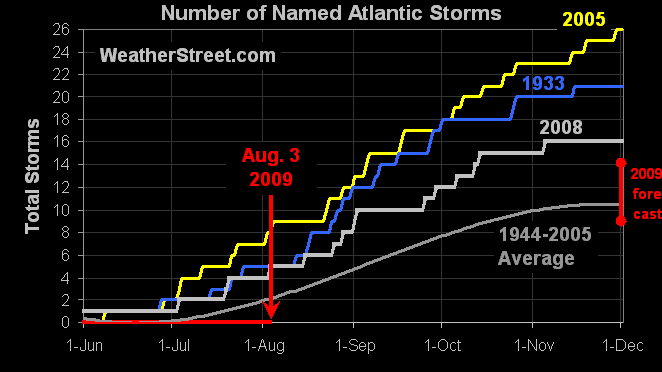
So, where are all of the news stories about the fact we’ve had no tropical storms yet this year? As can be seen in the following graphic, as of this date in 2005 we already had 8 named storms in the Atlantic basin. And tomorrow, August 4, that number will increase to 9. In 2005 we were even told to expect more active hurricane seasons from now on because of global warming.

Of course, even though it is interesting that the 2009 tropical season is off to such a slow start, it may well have no significance in terms of long-term trends. But the lack of news coverage on the subject does show the importance of unbiased reporting when it comes to global warming. Let me explain.

Let’s say we really were in a slow, long-term cooling trend. What if the media decided they would only do news stories when there are record high temperatures or heat waves, ignoring record cold, and would then attribute those events to human-caused global warming? This would end up making the public fearful of global warming, even if the real threat was from global cooling.

The public expects – or used to expect – the media to report on all sides of important issues, so that we can be better informed on the state of the world. There have always been high temperature records set, and there have always been heat waves. In some sense, unusual weather is normal. It might not happen every day, but you can be assured, it will happen. But reporting on heat-related events while ignoring cold temperature records or events that do not support the claims of global warming theorists, will lead to a bias in the way the public views climate change.

Of course, someone might come along and claim that global warming has disrupted tropical storm activity this year, and so an unusually quiet season will also be claimed as evidence of global warming. This has already happened to some extent with cold weather and more snow being blamed on global warming.

But when the natural climate cycle deniers reach that level of desperation, they only appear that much more ridiculous to those of us who have not yet lost our ability to reason.


More...


July 29, 2009

"Notable Quotes"


"...humans are doing just what the other animals are doing: modifying and consuming their surroundings in order to thrive. The deniers curiously assert that all other forms of life on the planet have the ‘right’ to do this – except humans."


source


Roy Spencer
More...


June 13, 2009

Looking for the missing 10%


FROM-Roy Spencer


IPCC Admits they Could be Wrong about Humans Causing Global Warming

If that headline surprises you, then it is a good indication of how successful the United Nations Intergovernmental Panel on Climate Change (IPCC) has been in their 20-year long effort to pin the rap for global warming on humanity. I’m not reporting anything really new here. I’m just stating what is logically consistent with, and a necessary inference from, one of the most recognizable claims contained in the Summary for Policymakers in the IPCC’s 2007 report:

“Most of the observed increase in global average temperatures since the mid-20th century is very likely due to the observed increase in anthropogenic greenhouse gas concentrations.”

They assign a probablility of 90% to the term “very likely”. This is a curious use of statistical probability since warming over the last 50 years is either mostly due to anthropogenic emissions, or it isn’t. Probabilities do not apply to past events like this.More...

What the IPCC is really using probabilities for is to attach some scientific value to their level of faith. I would be very surprised if there weren’t vigorous objections to the use of probabilities in this way from members of the IPCC…but the IPCC leadership really needed a scientific-sounding way to help push their political agenda, so I’m sure any objections were overruled.

But I digress. My main point here is that the IPCC is admitting that they might be wrong. That doesn’t sound to me like “the science is settled”, as Al Gore is fond of saying. If it is “very likely” that “most” of the observed warming was due to mankind, then they are admitting that it is possible that the warming was mostly natural, instead.

So, let’s play along with their little probability game. Given the extreme cost of greatly reducing our greenhouse gas emissions, wouldn’t you say that it would be important to actively investigate the 10% possibility that warming is mostly natural, as the IPCC readily admits?

Where is the 10% of government research dollars looking into this possibility? I suspect it is going to environmental NGO’s who are finding new ways to package “global warming” so that it doesn’t sound like a liberal issue. Or maybe they are working on more clever names to call researchers like me other than “deniers”, which is getting a little tiresome.

For many years the Department of Defense has had “Red Team” reviews devoted to finding holes in the “consensus of opinion” on weapons systems that cost a whole lot less than punishing the use of our most abundant and affordable sources of energy. It seems like a no-brainer that you would do something similar for something this expensive, and as destructive to the lives of poor people all over the world.

One could almost get the impression that there is more than just science that determines what climate science gets funded, and how it gets reported by the news media. Oh, that’s right I forgot…the United Nations is in charge of this effort. Well, I’m sure they know what they are doing


June 3, 2009

The Other Side Of The Story


This Episode brought to you by- Roy W. Spencer, Ph. D.

A Layman’s Explanation of Why Global Warming Predictions by Climate Models are Wrong

I occasionally hear the complaint that some of what I write is too technical to understand, which I’m sure is true. The climate system is complex, and discussing the scientific issues associated with global warming (aka “climate change”) can get pretty technical pretty fast.

Fortunately, the most serious problem the climate models have (in my view) is one which is easily understood by the public. So, I’m going to make yet another attempt at explaining why the computerized climate models tracked by the U.N.’s Intergovernmental Panel on Climate Change (IPCC) – all 23 of them – predict too much warming for our future. The basic problem has been peer reviewed and published by us, and so cannot be dismissed lightly.

But this time I will use no graphs (!), and I will use only a single number (!!) which I promise will be a small one.

I will do this in three steps. First, I will use the example of a pot of water on the stove to demonstrate why the temperature of things (like the Earth) rise or fall.

Secondly, I will describe why so many climate model “experts” believe that adding CO2 to the atmosphere will cause the climate system to warm by a large, possibly catastrophic amount.

Finally, I will show how Mother Nature has fooled those climate experts into programming climate models to behave incorrectly.

Some of this material can be found scattered through other web pages of mine, but here I have tried to create a logical progression of the most important concepts, and minimized the technical details. It might be edited over time as questions arise and I find better ways of phrasing things.

The Earth’s Climate System Compared to a Pot of Water on the Stove

Before we discuss the average temperature of the Earth, let’s start with the simple example of a pot of water placed on a stove. Imagine it’s a gas stove, and the flame is set on its lowest setting, so the water will become warm but will not boil. To begin with, the pot does not have a lid.


More...
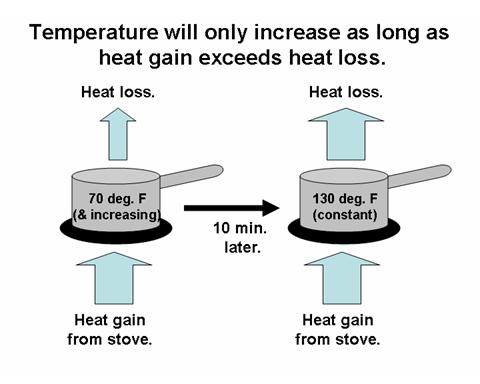
Obviously, the heat from the flame will warm the water and the pot, but after about 10 minutes the temperature will stop rising. The pot stops warming when it reaches a point of equilibrium where the rate of heat loss by the pot to its cooler surroundings equals the rate of heat gained from the stove. The pot warmed as long as an imbalance in those two flows of energy existed, but once the magnitude of heat loss from the hot pot reached the same magnitude as the heat gain from the stove, the temperature stopped changing.

Now let’s imagine we turn the flame up slightly. This will result in a temporary imbalance once again between the rate of energy gain and energy loss, which will then cause the pot to warm still further. As the pot warms, it loses energy even more rapidly to its surroundings. Finally, a new, higher temperature is reached where the rate of energy loss and energy gain are once again in balance.

But there’s another way to cause the pot to warm other than to add more heat: We can reduce its ability to cool. If next we place a lid on the pot, the pot will warm still more because the rate of heat loss is then reduced below the rate of heat gain from the stove. In this case, loosely speaking, the increased temperature of the pot is not because more heat is added, but because less heat is being allowed to escape.

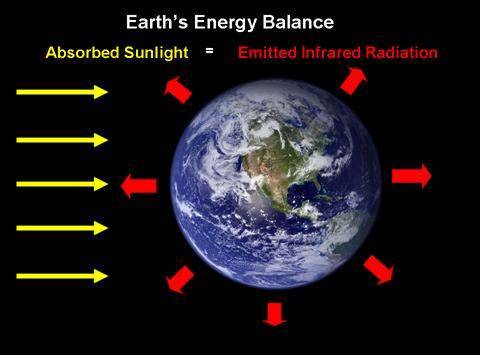
This example is the same fundamental situation that exists with climate change in general, and global warming theory in particular. A change in the energy flows in or out of the climate system will, in general, cause a temperature change. The average temperature of the climate system (atmosphere, ocean, and land) will remain about the same only as long as the rate of energy gain from sunlight equals the rate of heat loss by infrared radiation to outer space. This is illustrated in the following cartoon:


Again, the average temperature of the Earth (like a pot of water on the stove) will only change when there is an imbalance between the rates of energy gained and energy lost.

Global Warming

What this means is that anything that can change the rates of energy flow — in or out of the climate system — can cause global warming or global cooling. For instance, if the amount of cloud cover reflecting sunlight back to space decreases from, say, a change in weather patterns, then more sunlight will be absorbed by the land and ocean. As a result, there will then be an imbalance between the infrared energy lost and solar energy gained by the Earth. The Earth will warm until the amount of infrared energy loss to space (which goes up with temperature, like the heat loss by the pot went up with temperature) once again equals the amount of energy gained by the sun.

But just as in the case of the pot of water, we can also cause global warming by reducing the rate at which the Earth loses energy. For instance, the so-called greenhouse effect of the atmosphere, due mostly to water vapor, clouds, carbon dioxide and methane, acts like a radiative blanket, warming the lower atmosphere and the surface. In the theory of manmade global warming, increasing carbon dioxide concentrations in the atmosphere (presumably due to burning of fossil fuels) slightly enhances the Earth’s natural greenhouse effect. An energy imbalance results because the rate of cooling of the Earth is then reduced slightly, and as a result the Earth is expected to warm until equilibrium is once again restored.

Now for a magic number that we will be referring to later. It can be calculated theoretically that for every 1 deg C the Earth warms, it gives off an average of about 3.3 Watts per square meter more infrared energy to outer space. The effect is the same as that felt from a hot stove versus a warm one: at a distance, you feel more infrared (heat) radiation coming from a hot stove than from a warm stove.

The $64 Trillion Question: By How Much Will the Earth Warm?

This 3.3 Watts per sq. meter is how much faster the Earth loses energy to outer space if ONLY the temperature is increased, and nothing else is changed. In the real world, however, we can expect that the rest of the climate system will NOT remain the same in response to a warming tendency.

In fact, the most important scientific debate in global warming theory is not over what I have just described, which virtually all climate scientists will agree with. The main debate is instead over how clouds (and to a lesser extent other elements in the climate system) respond to that warming, thereby enhancing or reducing the warming. These indirect changes that further influence temperature are called feedbacks.

Returning to our example of the whole Earth warming by 1 deg. C, if that warming causes an increase in cloud cover, then the 3.3 Watts of extra infrared loss to outer space gets augmented by a reduction in solar heating by the sun. The result is a smaller temperature rise. This is called negative feedback, and if it exists in the real climate system, then manmade global warming will become, for most practical purposes, a non-issue.

But if the cloud cover of the Earth decreases with warming, then more sunlight will be let in and the Earth will warm to an even higher temperature. The same is true if the water vapor content of the atmosphere increases with warming. These are called positive feedbacks, and all 23 climate models tracked by the IPCC now exhibit positive cloud and water vapor feedback. The main difference between models that predict moderate warming versus those that predict strong warming has been traced to the strength of their positive cloud feedbacks.

Obviously, the question of how clouds in the REAL climate system respond to a warming tendency is of paramount importance, because that guides the development and testing of the climate models. Ultimately, the models must be based upon the observed behavior of the atmosphere.

So, what IS observed when the Earth warms? Do clouds increase or decrease? While the results vary with what years are analyzed, it has often been found that warmer years have less cloud cover, not more.

And this has led to the conclusion that cloud feedbacks in the real climate system are probably positive, although by an uncertain amount. The interpretation goes like this: Warming causes a decrease in clouds which then causes still more warming. Positive feedback. And if cloud feedbacks end up being too strongly positive, then we are in big trouble from manmade global warming.

How Mother Nature Fooled the World’s Top Climate Scientists

At this point an important question needs to be asked that no one asks: What caused the warming in the first place? By definition, cloud feedback can not occur unless the temperature changes…but what if that temperature change was caused by clouds in the first place?

This is important because if decreasing cloud cover caused warming, and this has been mistakenly interpreted as warming causing a decrease in cloud cover, then positive feedback will have been inferred even if the true feedback in the climate system is negative.

As far as I know, this potential mix-up between cause and effect — and the resulting positive bias in diagnosed feedbacks — had never been studied until we demonstrated it in a peer-reviewed paper in the Journal of Climate. Unfortunately, because climate research covers such a wide range of specialties, most climate experts are probably not even aware that our paper exists.

So how do we get around this cause-versus-effect problem? Our very latest research, now in peer review for possible publication in the Journal of Geophysical Research, shows that one can separate, at least partially, the effects of clouds-causing-temperature-change (which “looks like” positive feedback) versus temperature-causing-clouds to change (true feedback).

We analyzed 7.5 years of our latest and best NASA satellite data and discovered that, when the effect of clouds-causing-temperature-change is accounted for, cloud feedbacks in the real climate system are strongly negative. The negative feedback was so strong that it more than cancelled out the positive water vapor feedback we also found. It was also consistent with evidence of negative feedback we found in the tropics and published in 2007.

In fact, the resulting net negative feedback was so strong that, if it exists on the long time scales associated with global warming, it would result in only 0.6 deg. C of warming by late in this century.

Natural Cloud Variations: The Missing Piece of the Puzzle?

In this critical issue of cloud feedbacks – one which even the IPCC has admitted is their largest source of uncertainty — it is clear that the effect of natural cloud variations on temperature has been ignored. In simplest of terms, cause and effect have been mixed up. (Even the modelers will have to concede that clouds-causing-temperature change exists because we found clear evidence of it in every one of the IPCC climate models we studied.)

But this brings up another important question: What if global warming itself has been caused by a small, long-term, natural change in global cloud cover? Our observations of global cloud cover have not been long enough or accurate enough to document whether any such cloud changes have happened or not. Some indirect evidence that this has indeed happened is discussed here.

Even though they never say so, the IPCC has simply assumed that the average cloud cover of the Earth does not change, century after century. This is a totally arbitrary assumption, and given the chaotic variations that the ocean and atmosphere circulations are capable of, it is probably wrong. Little more than a 1% change in cloud cover up or down, and sustained over many decades, could cause events such as the Medieval Warm Period or the Little Ice Age.

As far as I know, the IPCC has never discussed their assumption that global average cloud cover always stays the same. The climate change issue is so complex that most experts have probably not even thought about it. But we meteorologists by training have a gut feeling that things like this do indeed happen. In my experience, a majority of meteorologists do not believe that mankind is mostly to blame for global warming. Meteorologists appreciate how complex cloud behavior is, and most tend to believe that climate change is largely natural.


And this cause-versus-effect issue is not limited to just clouds. For instance, there are processes that can cause the water vapor content of the atmosphere to change, mainly complex precipitation processes, which will then change global temperatures. This has long been known, but again, climate change research covers such a wide range of disciplines that very few of the experts have recognized the importance of obscure studies that have been published.


While there are a number of other potentially serious problems with climate model predictions, this issue alone has the power to mostly deflate all predictions of substantial global warming. It is only a matter of time before others in the climate research community realize this, too.


May 7, 2009

"trifling investment of fact"


FROM-Roy Spencer

Why America Does Not Care About Global Warming

It is clear that concern in the United States over global warming is diminishing. In a Washington Whispers editorial, Paul Bedard quotes a Gallup Poll editor as saying Al Gore’s campaign to raise awareness of the “climate crisis” has failed. In one recent Pew Research Center survey, global warming rated at the bottom of a list of 20 domestic issues that Americans are concerned about.
Why is there so much apathy in the U.S. over something that threatens to transform the world by killing off thousands of species, flooding coastal areas, and making the world as much as 10 degrees F hotter? Do we just not care about the environment? Has the global warming message been oversold? Is the public experiencing ‘global warming fatigue’? Does the global warming problem seem so insurmountable to people that they just want to ignore it and hope that it goes away?

From my travels around the country and talking to people, the largest source of apathy is none of these. In my experience, people simply do not believe the ‘scientific consensus’ is correct. Most people do believe the Earth has warmed, but they think that warming has been largely natural. This was recently supported by a Rasmussen Reports poll which showed only 1/3 of American voters now believe global warming is caused by humans.
More...

How can non-experts question the opinion of scientific experts? I believe it is because the public seems to have a better appreciation than the scientists do of a fundamental truth: There are some problems that science does not yet understand. There have been predictions of environmental doom before, and those have all failed. This has made people suspicious of spectacular scientific claims. As I have mentioned before, even Mark Twain over 100 years ago made fun of the predilection scientists have for making grand extrapolations and pronouncements:

“There is something fascinating about science. One gets such wholesale returns of conjecture from such a trifling investment of fact.”
-Mark Twain, Life on the Mississippi (1883)

The scientific community has brought this problem upon themselves by not following their own rules and procedures. Scientists have ‘cried wolf’ too many times, and some day that might end up hurting all of us when some unusual and dangerous scientific concern does arise. I think that people intuitively understand that spectacular scientific claims require spectacular evidence. Just saying something ‘might’ happen ‘if current trends continue’ does not impress the public. They have heard it all before.

The analogy I sometimes think about is our understanding of the human brain. What if there was a group of researchers who built a computer model of how the brain works, and they claimed that they could take some measurements of your brain and tell you what you would be thinking 24 hours from now. Would you believe them?

No, even though you are not an expert regarding the operation of the human mind, you probably would not believe them. From your daily experience you would suspect that those experts were probably overreaching, and claiming they knew more than they really did.

Of course, if the experts had performed such experiments before and succeeded, then you might be more inclined to believe them. But in the climate business, we have no previous forecast successes that are relevant to the theory of manmade global warming. We can’t even forecast natural climate variations, because we do not understand them. Simply forecasting long-term warming probably has a 50/50 chance of being correct just by accident, since it seems to be more common for warming or cooling to occur than for the temperature to remain constant, year after year, decade after decade.

And coming up with possible explanations for what has happened in the past (’hindcasts’) do not really count, either. It is too easy to happen upon the wrong explanation which can be made to fit the data, a technique scientists call (rather pejoratively) “curve-fitting”.

In weather forecasting, MANY forecasts are required before one can confidently determine, based upon the number of successes and failures, whether those forecasts had any real skill beyond what might be expected just based upon chance. Climate forecasting is nowhere near being able to demonstrate forecast skill to the level of confidence that is routinely discussed in weather forecasting.

So, for those of you in the environmental community who think the global warming message needs to be repackaged, or rephrased, or have a change in terminology …well…I think you are wasting your time. The people have gotten the message, loud and clear: Global warming is manmade, and it is only going to get worse.


The trouble is that the people simply don’t think you know what you are talking about. And if global warming is largely a natural process, cutting down on our greenhouse gas emissions is going to have no measurable effect on future global temperatures.

Now, if you think you might succeed through a different kind of deception of the public…well, that indeed might work.


May 2, 2009

Willful Blindness


"Maybe those in control of the research dollars are afraid of what might be found if the research community looked too closely at the satellite measurements. There are now billions — if not trillions — of dollars in future taxes, economic growth, and transfers of wealth between countries that are riding on the climate models being correct."

FROM- Roy Spencer PhD.


Climate Model Predictions: It’s Time for a Reality Check

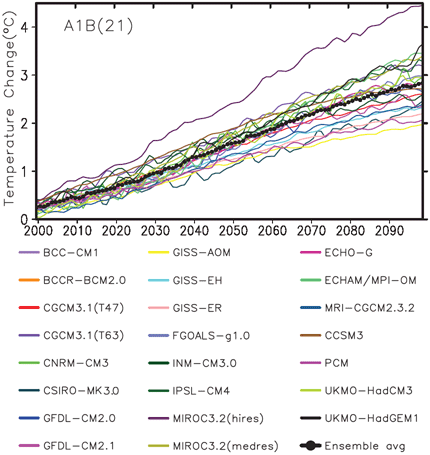
The fear of anthropogenic global warming is based almost entirely upon computerized climate model simulations of how the global atmosphere will respond to slowly increasing carbon dioxide concentrations. There are now over 20 models being tracked by the IPCC, and they project levels of warming ranging from pretty significant to catastrophic by late in this century. The following graph shows an example of those models’ forecasts based upon assumed increases in atmospheric carbon dioxide this century.


While there is considerable spread among the models, it can be seen that all of them now produce levels of global warming that can not be ignored.

But what is the basis for such large amounts of warming? Is it because we know CO2 is a greenhouse gas, and so increasing levels of atmospheric CO2 will cause warming? NO!…virtually everyone now agrees that the direct warming effect from extra CO2 is relatively small – too small to be of much practical concern.

No, the main reason the models produce so much warming depends upon uncertain assumptions regarding how clouds will respond to warming. Low and middle-level clouds provide a ‘sun shade’ for the Earth, and the climate models predict that those clouds will dissipate with warming, thereby letting more sunlight in and making the warming worse.

[High-altitude (cirrus) clouds have the opposite effect, and so a dissipation of those clouds would instead counteract the CO2 warming with cooling, which is the basis for Richard Lindzen's 'Infrared Iris' theory. The warming in the models, however, is now known to be mostly controlled by the low and middle level clouds – the “sun shade” clouds.]

But is this the way nature works?More... Our latest evidence from satellite measurements says “no”. One would think that understanding how the real world works would be a primary concern of climate researchers, but it is not. Rather than trying to understand how nature works, climate modelers spend most of their time trying to get the models to better mimic average weather patterns on the Earth and how those patterns change with the seasons. The unstated assumption is that if the models do a better job of mimicking average weather and the seasons, then they will do a better job of forecasting global warming.

But this assumption can not be rigorously supported. To forecast global warming, we need to know how the average climate state — and especially clouds — will change in response to the little bit of warming from the extra CO2. Indeed, the model that best replicates the average climate of the Earth might be the worst one at predicting future warming.

This fact gets glossed over – or totally ignored – as the IPCC dazzles us with the level of effort that has been invested in computer modeling of the climate system over the last 20 years. The IPCC can show how many people they have working on improving the models, how many years and how much money has been invested, how big and fast their computers are, and how many peer-reviewed scientific publications have resulted.

But unless we know how clouds change with warming, it is all a waste of time from the standpoint of knowing how serious manmade global warming will be. Even the IPCC admits this is their biggest uncertainty…so why is so little work being done trying to answer that question?

AN APPEAL TO THE DECISION MAKERS

We now have billions of dollars in satellite assets orbiting the Earth, continuously collecting high-quality data on natural, year-to-year changes in climate. I believe that these satellite measurements contain the key to understanding whether manmade global warming will be catastrophic, or merely lost in the noise of natural climate variability.

That is why I spend as much time as I can spare trying to understand those satellite measurements. But we need many more people working on this effort. Despite its importance, I have yet to meet anyone who is trying to do what I am doing.

To be fair, the modelers do indeed compare their models to satellite measurements. But those comparisons have not been detailed enough to answer the most important questions…like how clouds respond to warming.

The comparisons they have done have been confusing and inconclusive, which is part of the reason why they don’t rely on the satellite measurements very much. The modelers claim that the satellite measurements have been too ambiguous, and so they increasingly rely only upon the models.

But I will continue to assert (until I am blue in the face or die, whichever comes first) that their confusion stems from a very simple issue they have overlooked: mixing up cause and effect. The previous satellite observations that showed clouds tend to decrease with warming does not mean that warming causes clouds to decrease!

We have recently submitted to Journal of Geophysical Research a research paper that shows how one can tell the difference between cause and effect — between clouds causing a temperature change, and temperature causing a cloud change. And when this is done during the analysis of satellite data, it is clear that warming causes an increase in the sunshade effect of clouds. (While the data did suggest strong positive water vapor feedback, which enhances warming, that was far exceeded by the cooling effect of negative feedback from cloud changes.)

These results suggest that the climate system has a strong thermostatic control mechanism – exactly opposite to the way the IPCC models have been programmed to behave — and that the widespread concern over manmade global warming might well be a false alarm.

The potential importance of this result to the global warming debate demands a reexamination of all of the satellite data that have been collected over the last 25 years, with the best minds the science community can spare. Simply asserting that ‘Dr. Spencer does not know what he is talking about’ will not cut it any more.

We now have two papers in the peer-reviewed scientific literature that paved the way for this work (here and here), and so one can not simply dismiss the issue based upon some claim that we ‘skeptics’ do not publish our work.

I just presented our latest results at the NASA CERES Team meeting to about 100 attendees, and there were no major objections voiced to my analysis of the results. (CERES is the instrument that monitors how global cloud changes affect the energy balance of the Earth). I was pleased to see that there are still some scientists who are interested in the science.

Rather than simply asserting that I am wrong, why not take a fresh look at the data that have been collected over the years? Given the importance of the issue, it would seem to be the prudent thing to do. A red team-blue team approach is needed here, with the red team specifically looking for evidence that the IPCC has been wrong in their previous evaluation of the satellite data.

I suggested this years ago in congressional testimony, but one thing I’ve learned is that most congressional hearings are not designed to uncover the truth.

Maybe those in control of the research dollars are afraid of what might be found if the research community looked too closely at the satellite measurements. There are now billions — if not trillions — of dollars in future taxes, economic growth, and transfers of wealth between countries that are riding on the climate models being correct.

Scientific debate has all been shut down. The science of climate change was long ago taken over by political interests, and I am not hopeful that the situation will improve anytime soon. But I will continue to try to change that.


April 11, 2009

Or can they even boil water?


from Roy Spencer PhD.

A Global Warming Cookbook: What Causes Temperature to Change?


Something that fascinates me about the science of global warming is that some climate ‘experts’ do not have any better understanding of the basic physical processes involved than the lay person does.

For instance, in a recent paper of mine that was rejected for publication in Geophysical Research Letters, the editor assigned only a single peer reviewer, who did not even understand what causes temperature to change. And yet, the reviewer was casting judgment on my analysis that showed that the cloud-altering behavior of the Pacific Decadal Oscillation over the last 100 years might explain most of what we now call climate change and global warming.

So, let’s review the basics of why the temperature of an object changes. In a few minutes, you will have a better understanding than even that (presumed) climate expert has. It doesn’t matter whether it is the Earth, or a pot of water on the stove, the fundamental concepts are the same. And if you think you already understand why a pot of water on the stove warms up, you might be in for a surprise....

April 8, 2009

Cheetah it ain't


from Roy Spencer PhD

The 800 Pound Gorilla in the Climate System

The issue of global warming has so many facets that it has always been difficult to concisely state the objections we skeptics have to the theory (yes, ‘theory’) that our present warmth is caused by all of you consumers out there driving your SUVs and eating Big Macs. What follows is a demonstration of my main objection.

The claim that global warming is due to people is indeed a valid hypothesis. Human activity produces carbon dioxide, carbon dioxide in the atmosphere is increasing, and CO2 is indeed a greenhouse gas. Ergo….

But how often in science is it decided that the first hypothesis to come along will forever be the only one allowed? That is effectively what the United Nations Intergovernmental Panel on Climate Change (IPCC) has done.

Ever since the IPCC was formed twenty years ago, their intent has been to tie global warming to human greenhouse gas emissions. They have never seriously investigated potential natural sources of global warming…except to say they can’t think of any that are large enough to cause the warming.

They then run their climate models with tiny forcings, such as a tiny change in solar output, and then say, “See? Natural forcings can not explain warming…only increasing CO2 can!” This conclusion is then advertised with words like “this demonstrates that natural forcings can not explain global warming”.

As I keep emphasizing, though, this only shows how little we know about natural climate variability. The assumption that the climate system has always been in balance, with a constant temperature, until humans came along is just that: an assumption. There is no way to prove it because we do not have the global measurements needed to prove it...........