Pages

May 4, 2009

Skeptics From Around the Globe


MEXICO


Dr. Victor Manuel Velasco Herrera, -researcher at the Institute of
Geophysics of the National Autonomous University of Mexico


“The models and forecasts of the UN IPCC "are incorrect because they only are based on mathematical models and presented results at scenarios that do not include, for example, solar activity.”

Skeptics From Around the Globe

AUSTRALIA


Lance Endersbee, Emeritus Professor, former dean of Engineering and Pro-Vice Chancellor of Monasy University, Australia


"In the western nations there is a strong popular belief that mankind is causing
global warming, and that natural climate change has ceased. We are told that
man-made climate change will determine our future, with warmer climates,
increased droughts, and rising sea levels.

The media have become advocates in support of this view, and contrary debate
is suppressed. Western governments now plan to “stop” climate change, an
arrogant idea that has already caused enormous costs. In my view it is all a
scientific scandal, a political farce, and a financial calamity."


More...


Skeptics From Around the Globe

UNITED STATES


Howard Hayden, PhD, Emeritus Professor (Physics), University of Connecticut


"With only on weak correlations and computer models with many arbitrary coefficients, some fear mongers (including, but not limited to Al Gore) have expressed willingness to destroy the economies of the world by restricting energy production."

IMAGE OF THE DAY

May 3, 2009

Skeptics From Around the Globe


JAPAN


Kanya Kusano-program director of the Japan Agency for Marine-Earth Science and Technology

‘The IPCC's conclusion that from now on atmospheric temperatures are likely to show a continuous, monotonous increase, should be perceived as an unprovable hypothesis. I believe the anthropogenic (man-made) effect for climate change is still only one of the hypotheses to explain the variability of climate, it could take 10 to 20 years’ more research to prove or
disprove the theory of anthropogenic climate change,” ....“I believe that cosmic rays, which are modulated by cycles in the strength of the sun's magnetic fields, may potentially have large-scale impacts on the earth's climate.”


More...


Overslept


FROM-Energy Tribune

China’s Nuclear Construction Spree

China’s nuclear power sector will triple in size over the next decade. According to the latest data from the National Energy Administration, China will activate 24 new reactors by 2020. That new capacity should allow the country to more than quadruple the quantity of electricity it generates from fission.

With 11 reactors now in place, China has about 9.1 gigawatts of nuclear capacity. Within a decade, that capacity is expected to hit 40 GW, thereby doubling nuclear’s share of the Chinese electric market from 2 percent to 4 percent.

The latest units being built are at the Sanmen Nuclear Power Plant in Zhejiang province. The three-phase scheme, with an investment of more than $5.9 billion earmarked for the first phase, will incorporate the application of the third-generation pressurized water reactor technology AP1000 introduced from US-based Westinghouse. The first phase project will include two units each with a generating capacity of 1.25 GW, which are slated for completion in 2013 and 2014. Additional reactor projects will begin construction this year, all of which will be located in coastal areas.

According to Qian Zhimin, the chairman of China Guangdong Nuclear Power Corp (CGNPC), the Chinese government will issue licenses this year to construct another four or eight reactors, making China the world leader in volume of nuclear power stations under construction.

To promote the nuclear power sector, Chinese nuclear entities are aggressively working with their overseas partners. In late April, Kazakh national nuclear company Kazatomprom and CGNPC agreed to set up a joint venture to construct nuclear power stations in China. The Kazakh company will supply China with some 24,000 tons of uranium by 2020.


More...


Eventually you run out of feet


FROM-Taipei Times

The real risks posed by global warming

By Vaclav Klaus


I am surprised at how so many people nowadays in Europe, the US, and elsewhere have come to support policies underpinned by hysteria over global warming, particularly cap-and-trade legislation to reduce greenhouse gas emissions and subsidies for “green” energy sources. I am convinced that this is a misguided strategy — not only because of the uncertainty about the dangers that global warming might pose, but also because of the certainty of the damage that these proposed policies aimed at mitigation will impose.

I was invited to address this issue at a recent conference in Santa Barbara, California. My audience included business leaders who hope to profit from cap-and-trade policies and from subsidies for renewable energy and “green” jobs. My advice to them was to not get caught up in the hysteria.

Europe is several years ahead of the US in implementing policies intended to mitigate global warming. All of the EU’s member countries have ratified the Kyoto Protocol and adopted a wide range of policies to lower their emissions and meet their Kyoto targets.

These policies include a cap-and-trade initiative known as the Emissions Trading Scheme, steep fuel taxes, and ambitious programs to build windmills and other renewable energy projects. These policies were undertaken at a time when the EU economy was doing well and — one hopes — with full knowledge that they would have significant costs.

With the global financial crisis and the sudden economic downturn, two things are becoming clear. First, it will be difficult to afford these expensive new sources of energy. Second, energy rationing policies like cap-and-trade will be a permanent drag on economic activity. Ironically, emissions have not decreased as a result of these policies, but are doing so now as the world economy moves into recession.

This is not a surprise to someone like me, having been actively involved in my country’s transition from communism to a free society and market economy. The old, outmoded heavy industries that were the pride of our communist regime were shut down — practically overnight — because they could not survive the opening of the economy. The result was a dramatic decline in carbon dioxide emissions.

The secret behind the cut in emissions was economic decline. As the economies of the Czech Republic and other central and eastern European countries were rebuilt and began to grow again, emissions have naturally started to increase. It should be clear to everyone that there is a very strong correlation between economic growth and energy use.

So I am amazed to see people going along with the currently fashionable political argument that policies like cap-and-trade, government mandates, and subsidies for renewable energy can actually benefit an economy. It is claimed that government, working together with business, will create “a new energy economy,” that the businesses involved will profit and that everyone will be better off.

This is a fantasy. Cap-and-trade can only work by raising energy prices. Consumers who are forced to pay higher prices for energy will have less money to spend on other things. While the individual companies that provide the higher-priced “green” energy may do well, the net economic effect will be negative.

It is necessary to look at the bigger picture. Profits can be made when energy is rationed or subsidized, but only within an economy operating at lower, or even negative, growth rates. This means that over the longer term, everyone will be competing for a piece of a pie that is smaller than it would have been without energy rationing.

This does not auger well either for growth or for working our way out of today’s crisis.

More...


Today's Thought


"The most extreme environmentalists have as an ultimate goal the reduction of the human population to such a level as they believe concords with the 'carrying capacity' of this planet, and feel that their morality is on a higher plane than those who do not share this desire. And with the help of environmental organisations, they have worked hard at getting to the top of committees, organisations and, yes, governmental bureaucracies. Should President Obama ever feel the need to tell the EPA to back off, he may be surprised at the answer he receives."

To Tell The Truth Part 2


"If an honest man is wrong, after demonstrating that he is wrong, he either stops being wrong or he stops being honest."
- Anon

In my original post I primarily focused on older emeritus skeptic/realist scientist and their reasons and motivations for speaking out against the global warming mantra. The reason this captivated me was the idea that men of stature would openly oppose the orthodoxy of their science seemed inconsistent with human nature.

Consider this as well, does it take any courage to go with the flow? Not at all, it is the easiest thing in the world to just go along. The real courage is when you oppose the consensus. In the case of scientist in today's environment which has been corroded by the Al Gores and James Hansen's of the political and scientific community openly supported by a media without objectivity and often lacking scruples, the scientist who opposes the orthodoxy is subject to open hostility and disdain both professionally and publicly. Who needs this going into retirement.

Unless you believe that all of the skeptics are immoral and influenced by the payoffs from fossil fuel corporations, it just does not make sense. It has been my observation that the young are far more susceptible to the influence of money and peer pressure than the older and more established in society. As to their being somehow unaware or uninformed about developments in the climate field I observed:


Let me point to a simple fact that is often overlooked when this discussion of the Emeritus of some skeptic scientist is ridiculed and used as a straw man to discredit their voices. The hypothesis of Anthropogenic Global Warming has been at the forefront of climate and related sciences for over 20 years now. These so called old men who are now reaching retirement or even have been retired for a few years now, have generally maintained their positions within their institutions and are fully aware of ongoing research, But more important, for the past ten, fifteen, twenty years they were not retired in Florida enjoying the sun, they were actually the lead scientist in the prime of their careers investigating and researching these theories.


But what really grabbed at me was the idea that such men and women would somehow be uncaring about their children's and grand children's futures, if there were any doubt in their minds as to the threat of global warming. As a father and grandfather I could not see so many men of science reaching the ends of their careers in a field they obviously were devoted to, deceitfully opposing a theory that could, if true, destroy the Earth for future generations.

After all one of the alarmist arguments for action is the precautionary principle, even if their projections are not as bad as they predict, it is better to be safe than sorry. Are skeptics any less concerned for the Earth or future generations?
The truth I suspect, with some evidence, is that most of the scientist who became skeptical of the global warming theory did not start out skeptical or at least not to the point of open opposition to the theory. I suspect that their skepticism was born out of actual research and a greater understanding of the science itself.

In my original post on the subject I quoted one of the most prominent realist scientist who alluded to this. Roy Spencer wrote:


"I remember the old days at NASA, when even John Theon was singing the same tune as most people at NASA were. Manmade global warming was a potentially serious threat, and NASA wanted Congress to fund new satellites to study the problem. It was a team effort to get that accomplished."

I believe that most scientist originally took the theory of global warming as a potentially serious threat, even those who are now skeptics.

How often have you heard of a scientist who was once skeptical of global warming suddenly being won over by the science ? I have never heard of any and I try to stay informed on the subject.

The opposite is common though, such as Dr. Rosa Compagnucci a professor in the Department of Atmosphere Sciences at the University of Buenos Aires, a specialist on the "El Niño" phenomenon. She was a member and author of the IPCC Working Group II on Latin America. She left the IPCC fold due to her concerns about the ignoring of potential global cooling.

Here though is the story of a true believer who virtually overnight became an outspoken critic and skeptic of global warming.

In the summer of 2003 Europe was hit by a tremendous heat wave. Of course this was jumped on by the alarmist to prove global warming if not directly at least as a sign of what we had to look forward to. One of the more outspoken proponents along these lines was a well known and respected Hungarian scientist Miklos Zagoni.

Lake Blaton, Europe's largest lake and a Hungarian national treasure was shrinking and Dr. Zagoni had no doubts as to why it was happening


"Balaton's stability over the years shows the stability of climate change, but the last four years shows a big turn," he said. "This is the fourth year Balaton has had more evaporation than precipitation -- a typical case of climate change.

"Statistically, this is a very significant trend change, and I believe it's a direct cause of global warming."

Zagoni sees no short-term solution.

"Society as a whole has to stop the process of climate change. This may result in an economic versus ecological battle, but we have to change the way we live.

"Maybe this summer, with all the (heat wave-related) deaths in France and fires in Portugal, will prove a turning point and finally push politicians' minds in the right direction."

Besides being a Science Historian Dr. Miklos Zagoni, is a Physicist at Eötvös Loránd University. As late as 2007 he was a regular speaker and attendee at environmental conferences both privately and government sponsored including being an expert reviewer for this past IPCC report. He was also well known as one of Hungary's and Europes most outspoken proponents of the theory of man made global warming. Here is an example of his beliefs which he was often asked to give on matters having to do with global warming. In an interview about what Hungary would be like in 2025 :


...in SW Hungary is experiencing "more than" a Mediterranean climate, according to climate expert Miklos Zagoni. "Life will be near impossible in the central part of the country while most of North Hungary will be threatened by major floods (along the Bodrog, Hernad and Zadyva rivers) and inland waters," ... "In the last 50 years Hungary has lost as much as 15% of its general annual precipitation. The summers have become extremely hotter and drier." He explained that when there is rain or snow then this descends in larger quantities at an alarming rate. "That's why Hungary is suffering droughts and floods during the year. Each region in Hungary is burdened by climatic disorders in one way or another..... "Many vintners had to stop producing grapes in the region,... "In NW Hungary the forests of Sopron are struggling to cope with the dry and hot weather.


By any standard Dr. Zagoni was a not only an outspoken proponent of man made global warming, he was and is a committed environmentalist.

Then a fellow Hungarian, a fellow physicist who had worked for NASA for many years resigned in protest.

Ferenc Miskolczi, an atmospheric physicist at NASA's Langley Research Center with three decades of experience, had found that researchers have been repeating a mistake when calculating the impact of greenhouse gas emissions on temperatures. We're not scientists, but it looks to us like Miskolczi found that the Earth does a good job of adapting and self-regulating.


As has been noted elsewhere, Miskolczi's theory could explain why the warming that models have been predicting for decades has never materialized.

NASA's response to the new results? It refused to publish them, reports DailyTech.com. Miskolczi quit, citing in his resignation letter a clash between his "idea of the freedom of science" and NASA's "practice of handling new climate change related scientific results."


Dr. Zagoni came to understand Miskolczi's theory and saw to his mind that it was correct, it totally changed his outlook and belief about man made global warming. Or as he put it “I fell in love.” The theory made so much sense to him that for the past two years he has been tirelessly traveling the world explaining it to anyone who will listen. Slowly but surely people are.


Recently Miklos Zagoni was asked if he was a skeptic, he replied:

“I am not sceptic at all”, he said, “I am positively convinced that the anthropogenic global warming theory is wrong. New developments in the physics of greenhouse effect and radiative transfer show that the accepted theory leads to largely exaggerated global warming projections”.


That is not only a courageous man that is a scientist.

Movie Night


May 2, 2009

"Notable Quotes"

"Detailed forecasts are not possible, because we don't know how emissions will in fact develop. We climate researchers can only offer possible scenarios. In other words, things could end up being completely different. But there are undoubtedly parts of the world that will benefit on balance from climate change. Those areas tend to be in the north, where it has been cold and uncomfortable in the past. But it's considered practically heretical to even raise such issues."


Dr. Hans von Storch- Director of Institute for Coastal Research of the GKSS Research Centre in Geesthacht, Professor at the Meteorological Institute
of the University of Hamburg

Just ask Napoleon

Yeah but what do the Ruskies know about cold weather, Huh?

FROM-ICECAP
AARI Predicts Arctic Cooling/Ice Recovery To Continue

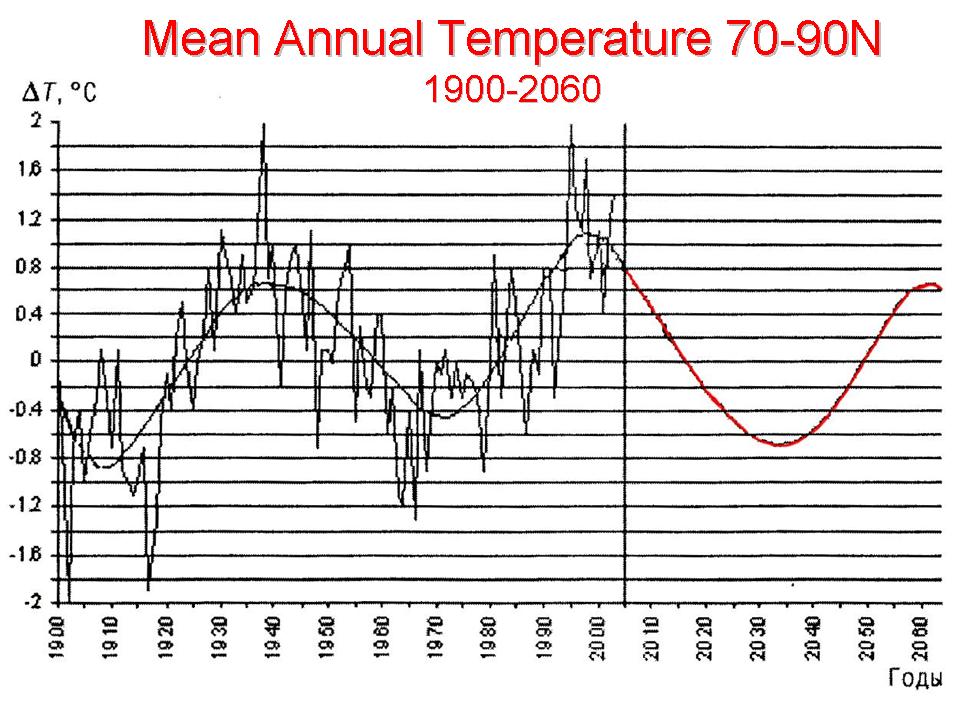
..The most competent polar scientific organization, Arctic and Antarctic Research Institute (AARI) in St. Petersburg, Russia published recently 3 books summarizing scientific results of climate changes in the Arctic region for the last century. One of it dedicated to Arctic climate. Based on the results obtained they forecast coming temperature and sea ice cover area changes in the Polar seas for the next 10-20 years.... .


Anomaly of mean annual air surface temperature 1900-2006 in the zone of 70-90 N and its predicted trend (Frolov et al. Scientific research in Arctic. Vol. 2. Climatic changes in the ice cover of the Eurasian shelf seas. -SPb.: “Nauka”, 2007, 158 p.) Larger image here.

The authors showed that the basic causes of the Arctic climate change have the natural origin and potential magnitude of several orders more than that for the level of anthropogenic impact on the climate. Estimates of possible changes of Arctic air temperature and ice cover propagation area for the 21” century are given on a basis of the revealed stable cyclic oscillations of 10, 20 and 50 to 60 years. See PDF here.


More...

Read Original here

Willful Blindness


"Maybe those in control of the research dollars are afraid of what might be found if the research community looked too closely at the satellite measurements. There are now billions — if not trillions — of dollars in future taxes, economic growth, and transfers of wealth between countries that are riding on the climate models being correct."

FROM- Roy Spencer PhD.


Climate Model Predictions: It’s Time for a Reality Check

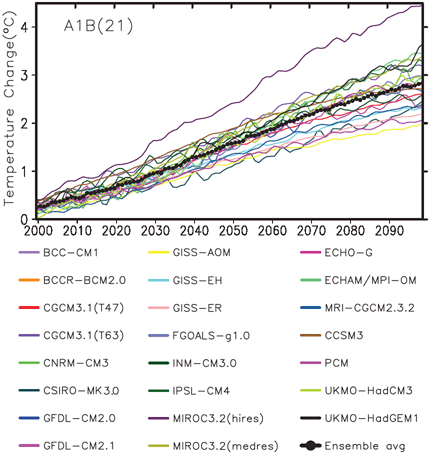
The fear of anthropogenic global warming is based almost entirely upon computerized climate model simulations of how the global atmosphere will respond to slowly increasing carbon dioxide concentrations. There are now over 20 models being tracked by the IPCC, and they project levels of warming ranging from pretty significant to catastrophic by late in this century. The following graph shows an example of those models’ forecasts based upon assumed increases in atmospheric carbon dioxide this century.


While there is considerable spread among the models, it can be seen that all of them now produce levels of global warming that can not be ignored.

But what is the basis for such large amounts of warming? Is it because we know CO2 is a greenhouse gas, and so increasing levels of atmospheric CO2 will cause warming? NO!…virtually everyone now agrees that the direct warming effect from extra CO2 is relatively small – too small to be of much practical concern.

No, the main reason the models produce so much warming depends upon uncertain assumptions regarding how clouds will respond to warming. Low and middle-level clouds provide a ‘sun shade’ for the Earth, and the climate models predict that those clouds will dissipate with warming, thereby letting more sunlight in and making the warming worse.

[High-altitude (cirrus) clouds have the opposite effect, and so a dissipation of those clouds would instead counteract the CO2 warming with cooling, which is the basis for Richard Lindzen's 'Infrared Iris' theory. The warming in the models, however, is now known to be mostly controlled by the low and middle level clouds – the “sun shade” clouds.]

But is this the way nature works?More... Our latest evidence from satellite measurements says “no”. One would think that understanding how the real world works would be a primary concern of climate researchers, but it is not. Rather than trying to understand how nature works, climate modelers spend most of their time trying to get the models to better mimic average weather patterns on the Earth and how those patterns change with the seasons. The unstated assumption is that if the models do a better job of mimicking average weather and the seasons, then they will do a better job of forecasting global warming.

But this assumption can not be rigorously supported. To forecast global warming, we need to know how the average climate state — and especially clouds — will change in response to the little bit of warming from the extra CO2. Indeed, the model that best replicates the average climate of the Earth might be the worst one at predicting future warming.

This fact gets glossed over – or totally ignored – as the IPCC dazzles us with the level of effort that has been invested in computer modeling of the climate system over the last 20 years. The IPCC can show how many people they have working on improving the models, how many years and how much money has been invested, how big and fast their computers are, and how many peer-reviewed scientific publications have resulted.

But unless we know how clouds change with warming, it is all a waste of time from the standpoint of knowing how serious manmade global warming will be. Even the IPCC admits this is their biggest uncertainty…so why is so little work being done trying to answer that question?

AN APPEAL TO THE DECISION MAKERS

We now have billions of dollars in satellite assets orbiting the Earth, continuously collecting high-quality data on natural, year-to-year changes in climate. I believe that these satellite measurements contain the key to understanding whether manmade global warming will be catastrophic, or merely lost in the noise of natural climate variability.

That is why I spend as much time as I can spare trying to understand those satellite measurements. But we need many more people working on this effort. Despite its importance, I have yet to meet anyone who is trying to do what I am doing.

To be fair, the modelers do indeed compare their models to satellite measurements. But those comparisons have not been detailed enough to answer the most important questions…like how clouds respond to warming.

The comparisons they have done have been confusing and inconclusive, which is part of the reason why they don’t rely on the satellite measurements very much. The modelers claim that the satellite measurements have been too ambiguous, and so they increasingly rely only upon the models.

But I will continue to assert (until I am blue in the face or die, whichever comes first) that their confusion stems from a very simple issue they have overlooked: mixing up cause and effect. The previous satellite observations that showed clouds tend to decrease with warming does not mean that warming causes clouds to decrease!

We have recently submitted to Journal of Geophysical Research a research paper that shows how one can tell the difference between cause and effect — between clouds causing a temperature change, and temperature causing a cloud change. And when this is done during the analysis of satellite data, it is clear that warming causes an increase in the sunshade effect of clouds. (While the data did suggest strong positive water vapor feedback, which enhances warming, that was far exceeded by the cooling effect of negative feedback from cloud changes.)

These results suggest that the climate system has a strong thermostatic control mechanism – exactly opposite to the way the IPCC models have been programmed to behave — and that the widespread concern over manmade global warming might well be a false alarm.

The potential importance of this result to the global warming debate demands a reexamination of all of the satellite data that have been collected over the last 25 years, with the best minds the science community can spare. Simply asserting that ‘Dr. Spencer does not know what he is talking about’ will not cut it any more.

We now have two papers in the peer-reviewed scientific literature that paved the way for this work (here and here), and so one can not simply dismiss the issue based upon some claim that we ‘skeptics’ do not publish our work.

I just presented our latest results at the NASA CERES Team meeting to about 100 attendees, and there were no major objections voiced to my analysis of the results. (CERES is the instrument that monitors how global cloud changes affect the energy balance of the Earth). I was pleased to see that there are still some scientists who are interested in the science.

Rather than simply asserting that I am wrong, why not take a fresh look at the data that have been collected over the years? Given the importance of the issue, it would seem to be the prudent thing to do. A red team-blue team approach is needed here, with the red team specifically looking for evidence that the IPCC has been wrong in their previous evaluation of the satellite data.

I suggested this years ago in congressional testimony, but one thing I’ve learned is that most congressional hearings are not designed to uncover the truth.

Maybe those in control of the research dollars are afraid of what might be found if the research community looked too closely at the satellite measurements. There are now billions — if not trillions — of dollars in future taxes, economic growth, and transfers of wealth between countries that are riding on the climate models being correct.

Scientific debate has all been shut down. The science of climate change was long ago taken over by political interests, and I am not hopeful that the situation will improve anytime soon. But I will continue to try to change that.


The New "White Man's Curse" - Unleashed


Navajo Nation President Joe Shirley said in a statement the decision was further proof that the U.S. government isn’t “honest and truthful in its dealings with Native America.”

“I have people dying every day because of poverty, alcoholism, drug abuse, domestic violence, gangs, and the U.S. Government is not there to adequately fund the direct service programs that cater to these needs,”


How fitting with the story I just posted about coal plants that I ran across this at Heliogenic Climate Change. This is not all that unexpected due to the current political climate but disheartening none the less. We posted on this before and now that it has come to fruition one can only be appalled at the absolute hypocrisy of these greennuts that now control our future. Their absolute lack of concern for the poorest of the poor is disgusting and ought to be opposed by anybody with an ounce of compassion.

These policies of starving the world of life enriching energy, in order to restrict the emissions of a natural life giving gas is beyond stupidity, it is dangerous and Orwellian.


FROM- New Mexico Independent

EPA pulls the plug on Desert Rock coal-fired power plant
ALBUQUERQUE — In a dramatic move yesterday, the U.S. Environmental Protection Agency (EPA) withdrew the air quality permit it issued last summer for the Desert Rock coal-fired power plant, which is slated to be built on the Navajo Nation in the Four Corners region just southwest of Farmington, New Mexico.

The action drew praise from critics of the plant and blistering commentary from its proponents.

Assistant New Mexico Attorney General Seth Cohen, who has been one of the primary litigators working on the state’s appeal of the original permit, said the decision by the new administration at the EPA marked “a huge victory.”

“The EPA was supposed to file their final brief today in opposition to our arguments, but had asked for an extension, so we were hopeful,” Cohen told NMI. “Today, in effect, they agreed with us that EPA had cut corners in issuing the permit last summer. It’s a huge victory for public health and the environment in New Mexico.”
But Jeff Holmstead, former head of the air program at EPA and now head of the Environmental Strategies Group at Bracewell & Giuliani, the law firm representing the plant’s developer, Sithe Global, said in a statement that he has “never seen anything like it.”

“I don’t think anyone ever imagined that the new team at EPA would seem to have such little regard for due process or basic notions of fairness,” Holmstead said. “Everyone understands that a new Administration has discretion to change rules and policies prospectively. But I’ve never seen any Administration try to change policies and rules retroactively.”More...
While a lot of attention has been paid in the last week to the EPA’s recent finding that carbon dioxide–the greenhouse gas that is belched from coal-burning power plants–poses a danger to human health and the environment, the decision to withdraw the Desert Rock permit yesterday rested on other issues put forward by the state of New Mexico.

The EPA found that the permitting process was issued prematurely, before complete analysis could be conducted of hazardous air emissions like mercury, or the impact of the facility on endangered species, or the impact on soil, vegetation, and visibility in the region. The permit also didn’t adequately examine particulate matter.

Also, in the review of “best available technologies,” developers of the project didn’t include a process called integrated gasification combined cycle (IGCC), the EPA said. Using IGCC technology–which turns the coal into gas before burning it–would make Desert Rock better able to control air pollution.

While many consider IGCC to be an experimental technology, it’s currently being used in at least two other coal-burning power plants, and the state argued in its appeal that it should have at least been studied as an option.

Yesterday’s decision effectively sends the entire permit back to the drawing board.

Holmstead argued that the permit was the most stringent of any such permit issued in the country. The application was submitted five years ago, he said, and dragged on for several years while the company and the Navajo Nation — a strong supporter of the project — tried to “address everybody’s concerns.”

Navajo Nation President Joe Shirley said in a statement the decision was further proof that the U.S. government isn’t “honest and truthful in its dealings with Native America.” Shirley said that the EPA withdrawal of the permit will harm the Navajo people.

“I have people dying every day because of poverty, alcoholism, drug abuse, domestic violence, gangs, and the U.S. Government is not there to adequately fund the direct service programs that cater to these needs,” he said.

Shirley concluded by saying that the message from the EPA is that it will hold projects “on Navajo land to standards that may well be impossible to meet — and that wouldn’t be applicable elsewhere.”

Cohen, however, said New Mexico respects the right of the Navajo Nation to develop its land, but it needs to be done in a way that protects air quality in New Mexico.

“There needs to be a substantial re-analysis, but we’ll work with the applicant to re-think the permit,” he said.

New Mexico Environment Department Secretary Ron Curry made similar remarks in a statement issued by Gov. Bill Richardson’s office that noted concerns related to carbon dioxide and climate change.

“Air emissions from Desert Rock would have singlehandedly undone our state’s climate change initiatives,” Curry said. “We stand ready to assist EPA Region 9 and the Navajo Nation to make significant improvements to the design of this facility including technologies that will address greenhouse gas emissions.”


This is gonna really piss off James

Is reality setting in?


FROM-Science (Amazing!)

Coal Plant Ban May Not Curb Climate Change

What would happen if the United States stopped building coal-fired power plants? The solution may not be the panacea some have predicted. Although the plants are the single biggest polluter in the United States, contributing to smog, acid rain, and global warming, a new analysis shows that banning them would increase the cost of natural gas while doing little to aggressively combat climate change.


Coal has faced strong opposition from policymakers and the public. In 2007, 59 out of 151 proposed U.S. coal plants were either denied licenses by state governments or abandoned, while environmental groups contested dozens in court. What's more, the governors of at least two states, Florida and Kansas, have said that they will not approve new coal-fired power plants.

But energy researchers Jay Apt and Adam Newcomer of Carnegie Mellon University in Pittsburgh, Pennsylvania, wondered if banning these plants would do any good. To find out, they modeled four different energy scenarios through the year 2030. One scenario takes a business-as-usual approach, with no ban on coal plants, keeps energy demand growth at historical rates, and new demand met by the current contribution of energy providers, including coal, nuclear power, natural gas, oil, and renewables. The next three scenarios ban the construction of future coal-fired power plants. In two of these, energy demand still grows at historical rates, but one scenario meets demand with increases in natural gas production, while the other assumes a large push for wind energy, supplemented by natural gas. The final scenario quenches increased energy needs with wind and natural gas as well, but it assumes that U.S. residents won't require any more energy than they do today--if, say, people become much more efficient in their energy usage; the only increase in demand would come from a growing population. The team applied the model to three main regions in the United States: the Midwest, Texas, and parts of the East Coast.

In every model, the use of natural gas skyrocketed, the researchers report online this week in Environmental Science & Technology. Under the wind scenario, for example, natural gas demand rose 55% by 2030 in Texas, 430% on the East Coast, and 470% in the Midwest. As demand for natural gas doubles, it can lead to anywhere from a 175% to 500% increase in price, says Apt. That could drive companies that rely on natural gas overseas, he says, especially those that aren't tied to working in the United States.

The researchers also found that carbon dioxide emissions didn't drop as much as they had expected. If coal plants are not banned, by 2030 emissions rise 43% in Texas, 24% in parts of the East Coast, and 17% in the Midwest, according to the model. But if they are banned, by 2030, emissions are cut anywhere from 6% to 15% in Texas, 18% to 48% along parts of the East Coast, and 10% to 27% in the Midwest. Overall, that's not enough to meet target emission reductions, says Apt. To avoid more than 2°C warming--and the deadly heat waves, intense droughts, and sea level rise it would bring--the United States needs to cut emissions about 80% by 2050. Only the scenario that assumes no increase in energy demand comes close to meeting this standard--and just on the East Coast.

Howard Herzog, an energy researcher at the Massachusetts Institute of Technology in Cambridge, says that a better approach would be to keep coal as part of the energy portfolio, but to find new ways to curb CO2 emissions from these plants. "Singling out any one fuel" is a bad idea, he says. Instead, "we need to look at technologies [such as carbon capture and storage] that allow us to reduce our carbon emission and still utilize our most important domestic supply [of energy]."


More...


Re-Educating the Ignorant Masses


I do not know whether to laugh or cry when I read something like this.

I laugh because studies show and polls prove that the more people actually learn about global warming/ climate change / deterioration atmospheric crisis- or whatever other term they use to describe it, the less people believe it. The simple answer to this is that the more you study the issue the less sense it makes and the more years that pass by. the more reality disproves it.

I cry, because we have reached a stage in human advancement when those who should lead us in truth-science, governments, media instead try to deceive and manipulate us with words and findings from focus groups.

"Mr. Perkowitz and allies in the environmental movement have been briefing officials in Congress and the administration in the hope of using the findings to change the terms of the debate now under way in Washington".

FROM- NYT

Seeking to Save the Planet, With a Thesaurus

WASHINGTON — The problem with global warming, some environmentalists believe, is “global warming.”

The term turns people off, fostering images of shaggy-haired liberals, economic sacrifice and complex scientific disputes, according to extensive polling and focus group sessions conducted by ecoAmerica, a nonprofit environmental marketing and messaging firm in Washington.

Instead of grim warnings about global warming, the firm advises, talk about “our deteriorating atmosphere.” Drop discussions of carbon dioxide and bring up “moving away from the dirty fuels of the past.” Don’t confuse people with cap and trade; use terms like “cap and cash back” or “pollution reduction refund.”

EcoAmerica has been conducting research for the last several years to find new ways to frame environmental issues and so build public support for climate change legislation and other initiatives. A summary of the group’s latest findings and recommendations was accidentally sent by e-mail to a number of news organizations by someone who sat in this week on a briefing intended for government officials and environmental leaders.

Asked about the summary, ecoAmerica’s president and founder, Robert M. Perkowitz, requested that it not be reported until the formal release of the firm’s full paper later this month, but acknowledged that its wide distribution now made compliance with his request unlikely.

The research directly parallels marketing studies conducted by oil companies, utilities and coal mining concerns that are trying to “green” their images with consumers and sway public policy.More...


Environmental issues consistently rate near the bottom of public worry, according to many public opinion polls. A Pew Research Center poll released in January found global warming last among 20 voter concerns; it trailed issues like addressing moral decline and decreasing the influence of lobbyists. “We know why it’s lowest,” said Mr. Perkowitz, a marketer of outdoor clothing and home furnishings before he started ecoAmerica, whose activities are financed by corporations, foundations and individuals. “When someone thinks of global warming, they think of a politicized, polarized argument. When you say ‘global warming,’ a certain group of Americans think that’s a code word for progressive liberals, gay marriage and other such issues.”

The answer, Mr. Perkowitz said in his presentation at the briefing, is to reframe the issue using different language. “Energy efficiency” makes people think of shivering in the dark. Instead, it is more effective to speak of “saving money for a more prosperous future.” In fact, the group’s surveys and focus groups found, it is time to drop the term “the environment” and talk about “the air we breathe, the water our children drink.”

“Another key finding: remember to speak in TALKING POINTS aspirational language about shared American ideals, like freedom, prosperity, independence and self-sufficiency while avoiding jargon and details about policy, science, economics or technology,” said the e-mail account of the group’s study.

Mr. Perkowitz and allies in the environmental movement have been briefing officials in Congress and the administration in the hope of using the findings to change the terms of the debate now under way in Washington.

Opponents of legislation to combat global warming are engaged in a similar effort. Trying to head off a cap-and-trade system, in which government would cap the amount of heat-trapping emissions allowed and let industry trade permits to emit those gases, they are coaching Republicans to refer to any such system as a giant tax that would kill jobs. Coal companies are taking out full-page advertisements promising “clean, green coal.” The natural gas industry refers to its product as “clean fuel green fuel.” Oil companies advertise their investments in alternative energy.

Robert J. Brulle of Drexel University, an expert on environmental communications, said ecoAmerica’s campaign was a mirror image of what industry and political conservatives were doing. “The form is the same; the message is just flipped,” he said. “You want to sell toothpaste, we’ll sell it. You want to sell global warming, we’ll sell that. It’s the use of advertising techniques to manipulate public opinion.”

He said the approach was cynical and, worse, ineffective. “The right uses it, the left uses it, but it doesn’t engage people in a face-to-face manner,” he said, “and that’s the only way to achieve real, lasting social change.”

Frank Luntz, a Republican communications consultant, prepared a strikingly similar memorandum in 2002, telling his clients that they were losing the environmental debate and advising them to adjust their language. He suggested referring to themselves as “conservationists” rather than “environmentalists,” and emphasizing “common sense” over scientific argument.

And, Mr. Luntz and Mr. Perkowitz agree, “climate change” is an easier sell than “global warming.”


May 1, 2009

Skeptics From Around the Globe


UNITED STATES


Lee C. Gerhard, PhD, Senior Scientist Emeritus, University of Kansas; former director and state geologist, Kansas Geological Survey


"Please don't argue that climate is changing at rates and intensities not ever seen before. That is just not true. Read the data already out there from the geologists and those who study past climate change.Tell me why otherwise competent scientists argue for their theory but fail to provide any support for their theory other than constant repetition of untrue statements and alarmist exaggerations."

More...


Today's Thought


You can almost hear the first green president channeling JFK: “Ask not what you can do for a crisis; ask what the crisis can do for you.”

Steve Milloy

More...


"We've got a Winner"


Well stated and I would add that many proponents treat it not as a theory but a scientific law, like gravity. The fact that they do this in light of the failure of the theory to live up to its own projections and are constantly changing the criteria by which to judge their theory shows how far from science it truly is.

FROM-C-3

As New Data Continues To Contradict, Is GW Theory Now Global Warming 'Speculation' At Best


Although the global warming theory has been the favorite adopted theory of the political class, grant-seeking scientists and guilt ridden celebrities/journalists, it has not returned all the love bestowed on it by the reverent. Other than the period between the mid-70's and late 90's, the hypothetical human CO2 causation of global warming has meager observation evidence to support it. That being the case, the term "Global Warming Theory" has become an incorrect scientific description, no longer deserving the respect of 'theory' status.

Instead, based on the following widely accepted definitions, a simple review reveals it has become, at best, Global Warming Speculation, unsubstantiated by any real world data or proof. Unfortunately for the devoted, global warming can't even sustain a position of being a convincing hypothesis.

A speculation is a conjecture expressing a belief about something; the expression of a belief that is held with confidence but not substantiated by positive knowledge or proof.

A hypothesis is a proposition that attempts to explain a set of facts in a unified way. It generally forms the basis of experiments designed to establish its plausibility. Simplicity, elegance, and consistency with previously established hypotheses or laws are also major factors in determining the acceptance of a hypothesis.

A scientific law is a hypothesis that is assumed to be universally true. A law has good predictive power, allowing a scientist (or engineer) to model a physical system and predict what will happen under various conditions.

A theory
is a set of statements, including laws and hypotheses, that explains a group of observations or phenomena in terms of those laws and hypotheses. A theory thus accounts for a wider variety of events than a law does. Broad acceptance of a theory comes when it has been tested repeatedly on new data and been used to make accurate predictions.


Global warming is not a theory; not a scientific law; and, no longer a hypothesis. Its relevance in the rational, scientific realm is tenuous, and as a UK judge recently ruled, global warming belief is actually a religion. In addition, as the believers of global warming not only embrace, but proclaim profusely, at every opportunity, the belief of catastrophic, doomsday results caused by the hand of global warming, the terms religious beliefs or speculations have become that much more appropriate.

More...


Truth in Fiction


Dip into 'State of Fear' for global warming answers

In an Edge item in Saturday's Tribune Viewpoints page, the headline asked, "What to believe?" The quandary, it seemed, stemmed from record-breaking temperatures on the West Coast versus news from an Australian paper that the ice in Antarctica is increasing rather than decreasing as recent American news sources have been saying.

May I suggest to all a terrific, page-turning novel called "State of Fear" by Michael Crichton? Although this is an engaging fiction piece, it is full of non-fiction, data from the likes of NASA, The Goddard Space Institute, Columbia University, and Oak Ridge National Laboratory, Oak Ridge, Tenn., among others.

It contains two appendices and a 20-page bibliography and is a balanced account presented with all the skills the late Mr. Crichton possessed. It might interest you to know that the news that Antarctica's ice is increasing, on the whole, was already present in this 2004-copyrighted tome. Perhaps you might add to your question with another, "Why aren't we hearing about this in American newspapers?"


If, says one of Crichton's characters, the elements of our atmosphere were measured in terms of a football field, nitrogen would take us from the goal to the 78 yard line. Oxygen would take us from there to the 99-yard line. Most of the yard remaining consists of argon. Argon takes us to within 3 inches of the goal. Only one inch of the remaining three is made up of carbon dioxide. One inch in 100 yards.


In the last 50 years, we're told, carbon dioxide in the atmosphere has increased. But in this analogy, it has increased only 3/8 inch, "less than the thickness of a pencil," meaning that it is "a miniscule change in our total atmosphere."

Articles worldwide would lead one to believe that all scientists "believe in" global warming, yet the lead climatologist at MIT says that we are only going through a natural cycle. Other scientists in agreement include those at Harvard, Columbia, Duke, Virginia, Colorado, University of California-Berkeley and other top universities.

In addition, much of what we're hearing is based on records that have been kept for less than 200 years. Early on, the data depended on "people going out to a little box and writing down the temperature twice a day."

If they were ill or distracted or too busy, they may not have been diligent about it. The best kept records were in this country, of course, and in the last century, much more accurate.

But this is about "global warming," and other countries were not nearly as consistent or accurate about weather data, even as late as the 1930s or '40s. In other words, we're talking about less than 200 years of not-so-precisedata.

Those not-so-precise data show that in the last 120 years, there has been an increase in general of a third of a degree Celsius — with the warmest year in the last century being 1934. The temperature has, on average, been going up the last 30 years, but it went downthe previous 30 years.

Current temperatures are roughly the same as those in the 1930s when we, supposedly, were not emitting the kinds of greenhouse gases we're emitting now. There seems to be more correlation between the "urban heat effect" and temperature rising than there does between carbon dioxide levels and temperature rising.


For instance, New York City with all its asphalt and concrete, has increased 5 degrees Fahrenheit in 178 years while Albany, less than 140 miles away has declined one-half degree in the same time period.

The two cities' carbon dioxide levels were identical, but Albany got colder. West Point, between the two geographically, was unchanged.


Weather, of course, is local, but the data are about climate, versus weather, over an extended period of time, albeit a drop in the bucket compared to the eons of history purported by the fossil record. New York's population growth is much more likely to account for the difference (a growth of from 120,000 in 1815 to more than 8 million today).

There are few, if any, double-blind studies going on in the field of climate study; whereas in medicine, double-blind studies are the norm. Hundreds of studies have shown that without double-blind studies, "expectations determine outcome." And politics has crept in to further erode non-bias in global warming studies.

There is more, so much more, to support the notion brought up by my late, terrifically smart friend, Don Jacobson, in a letter to the editor last year that much of this "group think" about global warming is akin to a phenomenon shown in the short story, "The Emperor's New Clothes."
In any case, those willing to look at data from scientists on both sides of this issue, leaving personal bias and preconceived notions aside, will find the question "what to believe" easier to answer. A good start is the fast-paced piece of fiction/non-fiction called "State of Fear."
More...


Mad Scientist Watch


FROM-FP Passport

Britain's Royal Society to study climate "geoengineering"

An interesting editorial in The Guardian by a member of Britain's Royal Society, the country's national academy of science, announced -- with a bit of modesty bordering on self-skepticism -- plans to look into "geoengineering" schemes to combat climate change:

The Royal Society has set up a study group on geoengineering climate. Without the answers there will be no way to take sensible decisions on this issue, based on evidence and facts rather than beliefs and suppositions (either for or against the idea). It may well be that our study will conclude that such schemes are not feasible, or too costly, have serious side-effects, or are too difficult to control. But it may not; and it is likely that we will need a lot more information before we can really decide."


After this rather remarkable bit of don't-get-your-hopes-too-high-ism, John Shepherd, the author, gets around to defining just what geoengineering means:

Geoengineering schemes for moderating climate change come in two main flavours. First there are those that aim to increase the amount of sunlight that is reflected away from the Earth (currently about 30%) by a few percent more. Second there are some that aim to increase the rate at which CO2 is removed from the atmosphere, by enhancing the natural sinks for CO2, and maybe even by deliberately scrubbing it out of the air.


In other words, the Royal Society will be studying the possibility of reflecting sunlight away from the earth on a massive scale, and looking at new ways to sink CO2 into the ocean, or scrub clean the atmosphere. Pretty Jules Verne-seeming stuff, as Shepherd acknowledges:
"If world leaders are unable to agree on effective action to deal with climate change ... we may in future be glad that someone took these ideas seriously. Seriously enough to separate the real science from the science fiction, anyway."

What's remarkable is that the Royal Society, founded in 1660, represents nothing if not the nation's crusty scientific establishment. And while the author presents these schemes with much hesitation and ado, it does seem an indicator of just how much more urgent, and desperate, the discussion over climate change is beginning to seem in the U.K.

More...

The Oceans Are Rising Faster Than Ever!


FROM-C-3

Greatest Lie Ever Told?

Let's Review Place #26:
Maloy, Norway


For years (decades?), climate alarmist scientists have been claiming that the oceans were rising with "unprecedented" speed due to human-caused global warming. These scientists claim that because of all the melting of glaciers and ice sheets, due to human-caused warming, the sea levels are rising at an accelerated pace and will continue to so - up to a 20 foot rise by the end of the century is predicted. If this accelerated sea level rising is happening as claimed, then it should be evident across the world. Fortunately, the sea rise at Maloy, Norway is averaging about a third of a foot per century. This is just but one example of ocean facts countering sea-rise alarmism hype - more to follow. (On average, recent satellite measurements put global ocean level increases at 3mm/year or 1 foot/century.)


We are all toxic now


FROM-Climate Science

Is The Atmospheric Concentration Increase From Human Added CO2 “Toxic”? That’s What The Economist Wrote In Their April 25 2009 Issue


I have always enjoyed and learned from the magazine “The Economist”. However, I have been critical of its biased reporting on the climate science subject (e.g. see).

In the April 25th 2009 issue there is an article titled “A green figleaf” (subscription required).

The article includes the text

“The EPA has been mulling the harmfulness of greenhouse gases since 2007, when, in a case brought by a coalition of states, cities and NGOs, the Supreme Court ruled that it should regulate greenhouse gases if they were found to be toxic. As expected, the EPA, now run by Lisa Jackson, who brings to the job 20 years of experience as a regulator who’s tough on business, gave a provisional ruling that they were; a final decision will come after a 60-day period of public consultation.”

Climate Science agrees that CO2 is a climate forcing, and has discussed the EPA approach in the weblogs

New Plans To Regulate CO2 As A Pollutant

Comments On The Plan To Declare Carbon Dioxide as a Dangerous Pollutant

A Carbon Tax For Animal Emissions - More Unintended Consequences Of Carbon Policy In The Guise Of Climate Policy

Will Climate Effects Trump Health Effects In Air Quality Regulations?

Supreme Court Rules That The EPA Can Regulate CO2 Emissions

Science Issues Related To The Lawsuit To The Supreme Court As To Whether CO2 is a Pollutant

However, the term “toxic”, according to the Merriam-Webster dictionary, has three uses

1. containing or being poisonous material especially when capable of causing death or serious debilitation with the examples “toxic waste”; “toxic radioactive gas”; “an insecticide highly toxic to birds”.

2. exhibiting symptoms of infection or toxicosis with the example “the patient became toxic two days later”.

3. extremely harsh, malicious, or harmful with the example “toxic sarcasm”

At the levels of CO2 in the atmosphere, CO2 does not fit any of these definitions. The Economist (and if they accurately reported) the EPA postion misrepresent the actual effect of CO2 in the atmosphere. It is a climate forcing NOT a toxic air pollutant.

More...

Spit and Pie Charts


I find that visual representations sometimes are very enlightening, after all "a picture is worth a thousand words" right? I thought I'd paint a picture of one of my favorite global warming quotes. The late Reid Bryson who was considered to be the father of modern climatology once said

"You can go outside and spit and have the same effect as doubling carbon dioxide".

What did he mean?

Well first let's look at a typical alarmist representation of the danger of carbon dioxide. This first pie chart shows a common representation of carbon dioxide.


This graph shows the distribution of GHG in Earth's atmosphere. Carbon Dioxide is clearly in the majority www.abcnews.com/sections/us/global106.html

So as you can clearly see that poisonous Carbon Dioxide is the primary source for this entire greenhouse effect that is going to boil the oceans, melt the ice caps, drown Bangladesh and reek havoc on the lives of your grandchildren.

So now that we have identified the problem as true eco warrior guardians of the Earth, let's get to the source of the problem.

This next pie shows where all that nasty carbon dioxide comes from.


As you can see the problem shrunk a great deal. Only about 11% of carbon dioxide of that 82% in that original chart is (so called) man made. We did not actually make it, it has been here all along, man despite common belief really does not make anything from scratch, he just puts existing stuff together in new and exciting ways. In the case of carbon dioxide he just basically burns an existing natural substance for all kinds of nefarious purposes, like staying warm.

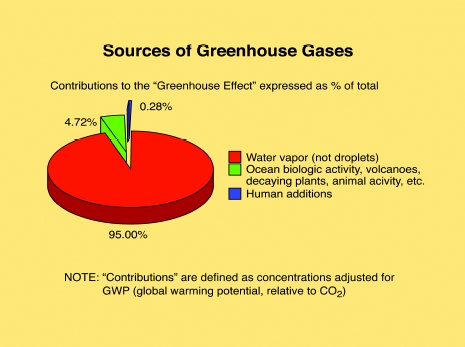
Now let's get to that spittun. You see the one thing left out of the press release of the impending catastrophe, is that poisonous carbon dioxide is not the main greenhouse gas, spit is. Well not exactly spit, actually not water drops at all but water vapor.

So where does carbon dioxide compare to water vapor in the scheme of things?


source

Now you begin to see what old Reid was talking about. Notice how minuscule mans contribution to the entire greenhouse effect is. In the first chart we are left with the impression that 76% of the greenhouse effect is from CO2 without much perspective put to it at all.

When you hear about carbon dioxide emissions it is referred to in terms like gigatons, but remember for each of these gigatons that we emit old Ma Nature is outpacing us about twenty to one.

Now .28% of the entire greenhouse effect sure does not sound that impressive does it?

Now our final pie, to show how tiny carbon dioxide is in the scheme of things check this out:


This is the make up of our Earth's atmosphere. Nitrogen, Oxygen and that tiny sliver of Argon. Where is carbon dioxide and methane and all that other stuff? They are too small to be represented in a pie chart, that is why they are called trace gasses.

How small amount of carbon dioxide is there in our atmosphere? Imagine the above graph represents 100,000 dots, so nitrogen would be 78,000 dots, oxygen would be 21,000 dots, Argon would be 1,000 dots and carbon dioxide would be currently about 39 dots. Or as Roy Spencer puts it:

"As of 2009, there are only 38 or 39 molecules of CO2 for every 100,000 molecules of atmosphere, and it will take mankind’s CO2 emissions another five years to raise that total by 1 molecule, to 40 out of every 100,000 molecules.....Yes, we might double the CO2 concentration of the atmosphere by late in this century…but 2 times a very small number is still a very small number."


It is not like that tiny amount of carbon dioxide is not important, life would come to a screeching halt without it. As that heretic Freeman Dyson pointed out:

"The fundamental reason why carbon dioxide in the atmosphere is critically important to biology is that there is so little of it. A field of corn growing in full sunlight in the middle of the day uses up all the carbon dioxide within a meter of the ground in about five minutes. If the air were not constantly stirred by convection currents and winds, the corn would stop growing."
"

But I still like Reid's

"You can go outside and spit and have the same effect as doubling carbon dioxide".


FROM-Jer

More...