Showing posts with label Polls. Show all posts
August 3, 2011
69% Say It’s Likely Scientists Have Falsified Global Warming Research
FROM-Rasmussen Report
The debate over global warming has intensified in recent weeks after a new NASA study was interpreted by skeptics to reveal that global warming is not man-made. While a majority of Americans nationwide continue to acknowledge significant disagreement about global warming in the scientific community, most go even further to say some scientists falsify data to support their own beliefs.
The latest Rasmussen Reports national telephone survey of American Adults shows that 69% say it’s at least somewhat likely that some scientists have falsified research data in order to support their own theories and beliefs, including 40% who say this is Very Likely. Twenty-two percent (22%) don’t think it’s likely some scientists have falsified global warming data, including just six percent (6%) say it’s Not At All Likely. Another 10% are undecided. (To see survey question wording, click here .)
The number of adults who say it’s likely scientists have falsified data is up 10 points from December 2009
.
Fifty-seven percent (57%) believe there is significant disagreement within the scientific community on global warming, up five points from late 2009. One in four (25%) believes scientists agree on global warming. Another 18% aren’t sure.
Republicans and adults not affiliated with either major political party feel stronger than Democrats that some scientists have falsified data to support their global warming theories, but 51% of Democrats also agree.
Men are more likely than women to believe some scientists have put out false information on the issue.
Democrats are more likely to support immediate action on global warming compared to those from other party affiliations.
Read Article here
May 13, 2011
51% Blame Extreme Weather on Long-Term Planetary Trends, 19% Blame Human Activity
FROM-Rasmussen Report
U.S. meteorologists say the deadly storms tearing up the South are not a result of climate change. None the less, the extreme weather has rekindled the global warming debate in Washington, D.C.
But a new Rasmussen Reports national telephone survey finds that 51% of American Adults think the recent severe weather is primarily caused by long-term planetary trends. Only 19% blame the extreme weather on human activity which many climate change activists view as the cause of global warming. Twelve percent (12%) say there's some other cause for the bad weather, and 19% more are not sure. (To see survey question wording, click here.)
Thirty-nine percent (39%) of Americans say the weather in their area is worse than it has been in recent years. Roughly half (49%) disagree with that assessment, but 12% are undecided.
Fifteen percent (15%) of adults say they have personally been impacted by the severe weather or have a family member who has suffered through it. Among those impacted by the severe weather, 62% say the weather in their area has been worse this year.
Read article here
April 20, 2011
April 17, 2011
Only a quarter of UK population concerned about climate change
Subtext: People are stupid, we need to explain better. It would be interesting to see the actual poll results, they must be pretty bad since they don't quote the actual numbers, but based on the story even Japan and India would not be over 50%
FROM-Ecologist
Only a quarter of UK population concerned about climate change
Twice as many people in India and Japan rank climate change as one of the most important environmental issues, highlighting the challenge facing UK policymakers and climatologists
Only a quarter of Britons believe climate change is one of the most important environmental issues facing the UK today, according to a survey conducted by Ipsos MORI and released to the Ecologist this week.
Ambivalence in the UK is in sharp contrast to Asian countries like India, South Korea and Japan where 50 per cent of those polled consider climate change to be one of the most important environmental issues.
The MORI poll involved more than 18,000 people across the world, who were asked to choose the three most important environmental issues facing their country. Of the 24 countries surveyed, the UK was among the least concerned about climate change, with energy security, waste disposal and overpopulation listed as the most pressing environmental issues. Other European countries showed similar results to UK, with people in Germany and Sweden principally concerned with sources of future energy supplies.
Climate researchers put the difference, in part, on the countries susceptibility to climate change. 'India has much less resilience to climate change and less money for adaptation and mitigation. They have an extremely large population in coastal cities which are sensitive to rising sea levels,' says Professor Corrine Le Quere, director of the Tyndall Centre for Climate Change. 'Bangladesh is also the neighbouring country which is very sensitive to rising sea levels so they might have immigration coming from Bangladesh.'
Direct contact with climatic events increases people’s awareness of climate change and makes them more likely to change their own habits, according to previous research by the Tyndall Centre. Professor Le Quere believes this phenomenon, combined with last year’s notoriously cold British winter, may explain why people in the UK are less concerned about climate change.
‘People tend to associate these events on a very short term and this can be a problem for climate policy. The actions that happen today will have impacts in 20 or 30 years and not just regionally, but worldwide.’
Some suggest a need to increase awareness of the links between everyday issues and climate change, which will in turn create more tangible reasons for people to change their habits. The Green Alliance say the survey highlights the need to make a connection between climate change and 'more concrete things that people care about' and that the Government's policy of 'nudging', favoured by David Cameron, was doomed to failure.
Dr Simon Buckell, from the Grantham Institute for Climate Change agrees. ‘People won’t sign up to expensive and systemic changes unless they are convinced by the evidence,' he says. 'They should be convinced there is a problem we need to do something about and that we have the correct policies to mitigate or adapt to these challenges. Science needs to show how current climate change affects economies and what that can mean going forward. Until people understand if there is, or isn’t a problem, people will be reticent to make a financial commitment.’
MORI researchers urged environmental campaigners to use public concern about energy security to their benefit, suggesting it could provide a 'hook by which campaigners can nudge the public towards many, if not all, pro-environmental behaviours'. WWF agreed saying it was now prioritising the push towards domestic renewable energy - particularly important given that fossil fuels account for around 85 per cent of the UK's greenhouse gas emissions and two-thirds of global emissions.
‘It is technically and economically feasible for the world to be meeting all of its energy needs from sustainable renewable sources by 2050. We need to get on with it - and the UK, with its massive renewable energy resources, should be at the forefront of the green energy revolution,’ says WWF head of climate change Keith Allot.
March 28, 2011
Back to 1997
Or Riding the Titanic
(also from 1997)
Pollsters and pundits will tell you that the most important criteria in evaluating a candidate, policy, issue etc is not so much the poll numbers themselves but the intensity level behind the polls. This is why as you get closer to an election pollsters, if they do not already, switch from general public polling to "likely" voter polling. The voters after all are the ones who actually determine the election, regardless of the popularity contest amongst the public.
The same holds true in regards to issues and policies, the reason that Obamacare is in so much political trouble is that more people strongly oppose it than strongly support it, The intensity level is with those who want to repeal it. The intensity for or against something or someone is what generally determines the outcome.
Much is being made of today's Gallup poll which shows global warming at the bottom of the list of environmental issues with the American public.
Although this is important, it is nothing new, global warming has been at or near the bottom of that polling question since it has been asked.In fact in today's write up of the poll they compare it to a similar poll taken in 2001
As you can see global warming was at the bottom back then too, it usually is. Although concern has dropped considerably since 2001, concern for all of the environmental issues has dropped compared to 2001, In my opinion the drop in concern over the loss of tropical rain forests is actually more troubling than any benefit in the drop in concern over global warming. But that is for another day.
The true metric of how far global warming has fallen as an issue is the "intensity" of how people look at it as a problem. In the methodology link to the poll they have a chart which shows what percentage of people worry about the various issues "a great deal", their intensity. Here is a summary;
2011 Mar 3-6 (sorted by “a great deal”)
Pollution of drinking water 51 %
Contamination of soil and water by toxic waste 48 %
Pollution of rivers, lakes, and reservoirs 46 %
Maintenance of the nation’s supply of fresh water for household needs 46 %
Air pollution 36 %
Extinction of plant and animal species 34 %
The loss of tropical rain forests 34 %
Urban sprawl and loss of open spaces 27 %
Global warming 25 %
As you can see not only is global warming at the bottom of the list overall, it is at the bottom of the list as far as the intensity of peoples concern about it. So how do we judge this most recent poll compared to the past intensity of concern about global warming.
Last year Gallup posted a graph reflecting the "great deal" of concern figures on the issues;
As you can see in 2010 it had dropped to 28% from the 33% it had held in 2009. So in two years global warming has fallen from being of great concern for one third the public to being of great concern for only one quarter of the public.
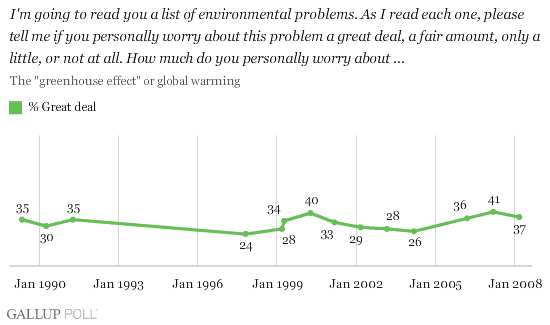
How does this compare historically? Well for some reason Gallup is making us do a bit of digging to compare apples to apples but we have done so. Perhaps in the future they will simply post the graph below updated to reflect their polls since 2008, but I can not find it on their web site. Here is the historical record of Gallup's polling on the intensity level regarding global warming through 2008:
As you can see since its high in 2007 of 41% can you say An Inconvenient Truth, Gallup did, the public's intensity about global warming has dropped from 41% to 37% to 33% to 28% and is now at 25% just slightly above the historical 1997 low of 24% which occurred just prior to the pre super El Nino year of 1998.
As you can see not only are the global warming alarmist losing the war on science, they are losing the only real thing they had going for them, they are losing the ability to scare the public.
(also from 1997)
Pollsters and pundits will tell you that the most important criteria in evaluating a candidate, policy, issue etc is not so much the poll numbers themselves but the intensity level behind the polls. This is why as you get closer to an election pollsters, if they do not already, switch from general public polling to "likely" voter polling. The voters after all are the ones who actually determine the election, regardless of the popularity contest amongst the public.
The same holds true in regards to issues and policies, the reason that Obamacare is in so much political trouble is that more people strongly oppose it than strongly support it, The intensity level is with those who want to repeal it. The intensity for or against something or someone is what generally determines the outcome.
Much is being made of today's Gallup poll which shows global warming at the bottom of the list of environmental issues with the American public.
Although this is important, it is nothing new, global warming has been at or near the bottom of that polling question since it has been asked.In fact in today's write up of the poll they compare it to a similar poll taken in 2001
As you can see global warming was at the bottom back then too, it usually is. Although concern has dropped considerably since 2001, concern for all of the environmental issues has dropped compared to 2001, In my opinion the drop in concern over the loss of tropical rain forests is actually more troubling than any benefit in the drop in concern over global warming. But that is for another day.
The true metric of how far global warming has fallen as an issue is the "intensity" of how people look at it as a problem. In the methodology link to the poll they have a chart which shows what percentage of people worry about the various issues "a great deal", their intensity. Here is a summary;
2011 Mar 3-6 (sorted by “a great deal”)
Pollution of drinking water 51 %
Contamination of soil and water by toxic waste 48 %
Pollution of rivers, lakes, and reservoirs 46 %
Maintenance of the nation’s supply of fresh water for household needs 46 %
Air pollution 36 %
Extinction of plant and animal species 34 %
The loss of tropical rain forests 34 %
Urban sprawl and loss of open spaces 27 %
Global warming 25 %
As you can see not only is global warming at the bottom of the list overall, it is at the bottom of the list as far as the intensity of peoples concern about it. So how do we judge this most recent poll compared to the past intensity of concern about global warming.
Last year Gallup posted a graph reflecting the "great deal" of concern figures on the issues;
As you can see in 2010 it had dropped to 28% from the 33% it had held in 2009. So in two years global warming has fallen from being of great concern for one third the public to being of great concern for only one quarter of the public.
How does this compare historically? Well for some reason Gallup is making us do a bit of digging to compare apples to apples but we have done so. Perhaps in the future they will simply post the graph below updated to reflect their polls since 2008, but I can not find it on their web site. Here is the historical record of Gallup's polling on the intensity level regarding global warming through 2008:
As you can see since its high in 2007 of 41% can you say An Inconvenient Truth, Gallup did, the public's intensity about global warming has dropped from 41% to 37% to 33% to 28% and is now at 25% just slightly above the historical 1997 low of 24% which occurred just prior to the pre super El Nino year of 1998.
As you can see not only are the global warming alarmist losing the war on science, they are losing the only real thing they had going for them, they are losing the ability to scare the public.
March 16, 2011
March 14, 2011
April 19, 2010
Voters Take Global Warming A Bit Less Seriously

FROM-Rasmussen Report
Monday, April 19, 2010
Voters continue to show less worry about global warming.
A new Rasmussen Reports national telephone survey finds that 54% of voters still believe global warming is a serious problem, but that's down eight points from a year ago. The new numbers includes 29% who consider it very serious, a number, too, that has been inching down in recent months.
But 43% now say global warming is not serious, including 21% who say it is not at all serious. The number who say global warming is not serious at all is at its highest level measured in regular tracking in over a year. The overall number of voters who question the seriousness of global warming crossed into the 40s for the first time in January.
Forty-eight percent (48%) of voters say global warming is caused by long-term planetary trends, while only 33% blame human activity. These results are identical to those found last month.
Belief that human activity is the primary cause of global warming has declined significantly. In April 2008, the numbers were nearly the mirror image of the current findings. At that time, 47% blamed human activity, while only 34% named long-term planetary trends as the reason for climate change.
Many voters also continue to believe their president has different views on the topic than they do. Most (55%) say President Obama believes global warming is caused by human activity, while only 15% think the president blames long-term planetary trends.
The decline in voter concern comes despite the failed UN effort in December to produce an international treaty aimed at limiting the human activity that Obama and others consider the primary cause of global warming. At that time, most Americans (52%) said there continues to be significant disagreement within the scientific community over global warming.
Fifty-nine percent (59%) also said it’s at least somewhat likely that some scientists have falsified research data to support their own theories and beliefs about global warming.
That helps explain why Americans remain evenly divided over how urgent it is to deal with global warming: 43% say we must take immediate action to stop it, but another 43% say we should wait a few years to see if global warming is real before making major changes.
Seventy-one percent (71%) of Americans say stimulating the economy to create more jobs is a bigger priority for U.S. leaders than stopping global warming to protect the environment.
The plurality of voters (47%) says there is a conflict between economic growth and environmental protection, a number that has held fairly consistent over the past several months. Just 30% do not see this conflict, while 23% are not sure.
When it comes to U.S. efforts to help the environment, just 29% of voters now believe reducing the amount of energy Americans consume is more important than developing new energy sources. Most voters (63%) continue to see finding new energy sources as the more important goal.
The number of voters who think reducing energy consumption is the higher priority ties the lowest level measured in over one year. The number who put new energy sources first ties results found in January.
Women are more likely than men to place more importance on reducing energy consumption. While those over the age of 30 place much higher importance on finding new energy sources, voters under 30 are evenly divided on the question.
Fifty-eight percent (58%) continue to see renewable energy sources such as solar or wind power as a better long-term investment than fossil fuels. Thirty percent (30%) say investing in fossil fuels is the better plan.
Most Americans see a need for major lifestyle cutbacks to help the environment, but even more don’t think that's likely to happen.
Voters support offshore oil drilling more than ever, and most don’t agree with the president’s decision to limit where that drilling can be done.
Despite major announcements in recent days from both Ford and Nissan about stepped-up development of electric cars, just 17% of Americans say it is at least somewhat likely that the next car they buy will be all-electric.
Separate polling finds that 44% of Americans believe solar energy should become a standard method of heating homes in the United States.
More...
March 17, 2010
Voters Take Global Warming Less Seriously

FROM-Rasmussen Report
The majority of U.S. voters continue to believe global warming is a serious problem, but the number who considers it very serious is at its lowest level in over a year.
The latest Rasmussen Reports national telephone survey shows 53% of voters think global warming is at least a somewhat serious problem. Yet that number includes just 28% who say it is a very serious problem, down three points from last month and the lowest level measured since the beginning of 2009.
Forty-two percent (42%) don’t think global warming is a serious problem, a number that has held relatively steady since December. Prior to December, however, that number never rose above 40%.
Voters weren't nearly as closely divided on the issue one year ago, when 64% saw global warming as a serious problem and 32% did not. But since then serious questions have been raised about the vaildity of some of the more prominent research on global warming.
Women are more likely than men to see global warming as a serious problem. Those voters between the ages of 18 and 29 are more likely than their elders to see the issue as serious.
Nearly half of voters (48%) believe global warming is caused primarily by long-term planetary trends, a number that also has held steady since last July. Just 33% blame the problem on human activity, which is one point below the lowest level measured in over a year. Eight percent (8%) attribute global warming to some other cause, and 11% are undecided.
Belief that human activity is the primary cause of global warming has declined significantly. In April 2008, the numbers were nearly the mirror image of the current findings. At that time, 47% blamed human activity, while only 34% named long-term planetary trends as the reason for climate change.
Since July, the number who believe long-term planetary trends are the chief culprit have ranged from 47% to 50%. Those who blame human activity have ranged from 33% to 42% in the same period.
As also has been the case over the past year, voters believe the president feels differently than they do. The latest survey shows the plurality (45%) believes President Obama sees human activity as the primary cause of global warming, though that is the lowest level measured since he took office. Twenty-four percent (24%) now say the president blames the problem on planetary trends, also the highest result found since last January. Another 23% are not sure what Obama believes.
The president was unsuccessful last December in his effort with other world leaders to produce a global treaty to reduce the human activity they blame for global warming.
Just 34% give the president good or excellent ratings on his handling of energy issues, down four points from February. Forty percent (40%) say the president is doing a poor job handling those issues.
In February, Obama announced an $8.3-billion government loan guarantee to build the first new nuclear plant in this country in over a quarter of a century. Nearly half of Americans (49%) favor the building of new nuclear power plants. Twenty-seven percent (27%) are opposed to the idea, and 24% are not sure.
By a 55% to 32% margin, most voters continue to believe finding new sources of energy is more important than reducing the amount of energy Americans now consume.
Most (55%) voters say investing in renewable energy sources like solar and wind power is the better plan for the country. Only 30% see fossil fuels as the better investment.
Forty-five percent (45%) see a conflict between economic growth and environmental protection, a number that has held relatively steady over the past several months. Just 26% do not see this conflict, and another 29% are not sure.
More...
March 12, 2010
HURRY SAVE THE CHILDREN !

That evil denial industry sure is warping peoples minds, better save the kids before its too late!

Maybe killing the the Polar Bears is not scary enough what can we do?
Climate change makes birds shrink in North America

H/T EU Referendum
More...

Maybe killing the the Polar Bears is not scary enough what can we do?
Climate change makes birds shrink in North America

H/T EU Referendum
More...
February 1, 2010
The Death of Global Warming

The global warming movement as we have known it is dead. Its health had been in steady decline during the last year as the once robust hopes for a strong and legally binding treaty to be agreed upon at the Copenhagen Summit faded away. By the time that summit opened, campaigners were reduced to hoping for a ‘politically binding’ agreement to be agreed that would set the stage for the rapid adoption of the legally binding treaty. After the failure of the summit to agree to even that much, the movement went into a rapid decline.
The movement died from two causes: bad science and bad politics.
After years in which global warming activists had lectured everyone about the overwhelming nature of the scientific evidence, it turned out that the most prestigious agencies in the global warming movement were breaking laws, hiding data, and making inflated, bogus claims resting on, in some cases, no scientific basis at all. This latest story in the London Times is yet another shocker; the IPCC’s claims that the rainforests were going to disappear as a result of global warming are as bogus and fraudulent as its claims that the Himalayan glaciers would melt by 2035. It seems as if a scare story could grab a headline, the IPCC simply didn’t care about whether it was reality-based.
With this in mind, ‘climategate’ — the scandal over hacked emails by prominent climate scientists — looks sinister rather than just unsavory. The British government has concluded that University of East Anglia, home of the research institute that provides the global warming with much of its key data, had violated Britain’s Freedom of Information Act when scientists refused to hand over data so that critics could check their calculations and methods. Breaking the law to hide key pieces of data isn’t just ’science as usual,’ as the global warming movement’s embattled defenders gamely tried to argue. A cover-up like that suggests that you indeed have something to conceal.More...
The urge to make the data better than it was didn’t just come out of nowhere. The global warmists were trapped into the necessity of hyping the threat by their realization that the actual evidence they had — which, let me emphasize, all hype aside, is serious, troubling and establishes in my mind the need for intensive additional research and investigation, as well as some prudential steps that would reduce CO2 emissions by enhancing fuel use efficiency and promoting alternative energy sources — was not sufficient to get the world’s governments to do what they thought needed to be done. Hyping the threat increasingly doesn’t look like an accident: it looks like it was a conscious political strategy.
Now it has failed. Not everything that has come out of the IPCC and the East Anglia Climate Unit is false, but enough of their product is sufficiently tainted that these institutions can best serve the cause of fighting climate change by stepping out of the picture. New leadership might help, but everything these two agencies have done will now have to be re-checked by independent and objective sources.
The global warming campaigners got into this mess because they had a deeply flawed political strategy. They were never able to develop a pragmatic approach that could reach its goals in the context of the existing international system. The global warming movement proposed a complex set of international agreements involving vast transfers of funds, intrusive regulations in national economies, and substantial changes to the domestic political economies of most countries on the planet. As it happened, the movement never got to the first step — it never got the world’s countries to agree to the necessary set of treaties, transfers and policies that would constitute, at least on paper, a program for achieving its key goals.
Even if that first step had been reached, the second and third would almost surely not have been. The United States Congress is unlikely to pass the kind of legislation these agreements would require before the midterm elections, much less ratify a treaty. (It takes 67 senate votes to ratify a treaty and only 60 to overcome a filibuster.) After the midterms, with the Democrats expected to lose seats in both houses, the chance of passage would be even more remote — especially as polls show that global warming ranks at or near the bottom of most voters’ priorities. American public opinion supports ‘doing something’ about global warming, but not very much; support for specific measures and sacrifices will erode rapidly as commentators from Fox News and other conservative outlets endlessly hammer away. Without a commitment from the United States to pay its share of the $100 billion plus per year that poor countries wanted as their price for compliance, and without US participation in other aspects of the proposed global approach, the intricate global deals fall apart.
Since the United States was never very likely to accept these agreements and ratify these treaties, and is even less prepared to do so in a recession with the Democrats in retreat, even “success” in Copenhagen would not have brought the global warming movement the kind of victory it sought — although it would have created a very sticky and painful political problem for the United States.But even if somehow, miraculously, the United States and all the other countries involved not only accepted the agreements but ratified them and wrote domestic legislation to incorporate them into law, it is extremely unlikely that all this activity would achieve the desired result. Countries would cheat, either because they chose to do so or because their domestic systems are so weak, so corrupt or so boththat they simply wouldn’t be able to comply. Governments in countries like China and India aren’t going to stop pushing for all the economic growth they can get by any means that will work — and even if central governments decided to move on global warming, state and local authorities have agendas of their own. The examples of blatant cheating would inevitably affect compliance in other countries; it would also very likely erode what would in any case be an extremely fragile consensus in rich countries to keep forking over hundreds of billions of dollars to poor countries — many of whom would not be in anything like full compliance with their commitments.
For better or worse, the global political system isn’t capable of producing the kind of result the global warming activists want. It’s like asking a jellyfish to climb a flight of stairs; you can poke and prod all you want, you can cajole and you can threaten. But you are asking for something that you just can’t get — and at the end of the day, you won’t get it.
The grieving friends and relatives aren’t ready to pull the plug; in a typical, whistling-past-the-graveyard comment, the BBC first acknowledges that even if the current promises are kept, temperatures will rise above the target level of two degrees Celsius — but let’s not despair! The BBC quotes one of its own reporters: “BBC environment reporter Matt McGrath says the accord lacks teeth and does not include any clear targets on cutting emissions. But if most countries at least signal what they intend to do to cut their emissions, it will mark the first time that the UN has a comprehensive written collection of promised actions, he says.”
Gosh! A comprehensive written collection of promised actions! And it’s a first!! Any day now that jellyfish is going to start climbing stairs. Sure, it will be slow at first — but the momentum will build!
The death of global warming (the movement, not the phenomenon) has some important political and cultural consequences in the United States that I’ll be blogging on down the road. Basically, Sarah Palin 1, Al Gore zip. The global warming meltdown confirms all the populist suspicions out there about an arrogantly clueless establishment invoking faked ’science’ to impose cockamamie social mandates on the long-suffering American people, backed by a mainstream media that is totally in the tank. Don’t think this won’t have consequences; we’ll be exploring them together as the days go by.
January 25, 2010
Falling faster than the temperature

Excerpt FROM-Pew Research
Public's Priorities for 2010: Economy, Jobs, Terrorism
Energy Concerns Fall, Deficit Concerns Rise
Dealing with global warming ranks at the bottom of the public’s list of priorities; just 28% consider this a top priority, the lowest measure for any issue tested in the survey. Since 2007, when the item was first included on the priorities list, dealing with global warming has consistently ranked at or near the bottom. Even so, the percentage that now says addressing global warming should be a top priority has fallen 10 points from 2007, when 38% considered it a top priority. Such a low ranking is driven in part by indifference among Republicans: just 11% consider global warming a top priority, compared with 43% of Democrats and 25% of independents.

More...
January 20, 2010
A new French Revolution too?

"A poll released Wednesday showed that the public appeared to have turned against the planned tax. The survey by pollster ViaVoice showed 51 percent of the French thought the government should abandon it."
France prepares fresh carbon tax plans
FROM-Breitbart
France renewed efforts on Wednesday to become the first big economy to tax harmful carbon emissions, with the government due to thrash out new plans for the measure to curb climate change.
Ministers were due to draw up amendments to a law that was rejected last month by the country's high court, days before it was to kick in -- an embarrassing setback for President Nicolas Sarkozy.
The tax is aimed at encouraging French consumers to stop wasting energy, but the court ruled that too many exemptions created inequalities and unfairly placed the burden of cuts on a minority of consumers.
Sarkozy had fiercely defended the measure in the face of strong public opposition, calling it a "revolutionary" approach in the fight against climate change and making it a pillar of his 2010 budget.
France would be the biggest economy to apply a direct carbon tax, mirroring measures that exist in Sweden, Denmark and Finland.
Ecology Minister Jean-Louis Borloo said he would propose plans to preserve most of the earlier bill, vowing not to hit families and key sectors hard, while seeking an agreement on how to tax heavy industry by July.
"We will not touch households, hauliers or fishermen," Ecology Minister Jean-Louis Borloo told reporters.
Industries such as metals and refineries, seen as major polluters, were spared under the earlier tax plan since they were already subject to European emissions quotas.
Borloo announced plans to launch formal talks with companies and authorities on ways to tax industry fairly, possibly through incentive schemes and tax credits.
After this consultation he aims to present a new bill to parliament by May.
While pursuing environmental reforms on the one hand, Sarkozy risks jeopardising another of his major priorities: making French businesses more competitive.
When the bill was struck down last month, numerous industry bodies said they feared that a new version would penalise them, hurting their competitiveness.
The leading business association, Medef, called on Tuesday for the tax to be postponed to 2011 and said it should be introduced throughout the European Union in order to avoid putting French industry at a competitive disadvantage.
"Such an approach would avoid all distortion of competition," said Medef's leader Laurence Parisot.
She added that an EU-level tax would strengthen Europe's stance in fighting global warming after the Copenhagen climate summit last month, where world leaders failed to reach a climate binding deal.
A poll released Wednesday showed that the public appeared to have turned against the planned tax. The survey by pollster ViaVoice showed 51 percent of the French thought the government should abandon it.
More...
January 17, 2010
Public still sceptical about climate change

FROM-Otago Daily Times
Almost half of New Zealanders are not convinced global warming is real, a survey suggests.
A survey by The New Zealand Herald has found that although United Nations experts have grown steadily more certain about climate change, the public is not so sure.
Almost one in five of 2296 respondents said the concept was a giant con, and a further 28% said global warming had not been conclusively proved.
Prime Minister John Key's science adviser, Sir Peter Gluckman, said the 28% figure was not surprising, as scientists were not claiming conclusive proof.
He said little in science could be conclusively proven.
But he and the director of Auckland University's School of Environment, Glenn McGregor, said there was a problem communicating climate science to the public - and scientists and the media were equally to blame.
An online survey of the Herald Readers' Panel was conducted by the Nielsen Company between December 10 and December 17, as world leaders prepared to meet at the UN climate conference in Copenhagen.
A total of 38% said global warming was a serious problem that needed action now, 13% said it was the world's biggest challenge, and 2% did not know.
A total of 19% - including almost 30% of men aged 45 or older - thought it was a giant con and a waste of money The findings are at odds with a telephone survey of 500 people a few weeks earlier paid for by the Greenhouse Policy Coalition and carried out by UMR research the week after damaging emails from an international group of climate scientists were taken from the University of East Anglia's climate research unit and leaked on to the internet.
That poll found about eight of every 10 people thought climate change was happening, although many did not think it was caused by people.
In March, three-quarters of the respondents to a ShapeNZ online poll of 2851 people said climate change needed to be dealt with now or urgently and 64% agreed the time had passed for doubting whether it was happening.
Some overseas polls, including one carried out for CNN in the US shortly before the Copenhagen summit, appear to show belief in global warming has slipped in the past year.
Dr McGregor, whose department at Auckland University includes climate sceptic Chris de Freitas, said scientists were increasingly certain climate was changing and the change was being driven by humans, but news reports tended to focus on alternative views.
If climat-ologists explained their research processes better, they might be able to avoid popular criticisms, such as recent accusations of scientists "fiddling" with climate records.
"When people don't understand the process, they just pick up on `oh, they've adjusted the [climate] record'.
That probably creates a lot of mistrust."
Public confidence in climate science was dented last year by the East Anglia emails showing scientists appearing to fudge data and seeking to avoid freedom of information requests from their detractors.
Almost all governments accept the findings of a UN report which concluded in 2007 that warming of the climate was "unequivocal" and it was more than 90% likely it was being caused by human actions.
Sir Peter said climate science was more difficult to explain than issues such as IVF or genetic modification.
"It is particularly complex ... which leaves room for confusion."
More...
January 7, 2010
The cool down in climate polls

FROM-National Post
Terence Corcoran,
As the United Nations' Copenhagen global warming catastrophe fades from memory, its emaciated remains quietly bulldozed into the freezing blue Danske harbour, public opinion had few places to go. And so it went nowhere. In fact, according to new tri-national polls released yesterday by Angus Read, the people of Canada, the Unites States and Britain are rapidly losing confidence in the whole enterprise.
Perhaps the most stunning poll result is the general lack of any confidence or hope or belief that Copenhagen could or would ever produce a binding agreement that would force the world's countries to reduce carbon emissions. To the question "Do you think the Copenhagen Accord will become a legally binding treaty in the future?", only 19% of Americans, 16% of Britons and 12% of Canadians said "yes."
Not that there was a whole lot of good feeling about Copenhagen going into last month's assembly. Under the auspices of the Intergovernmental Panel on Climate Change, Copenhagen opened with 170 nations clamouring for attention amid growing public doubts about the validity of global warming theory.
Increasing uncertainty shows up in yesterday's poll numbers. Angus Reid surveyed people in all three countries in November and December, before and after Copenhagen. The drop off in public support for the idea that global warming is a fact mostly caused by human activity looks most pronounced in Canada. In November, 63% of Canadians supported global warming as a man-made phenomenon. By Dec. 23, that support had fallen 52%. Among Canadians, 13% are now not sure.
A similar trend has been noted in the United States, where confidence in global warming theory has dropped to 46%, down from 49% in November -- and down from 51% in July last year. In Britain, only 43% believe man-made global warming is a fact, down from 47% in November and from 55% in July.
In all three countries, there are signs of growing skepticism. Part of the latest fall-off may be attributable to Climategate, the release of thousands of emails from the University of East Anglia's Climatic Research Unit. The emails, exchanged among the world's leading climate theorists, show climate science to be a battleground of conflict and uncertainty.
But there may be more going on in the public mind than emailfed skepticism. The emails, after all, received relatively little mainstream media attention, and they were only released in mid-November. The trend has been underway for months, even years, making it difficult if not impossible for politicians looking for a way out of the global warming policy swamp their governments helped create.
Not one of the three leaders of Canada, America or Britain comes out of Copenhagen looking good -- or looking all that bad -- in the minds of their citizens: 47% in Britain were dissatisfied with Prime Minister Gordon Brown's performance in Copenhagen, while 48% of Canadians were dissatisfied with Prime Minister Stephen Harper's. Given that Mr. Harper was subject of nightly television and daily news reports of Canada's role as a "fossil" at Copenhagen, it could have been worse. Fewer Americans (35%) were dissatisfied with President Barack Obama's performance. On the other hand, only 40% were satisfied.
But the waters on global warming political opinion are even murkier than the simple rankings suggest. Take, for example, the 48% of Canadians who were dissatisfied with Mr. Harper's performance. As many as a quarter of their number do not think global warming is a man-made problem. Some think warming is mostly caused by natural changes in climate, and others think global warming is a theory that has not yet been proven. By deduction, one might conclude that Mr. Harper's performance was unsatisfactory to many Canadians because he did not go far enough in opposing the Copenhagen process.
Whatever the case, it is clear that public opinion on global warming is now as muddled as the science seems to be. While there appears to be growing skepticism about the theory of man-made climate change, there still appears to be a willingness to accept measures to curb climate emissions. For example, 72% in Britain support a 50% reduction in carbon emissions by 2020. How is that possible when only 43% in Britain believe warming is a man-made problem?
People may just be confused and turned off by the politics. Mario Canseco, vice-president of Angus Reid Public Opinion, said in an interview yesterday that his impression from secondary sampling is that many people were turned off by extremists on both sides. By that he means that radical seizure of public events at Copenhagen, and the extreme positions taken, has served to confuse people rather than rally them. If the trends in the table below show anything, it is that the radicals are losing the battle.
More...
December 28, 2009
Most Albertans snub climate change threat

Only 41% believe in global warming
H/T Tom Nelson
FROM- Calgary Herald
By Tony Seskus
A new poll showing nearly a third of Albertans believe global warming is merely a theory could mean more federalist sparring lies ahead for the province, a Calgary political scientist suggests.
An Angus Reid Public Opinion survey released last week found that 31 per cent of Albertans think global warming is a theory that has not yet been proven.
Nationally, according to a separate poll, 17 per cent of Canadians share that opinion.
Furthermore, only 41 per cent of Albertans polled believe climate change is a fact and that it is mostly caused by emissions from vehicles and industrial facilities. In the national survey, more than half of respondents -- 56 per cent -- hold that belief.
Duane Bratt, a political scientist at Mount Royal University, says poll numbers like that suggest a gulf in opinion between Alberta and some other parts of the country that won't help Canadian federalism.
"It bodes very poorly and it's because the issue of climate change cuts into the common narrative of Alberta in the federal system," Bratt said.
"When you hear Albertans getting upset about the response of particularly (Quebec Premier) Jean Charest, it gets thrown into equalization payments, it gets into Quebec special status and Confederation.
"It gets framed as an issue of consumers versus producers, that instead of putting the burden on consumers -- which the majority live in Ontario and Quebec -- they are putting the onus on carbon producers, which singles out Alberta, Saskatchewan and Newfoundland."
Some of those divisions were on display at the Copenhagen climate change conference.
Quebec and Ontario both served notice during the climate talks they don't want their greenhouse gas cuts contributing the lion's share of national reductions simply to offset rising emissions from the carbon-intensive oilsands.
Premier Ed Stelmach, who did not attend the climate talks, fired back at the criticism with a media blitz that assailed other premiers and trumpeted Alberta's green credentials.
However, the provincial government is not engaging in a political debate on the legitimacy of climate change theory. On the government's website, it calls climate change a "serious and worldwide challenge."
Federally, Prime Minister Stephen Harper said last week in Copenhagen that the "preponderance of scientific evidence and opinion is that climate change is a very real challenge."
However, Harper added the science continues to evolve and that the science is not uniform.
Poll numbers indicating a continued skepticism among a third of Albertans did not surprise observers.
"Actually, I would have thought it would be higher," said Chaldeans Mensah, a political scientist at Grant MacEwan University. "People are very skeptical about the man-made, global warming theory."
He said the poll numbers could have been enhanced by the so-called "climategate" scandal, in which thousands of e-mails were hacked, leaked or stolen from the University of East Anglia's climatic research unit in Britain, leading to allegations researchers manipulated the evidence to support man-made global warming.
Dan Woynillowicz of the Pembina Institute, an environmental think-tank, also believes media coverage of the e-mail controversy-- as well as recent advertising questioning climate change theory -- may have raised questions in some Albertans' minds about the science.
Economic concerns about the impact new environmental legislation could have on the oilsands may also be a contributing factor, he said.
However, Woynillowicz added that there isn't "another issue of this magnitude to which there is this level of agreement within the scientific community."
More...
December 23, 2009
Spinning the truth away

This is an interesting way of spinning a poll- first the headline
December 23, 2009 - U.S. Voters Believe In Global Warming, Mixed On Treaty, Quinnipiac University National Poll Finds; Obama Under 50% As Support For Afghan War Drops
Now note what it says about global warming
American voters believe 59 - 34 percent that the earth is getting warmer, but most voters say the U.S. should not sign a treaty promising to reduce greenhouse gases, or should not sign such a treaty unless other nations do the same, according to a Quinnipiac University poll released today. Among voters who believe in global warming, 57 percent believe it is caused by human activity.
So 59 % of Americans believe it is getting warmer but of those 59% only 57% believe it is caused by man. So in fact a majority of Americans do not believe in man made global warming though a majority do believe it is getting warmer. If my math is correct what the poll actually shows is that only 33.6% of American believe in man made global warming.
Nice little trick there huh?
More...
December 21, 2009
Public Cooling On Global Warming

Fewer and fewer people believe climate change is real.
FROM-Forbes
In addition to divisions at Copenhagen between rich and poor countries, climate activists had to contend with some depressing poll results. Four new polls showed declining support for the belief that global warming is real.
The first was a survey taken in late September and early October by the highly respected Pew Research Center. Pew found a significant decline, from 71% in 2008 to 57% in 2009, in the proportion who believe there is solid evidence that global temperatures are rising. Another question in the poll showed that fewer people in 2009 saw global warming as a very serious problem than did in 2008--35% vs. 44%.
Next came a poll from ABC News and the Washington Post conducted in early November, before the so-called climategate scandal broke. In this poll, the number saying that global warming was probably happening declined to its lowest point since 1997, when they first asked the question. Like Pew, the ABC/Post pollsters found the number demanding action lower than it was last summer.
Also in early November, Harris Interactive ( HPOL - news - people ) surveyed adults online and found that 51% believed the "theory that increased carbon dioxide and other gases released into the atmosphere will, if unchecked, lead to global warming and an increase in average temperatures." That's the lowest rating since Harris began asking it 12 years ago.
In a fourth poll, conducted in early December by CBS News and The New York Times, 37% said global warming was a very serious problem and should be one of the highest priorities for government leaders. In 2007, 52% gave that response.
What's going on? All four pollsters point to our polarized politics as part of the explanation. Most of the movement in the polls has come from Republicans and conservatives who may have changed their minds about the issue or are simply using it to express dissatisfaction with President Obama. In the Pew poll, 75% of Democrats vs. only 35% of Republicans saw solid evidence of global warming. In the ABC/Post poll, the belief that warming is occurring fell by 20 points among Republicans between 2008 and 2009 while holding steady among Democrats. In the Harris poll, 73% of Democrats but only 28% of Republicans believed greenhouse emissions cause global warming. And, in the CBS/NYT poll, 22% of Republicans, compared with 52% of Democrats, called the issue a very serious problem requiring a high-priority response.More...
Interestingly, two surveys by Ohio State University taken before and after the heated Kyoto meetings in 1997 showed increased polarization. There was an 8-point gap between Democrats and Republicans before Kyoto and a 22-point gap after the conference.
But there are other possible explanations. Right now Americans are deeply concerned about the economy. I've always thought that the trade-off between protecting the environment and jobs was a phony one; people want both, but at certain times, their preference for one is greater than the other. Today, the economy is the No. 1 priority. In the new CBS/NYT poll, 61% (up from 36% in 2007) said stimulating the economy was more important now; 29% (down from 52%) said protecting the environment was.
Additionally, it shouldn't be surprising that opinion moves around a lot on issues where public opinion is mushy, as it is on many complex issues. In an October Pew poll, only 23% knew that the term "cap and trade" was associated with climate change.
Finally, people may simply be tired of hearing about the coming climate apocalypse. Only 28% in the new Harris poll knew that the subject of a major international conference in Copenhagen was climate change, demonstrating that although they've been bombarded with information by a sympathetic press, people just aren’t paying attention. In addition, media credibility is very low these days, and many Americans may simply be discounting what they read about climate change, especially after the recent climategate scandal. All in all, bad news for the activists.
Karlyn Bowman, a senior fellow who studies public opinion at the American Enterprise Institute, writes a weekly column for Forbes.
October 12, 2009
Aussies cooling on global warming

FROM-The Daily Telegraph
AUSTRALIANS are becoming less concerned about the threat of global warming, pushing environmental issues down the list of threats.
Climate change is no longer rated the top foreign policy issue for the Federal Government, a Lowy Institute poll will reveal today.
It was top of the list in 2007 but now is ranked seventh out of 10 policy priorities. Out of 12 possible threats, Australians rated global warming the fourth most critical, the survey found.
However a significant majority of Australians, 76 per cent, still saw climate change as a problem.
Details emerged as the Government was reminded just how difficult it would be to get its Carbon Pollution Reduction Scheme legislation, which would set up an Emissions Trading Scheme, through the Senate. Preliminary negotiations underlined that the Government will need Opposition support if it is to get a moderate version of the Bill approved.
The Greens produced amendments - almost certain to be rejected by the Government - which called for harsher treatment of fossil fuel users, and Family First's Steve Fielding accused the Greens of wanting to send Australia back to the Stone Age.
"If we did what the Greens propose, Australia would no longer exist because there'd be no industries left to drive our economy," he said.
Their amendments yesterday called for limited compensation to emission-intensive industries.
More...
September 29, 2009
Don't Badger Me
FROM-WisBuisness
WMC: Wisconsin voters oppose costly, Wisconsin-only global warming legislation
Over 60% say Global Warming is a National, International Issue
MADISON – With jobs dominating the public’s mind, a statewide poll of voters found over 60 percent say Wisconsin should not enact its own global warming policies, favoring national and international approaches, WMC reported Monday.
Also, voters oppose global warming proposals that hit them in the pocketbook with increased energy prices or potential job losses, the poll found. In 2007, Governor Jim Doyle convened a Global Warming Task Force that called for numerous new regulations to limit greenhouse gas emissions. The Legislature is likely to consider some of those proposals later this session.
The scientific survey of 500 Wisconsin voters was conducted by Public Opinion Strategies of Alexandria, Va. The survey has a margin of error of 4.38 percent. Voters were surveyed by telephone Sept. 15 and 16.
Wisconsin Voter Attitudes on Global Warming Proposals
* 62 percent of voters said they believe global warming is not Wisconsin’s problem to solve; 27 percent say it’s a crisis that Wisconsin should address.
* 37 percent say jobs and the economy are the top issue for their family; 1 percent said global warming.
* 68 percent of voters oppose increased renewable energy mandates when told of increased costs on their electric bill.
* Voters are unwilling to pay as little as $25 a month to pay for policies aimed at curbing greenhouse gas emissions by a 3-to-1 margin: 55 percent to 17 percent.
* 72 percent oppose restrictions on Canadian crude oil that would drive up gasoline prices.
* 73 percent oppose paying increased fees on utility bills to pay for energy efficiency programs for low-income families and businesses.
“Voters are concerned about global warming, but they don’t see it as Wisconsin’s problem to solve,” said WMC President James S. Haney. “With our unemployment rate at over 8 percent, voters are concerned about jobs and their own personal economic future. Costly, Wisconsin-only global warming regulations will make us less competitive as energy prices rise dramatically.”
“We could very well lose jobs to surrounding states that don’t adopt similar regulations,” Haney added. WMC supports a broad array of environmental protection options in its “Moving Wisconsin Forward Plan.”
“Given Wisconsin's weak economy and voters' heightened pocketbook concerns, it is not a shock to find voters react very negatively to any energy cost increases or potential job losses,” said Gene Ulm, Public Opinion Strategies partner who administered the survey.
“While voters see global warming as a problem that should be addressed, they also see it as a national and world problem that shouldn't fall just on Wisconsin's shoulders,” Ulm said. Click here to read Ulm’s complete analysis.
WMC released the survey results Monday, along with the actual questions used in the survey.
“Wisconsin businesses are already leading the way in reducing energy consumption and improving efficiency,” said James A. Buchen, WMC vice president of government relations. “To ensure that Wisconsin remains competitive, and all states compete on a level playing field, global warming policy should be made by the U.S. Congress and not the Wisconsin Legislature.”
Click here to see a WMC analysis of various global warming regulations: http://wmc.informz.net/z/cjUucD9taT00NTM5MTgmcD0xJnU9MTAwMDIxMTMyNSZsaT0xNjg2Mjcz/index.html
Renewable Energy Mandate -- The governor’s global warming task force recommends that 25 percent of electricity come from renewable sources by 2025. While projecting the exact cost of the proposal is difficult, PSC Commissioner Lauren Azar has estimated that Wisconsin’s current 10% renewable mandate could cost $7.6 billion. Other projections based upon PSC data on the cost of wind generation suggest that a 25% renewable mandate would cost at least $15 billion, without accounting for expensive upgrades in transmission capacity. (68 percent voter opposition)
Low Carbon Fuel Standard – A Low Carbon Fuel Standard (LCFS) is a bias against using Canadian crude oil – the dominant source of gasoline and diesel fuel for Midwest states like Wisconsin. Penalizing Canadian oil with a LCFS would likely result in fuel supply shortages and higher prices at the pump. The U.S. Congress rejected this flawed policy in the federal cap and trade legislation, as did the Minnesota Legislature. (72 percent voter opposition)
Increased Fees for Consumers – The task force recommended doubling or tripling special fees on utility bills to pay for energy efficiency and conservation programs, which would cost Wisconsin customers hundreds of millions of dollars each year. (73 percent voter opposition)
More...
WMC: Wisconsin voters oppose costly, Wisconsin-only global warming legislation
Over 60% say Global Warming is a National, International Issue
MADISON – With jobs dominating the public’s mind, a statewide poll of voters found over 60 percent say Wisconsin should not enact its own global warming policies, favoring national and international approaches, WMC reported Monday.
Also, voters oppose global warming proposals that hit them in the pocketbook with increased energy prices or potential job losses, the poll found. In 2007, Governor Jim Doyle convened a Global Warming Task Force that called for numerous new regulations to limit greenhouse gas emissions. The Legislature is likely to consider some of those proposals later this session.
The scientific survey of 500 Wisconsin voters was conducted by Public Opinion Strategies of Alexandria, Va. The survey has a margin of error of 4.38 percent. Voters were surveyed by telephone Sept. 15 and 16.
Wisconsin Voter Attitudes on Global Warming Proposals
* 62 percent of voters said they believe global warming is not Wisconsin’s problem to solve; 27 percent say it’s a crisis that Wisconsin should address.
* 37 percent say jobs and the economy are the top issue for their family; 1 percent said global warming.
* 68 percent of voters oppose increased renewable energy mandates when told of increased costs on their electric bill.
* Voters are unwilling to pay as little as $25 a month to pay for policies aimed at curbing greenhouse gas emissions by a 3-to-1 margin: 55 percent to 17 percent.
* 72 percent oppose restrictions on Canadian crude oil that would drive up gasoline prices.
* 73 percent oppose paying increased fees on utility bills to pay for energy efficiency programs for low-income families and businesses.
“Voters are concerned about global warming, but they don’t see it as Wisconsin’s problem to solve,” said WMC President James S. Haney. “With our unemployment rate at over 8 percent, voters are concerned about jobs and their own personal economic future. Costly, Wisconsin-only global warming regulations will make us less competitive as energy prices rise dramatically.”
“We could very well lose jobs to surrounding states that don’t adopt similar regulations,” Haney added. WMC supports a broad array of environmental protection options in its “Moving Wisconsin Forward Plan.”
“Given Wisconsin's weak economy and voters' heightened pocketbook concerns, it is not a shock to find voters react very negatively to any energy cost increases or potential job losses,” said Gene Ulm, Public Opinion Strategies partner who administered the survey.
“While voters see global warming as a problem that should be addressed, they also see it as a national and world problem that shouldn't fall just on Wisconsin's shoulders,” Ulm said. Click here to read Ulm’s complete analysis.
WMC released the survey results Monday, along with the actual questions used in the survey.
“Wisconsin businesses are already leading the way in reducing energy consumption and improving efficiency,” said James A. Buchen, WMC vice president of government relations. “To ensure that Wisconsin remains competitive, and all states compete on a level playing field, global warming policy should be made by the U.S. Congress and not the Wisconsin Legislature.”
Click here to see a WMC analysis of various global warming regulations: http://wmc.informz.net/z/cjUucD9taT00NTM5MTgmcD0xJnU9MTAwMDIxMTMyNSZsaT0xNjg2Mjcz/index.html
Renewable Energy Mandate -- The governor’s global warming task force recommends that 25 percent of electricity come from renewable sources by 2025. While projecting the exact cost of the proposal is difficult, PSC Commissioner Lauren Azar has estimated that Wisconsin’s current 10% renewable mandate could cost $7.6 billion. Other projections based upon PSC data on the cost of wind generation suggest that a 25% renewable mandate would cost at least $15 billion, without accounting for expensive upgrades in transmission capacity. (68 percent voter opposition)
Low Carbon Fuel Standard – A Low Carbon Fuel Standard (LCFS) is a bias against using Canadian crude oil – the dominant source of gasoline and diesel fuel for Midwest states like Wisconsin. Penalizing Canadian oil with a LCFS would likely result in fuel supply shortages and higher prices at the pump. The U.S. Congress rejected this flawed policy in the federal cap and trade legislation, as did the Minnesota Legislature. (72 percent voter opposition)
Increased Fees for Consumers – The task force recommended doubling or tripling special fees on utility bills to pay for energy efficiency and conservation programs, which would cost Wisconsin customers hundreds of millions of dollars each year. (73 percent voter opposition)
More...
Subscribe to:
Posts (Atom)