March 31, 2011

'Climate Change': the new Eugenics

FROM-The Telegraph


Civilization – Niall Ferguson’s brilliant, impeccably right-wing analysis of why it is that the West is going to hell in a handcart just gets better and better. (H/T Phantom Skier)
In the latest episode, he explored how the roots of the Holocaust lay in a dry run genocide carried out by the Germans (who else?) in German South-West Africa (now Namibia) in the 1900s against the Herero and Namaqua natives. Around 80 per cent of the former tribe and 50 per cent of the latter were brutally massacred with many of the survivors sent to concentration camps where their racial characteristics were studied by proto-Dr-Mengeles as part of the fashionable new scientific field popularised by Francis Galton – eugenics.
Ferguson said:
“The important point to note is that 100 years ago, work like Galton’s was at the cutting edge of scientific research. Racism wasn’t some backward-looking reactionary ideology: it was the state of the art and people then believed in it as readily as people today BUY the theory of man-made climate change.”
Obviously if you’re a believer in the Church of Climatism, this will sound like a monstrous slur. But it does also have the virtue of being true. As I note in my really-quite-soon-to-be-published book Watermelons, the values of the eugenics movement and of the modern green movement are closely connected.
Here, for example, is a popular 50s environmentalist called Harrison Brown in a book called The Challenge of Man’s Future (1954), discussing how to make the human species healthier:
“Thus we could sterilize or in other ways discourage the mating of the feeble-minded. We could go further and systematically attempt to prune from society, by prohibiting them from breeding, persons suffering from serious inheritable forms of physical defects, such as congenital deafness, dumbness, blindness, or absence of limbs.”
Brown, you’ll have gathered, was a keen eugenicist. Well, fine: so were lots of people back then, despite the setback their junk-science philosophy experienced with the end of Nazi Germany. But the point about Brown is that he was not just some ordinary bloke of no consequence: he was and is revered by many in the modern green movement as a key philosophical guru.
Among his biggest admirers is John Holdren, the green activist who is now President Obama’s Director of the White House Office of Science And Technology Policy, aka his Science Czar.
In 1986, Holdren edited and co-wrote an homage entitled Earth and the Human Future: Essays In Honor of Harrison Brown, in which he claimed:
“Thirty years after Harrison Brown elaborated these positions, it remains difficult to improve on them as a coherent depiction of the perils and challenges we face. Brown’s accomplishment in writing The Challenge of Man’s Future, of course, was not simply the construction of this sweeping schema for understanding the human predicament; more remarkable was (and is) the combination of logic, thoroughness, clarity, and force with which he marshalled data and argumentation on every element of the problem and on their interconnections. It is a book, in short, that should have reshaped permanently the perceptions of all serious analysts….”
As the author of this damning essay on the subject notes, as recently as 2007 Holdren was reiterating his admiration for Harrison Brown’s noxious views.
Holdren, let it not be forgotten, is also the author of this chilling paragraph, from a book he wrote in 1973 with fellow neo-Malthusian doom-mongers Anne Ehrlich and Paul Ehrlich, called Human Ecology: Problems and Solutions:
“A massive campaign must be launched to restore a high-quality environment in North America and to de-develop the United States. . . . Resources and energy must be diverted from frivolous and wasteful uses in overdeveloped countries to filling the genuine needs of underdeveloped countries. This effort must be largely political”
So thank you, Niall Ferguson, for totally getting it. The sooner sufficiently large numbers of people aware that, for all its fluffy pretensions, the green movement is rooted in pessimism, grotesque misanthropy and rabid anti-capitalism, the sooner we’ll be able to consign it to the dustbin of history next to all those other bad ideas that seemed so good to so many idiots at the time. Eugenics, for example.

Obama Builds Pipeline to Nowhere

FROM-Townhall

By John Ransom


After another of Obama’s ringing calls to inaction, confusion and delay, it should come as no surprise that people are even less sure now about the president’s energy policy than they were before he opened his mouth at Georgetown University on Wednesday and delivered another “landmark” speech.

We’ve come to expect that when B.O. talks about any policy, uncertainty follows. 

Many of his allies even feel betrayed. 

Welcome aboard, I say: He is who we said he was.  

Today’s major energy speech by the president was long on backdrop and short on specifics, a hallmark we've come to expect in an Obama landmark speech.
All he needed were the Styrofoam Grecian pillars.    

“If I am President,” Obama told us in 2008, “I will immediately direct the full resources of the federal government and the full energy of the private sector to a single, overarching goal — in ten years, we will eliminate the need for oil from the entire Middle East and Venezuela. “
This is a president who suffers from a kind of attention-deficit disorder, apparently.  He hasn’t used the full resources of the federal government to do anything but print money.

He’s been president for two years, and when it has come to producing more domestic energy and importing less, Obama has been noticeably less than energetic himself. When he talks about using abundant American resources like natural gas, we realize, sadly, that the only gas that will likely fill a pipeline that he proposes is the hot air from his mouth.
In places like Alaska, they share the uncertainty that all of us feel.
And the frustration.

“The president didn't single out Alaska's proposed pipeline specifically when he spoke about developing the nation's domestic natural gas resources,” writes the Anchorage Daily News (ADN) about the speech, somewhat forlornly, “but [Sen. Mark Begich, D-Alaska]  said he's been in ‘constant conversation’ with the White House about the project.”

The White House, Begich will find, is really good at that “constant conversation” part of the job. 

But every once in a while the White House should probably be quiet and let the grown-ups finish talking.

Obama bragged when he was running for president that he’d put “one million 150 mile-per-gallon plug-in hybrids on our roads within six years.” So far, he hasn’t even put one on the road. 

No one has. No such car exists. It's kind of a unicorn of the automotive world. 

Because that's what we're stuck with as policy these days: wishful thinking. Maybe leprechauns will come solve our problems.   

"Not being negative about Alaska is a positive," Begich reasoned in the ADN. 

That’s not exactly a winning motto for any state, or for any energy policy.  It might be the most ridiculous thing I have ever heard a sitting senator say, even one from Alaska. 

Say what you will but  “Drill, baby, drill,” sounds an awful lot better.  

I don’t follow college basketball but I hear that the president’s NCAA brackets are doing really well- I’m not making this up.  

I wish he was as resourceful in coming up with an energy policy. Then he, Charlie Sheen and LeBron could unveil it live at the Chicago Theatre.

They could have it televised by ESPN. 

They could call it “Winning the Future with a Pipeline to Nowhere.”

That is, if the Miami Heat haven’t already trademarked the term.  

March 29, 2011

WARNING!! Your underwear purchase may kill polar bears.!


In a post the other day about loblolly pines I half jokingly commented on the idea of CO2 labeling on lumber:

As a carpenter I often consider the CO2 content in my lumber as I build, I assume soon Home Depot will be required to label CO2 content on their lumber so as to take advantage of some government subsidy.
Of course I should have known that both my jest and the scope of my idea was too narrow for the current paranoia that grips academia when it comes to carbon dioxide. I give you an article today from the UPI

Carbon labels for consumer products urged

NASHVILLE, March 29 (UPI) -- U.S. scientists say a global carbon-labeling scheme for consumer products should be initiated as a sorely needed measure to mitigate climate change.

Writing this week in the journal Nature Climate Change, Michael Vandenbergh of Vanderbilt University and Thomas Dietz of Michigan State University say such a scheme could influence consumers to choose low-carbon products.

It could also improve the energy efficiency of firms, which would be concerned about brand reputation even if consumers only demonstrate limited willingness to pay for lower-carbon goods, they say.

While several carbon label efforts exist, no one scheme that accurately informs consumers and can be adopted cross-culturally and across products is in place to provide clear and effective labels.

Although labels by themselves will not solve the climate problem, the researchers say, the size of the consumer footprint suggests small changes in consumer purchasing behavior could bring significant emissions reductions.


Even more frightening is this is being seriously presented by a Professor of Sociology and Environmental Science and Policy (a very disturbing title in my opinion) and an an even more disturbingly credentialed Professor of Law , Tarkington Chair in Teaching Excellence Director, Environmental Law Program Director, Climate Change Research Network. One shudders to think of what these two gentleman brainwash teach our children, or how they can possibly use it in their future lives.

Besides the absolute worthlessness of the proposal, what are the chances that either of these two esteemed academics have a clue as to the terrible regulatory and economic burden this would place on global industry. Not to mention the government bureaucracies which would need to be established to create, monitor and enforce it. All of which would be passed onto the consumer and taxpayers.

How narrow and and closed minded has this entire exercise in elitist academic gobbledygook thinking gone when obviously intelligent people would consider such destructive policies as somehow warranted. This is what happens when people whose sole purpose in life is to sit around and think of theoretical schemes and have virtually no clue about the real world in which they live.


Claiming to be wise, they instead became utter fools.

STOP THE PRESSES !

Sanity in the Main Stream Media


FROM-Washington Times


EDITORIAL: Al Gore’s seawater swindle
Latest report shows oceans are not rising

Eighteen years ago, Al Gore warned that Florida’s coastal regions would one day be wiped off the map. “Because of the rising sea level, due to global warming, in the next few decades … up to 60 percent of the present population of Florida may have to be relocated,” Mr. Gore wrote in his book, “Earth in the Balance.” A peer-reviewed study published last month by the Journal of Coastal Research suggests the Sunshine State might last a while.

The United Nations Intergovernmental Panel on Climate Change (IPCC), co-recipient with Mr. Gore of the Nobel Peace Prize, quantified the sea-level rise as being between 7 and 23 inches by the year 2100. They argued that man’s emissions of carbon dioxide have been heating up the globe. While man’s CO2 is identical to that emitted by polar bears and other animals favored by environmentalists, the left insists “too much” of it is melting polar ice caps. This, the theory goes, makes the oceans swell.

A former research director with the Army Corps of Engineers and a former civil-engineering professor at the University of Florida decided to put the sea-rise claims to the test. They gathered U.S. tide-gauge readings from 57 stations where water levels had been continuously recorded for as long as 156 years. The result did suggest the sea level was increasing in the western Pacific, but this was offset by a drop in the level near the Alaskan coast. “Our analyses do not indicate acceleration in sea level in U.S. tide gauge records during the 20th century,” the study’s authors concluded. “Instead, for each time period we consider, the records show small decelerations that are consistent with a number of earlier studies of worldwide-gauge records.”

Perhaps Mr. Gore knows this. Last year, he reportedly dropped $8.9 million on a new mansion in an exclusive California neighborhood perilously close to the Pacific. With six bedrooms, six fireplaces and nine baths, Mr. Gore’s palatial ocean-view estate hardly reflects the carbon austerity he expects from everyone else. He was even caught a few years ago by the Tennessee Center for Policy Research failing to extinguish all of the lights in his larger home during “Earth Hour” in the Volunteer State.

This time around, fewer people appeared to participate in Saturday’s futile effort to showcase their awareness of global warming by turning off lights and electronic appliances for 60 minutes. According to the Montreal Gazette, power usage in Edmonton, Canada, actually increased by 1.01 percent during Earth Hour. Power usage did drop in Calgary, but as a power company spokesman explained, the drop “was so minuscule that it couldn’t even be attributed to that particular event.”

As more of the cataclysmic predictions of the global-warming charlatans fail to pan out, these feel-good stunts will become more and more irrelevant. That’s good news because Earth Hour is about hating automobiles and electricity, two of mankind’s most important technological developments. Nothing has done a better job of cleaning up cities and extending human life than the availability of power and mobility. Instead of embracing the cold and darkness for an hour, it makes far more sense to turn on an extra incandescent bulb and read a book by its warm glow. Now that would really hasten progress

March 28, 2011

Back to 1997

Or Riding the Titanic
 (also from 1997)

Pollsters and pundits will tell you that the most important criteria in evaluating a candidate, policy, issue etc is not so much the poll numbers themselves but the intensity level behind the polls. This is why as you get closer to an election pollsters, if they do not already, switch from general public polling to "likely" voter polling. The voters after all are the ones who actually determine the election, regardless of the popularity contest amongst the public.

The same holds true in regards to issues and policies, the reason that Obamacare is in so much political trouble is that more people strongly oppose it than strongly support it, The intensity level is with those who want to repeal it. The intensity for or against something or someone is what generally determines the outcome.

Much is being made of today's Gallup poll which shows global warming at the bottom of the list of environmental issues with the American public.


Although this is important, it is nothing new, global warming has been at or near the bottom of that polling question since it has been asked.In fact in today's write up of the poll they compare it to a similar poll taken in 2001

As you can see global warming was at the bottom back then too, it usually is. Although concern has dropped considerably since 2001, concern for all of the environmental issues has dropped compared to 2001, In my opinion the drop in concern over the loss of tropical rain forests is actually more troubling than any benefit in the drop in concern over global warming. But that is for another day.

The true metric of how far global warming has fallen as an issue is the "intensity" of how people look at it as a problem. In the methodology link to the poll they have a chart which shows what percentage of people worry about the various issues "a great deal", their intensity. Here is a summary;


 2011 Mar 3-6 (sorted by “a great deal”)   
                
Pollution of drinking water     51 %  
Contamination of soil and water by toxic waste     48 %      
Pollution of rivers, lakes, and reservoirs     46 %     
Maintenance of the nation’s supply of fresh water for household needs     46 % 
Air pollution     36 %        
Extinction of plant and animal species     34 %   
The loss of tropical rain forests     34  %    
Urban sprawl and loss of open spaces     27  %    
Global warming     25 %    

As you can see not only is global warming at the bottom of the list overall, it is at the bottom of the list as far as the intensity of peoples concern about it. So how do we judge this most recent poll compared to the past intensity of concern about global warming.

Last year Gallup posted a graph reflecting the "great deal" of concern figures on the issues;

As you can see in 2010 it had dropped to 28% from the 33% it had held in 2009. So in two years global warming has fallen from being of great concern for one third the public to being of great concern for only one quarter of the public.

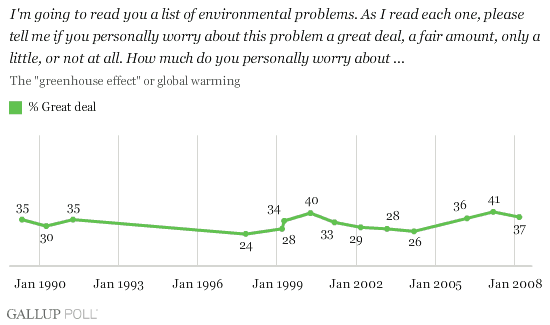
How does this compare historically? Well for some reason Gallup is making us do a bit of digging to compare apples to apples but we have done so. Perhaps in the future they will simply post the graph below updated to reflect their polls since 2008, but I can not find it on their web site. Here is the historical record of Gallup's polling on the intensity level regarding global warming through 2008: 

As you can see since its high in 2007 of 41% can you say An Inconvenient Truth, Gallup did, the public's  intensity about global warming has dropped from 41% to 37% to 33% to 28% and is now at 25% just slightly above the historical 1997 low of 24% which occurred just prior to the pre super El Nino year of 1998.

As you can see not only are the global warming alarmist losing the war on science, they are losing the only real thing they had going for them, they are losing the ability to scare the public.

March 27, 2011

Money for Nothing

Now look at them yo-yo's, that's the way you do it
You play the guitar on the M.T.V.
That ain't working, that's the way you do it
       Dire Straits

Living in the American South for most of my life I am familiar with the loblolly pine. It is not exactly the most majestic, or for that matter all that attractive as far as trees go.You put a bunch of them together and you get...well you get pretty much something like  the picture above.

But a tree is a tree and all living things have an important place in the grand scheme of things, until they don't. The loblolly pine has become an important crop in the South and therefore it is important not only as an ecological but also a economic entity to the region.

Recently the USDA awarded $60 million  to research the affects of climate change on crops and forests.
The three studies take a new approach to crop and climate research by bringing together researchers from a wide variety of fields and encouraging them to find solutions appropriate to specific geographic areas. One study will focus on Midwestern corn, another on wheat in the Northwest and a third on Southern pine forests.
As the article points out the lowly loblolly is important for many reasons to the believers in global warming.

Tim Martin, a professor of tree physiology at the University of Florida and the head of the forestry project, said it will focus on the loblolly pine, which covers 80 percent of the planted forest land in the southeastern U.S. Southern pine forests produce more wood products than any others in the country, and they pull a huge amount of carbon dioxide out of the atmosphere, making them important to the economy and environment, he said.


“Southern forests contain a third of all the sequestered carbon — stored carbon — in all the lower 48 states,” Martin said. “And every year, Southern forests store enough additional carbon to offset about 13 percent of the greenhouse gas emissions in the region. So just by virtue of growing, forests take CO2 out of the atmosphere and store it in the wood and in the soil.”

Martin’s team will aim to maximize the amount of carbon stored in those forests and in wood products, such as 2-by-4-inch boards used to build houses.
As a carpenter I often consider the CO2 content in my lumber as I build, I assume soon Home Depot will be required to label CO2 content on their lumber so as to take advantage of some government subsidy.

To give you an idea of where the mighty loblolly resides below is a map of its primary habitat.


 As you can see it is almost exclusively found in the South Eastern United States, with a slight incursion into Texas. That incursion must be why some of the Federal dough was handed out to some Aggies at Texas A&M or it may simply be that they are well qualified  researchers on the subject. Regardless, $20 million is being doled out to study the dire affects of climate change on the poor loblolly, why? Well as one of the recipients of this grant points out,:

Gan’s work will focus on assessing the risk and economic consequences of climate-induced disturbances such as wildfire and southern pine beetle outbreaks under global climate change.
“These are specifically very sensitive to climate change, especially with the temperature going up in the South,” Gan said. “I’ve done economic analysis research in the past several years on the southern pine beetle. I will try to expand that working area on adaptation and hope these results will go into help alleviate some of these impacts. This research will also look at some possible changes in management practices.”

The southern pine beetle would cause annual economic losses of $500 million to $870 million to southern U.S. timber production if predicted climate change occurs, Gan said. (emphasis mine)
Well we certainly don't want those nasty beetles getting into the loblolly crop, uh forests. And we all know how devastating forest fires can be, especially in a global warmed world, but I wondered just how bad is it for the 2x4 parentage?

So I checked with the authority for all things temperature related (US version) the NCDC of NOAA.  Checking on the Southeast United States which fortuitously seems to about match the same geographic area inhabited by loblolly, except for the Texas incursion.  I discovered this: 


Annual Temperature
Southeast Region


Annual 1901 - 2000 Average = 62.90 degF
Annual 1895 - 2010 Trend = -0.01 degF / Decade

At a glance I immediately realized that the Federal Government seems to be between 50 and 100 years late on the study, maybe they have been saving up their money to pay for it. It seems to me that it would have been more appropriate to investigate the affects of warming on the loblolly back between the Roaring Twenties and the end of World War 2 than now. The hottest year in the Southeastern US was 1922, you know back when SUV's were all the rage.

Like so much of the climate change meme, funding for projects is based upon a belief or a narrative rather than the reality. Models show that at some point in the future the South East United States will be warmer, so let's throw 20 million to study a non existent problem and act as if it is real. As we know this practice is not new to the climate alarmist forecasters. In 1988 James Hanson made a prediction about the loblolly habitat.
The model results suggest some near-term regional climate variations, despite the fixed ocean heat transport which suppresses many possible regional climate fluctuations; for example, during the late 1980s and in the 1990s there is a tendency for greater than average warming in the southeastern and central United States and relatively cooler conditions or less than average warming in the western United States and much of Europe.
His forecasting, though not all that accurate, didn't hurt his career path or his agencies funding.

In climate science it is not about accuracy, it is about having the magical mystery tour models to foretell the future. A future which will insure funding for research into a never ending crop of potential disasters and ill affects.

Academia has latched onto the climate change band wagon and is riding the taxpayer funded unicorn of make believe for all it is worth, The fact that it has not warmed in the southeastern  United States is not even a speed bump for the institutions, the researchers or their pimps in the Federal Agencies. The squandering of taxpayer's money to study the affects of a climate that has not changed on a tree that is not in danger does not even prick their conscious so pervasive is the delusion that they know what is happening and what is best.

It truly is money for nothing what a gig if you can get it.

March 26, 2011

Missing from the models

Here is yet another piece of that ever expanding puzzle which is the Earth's ecosystem which has not been included in the climate models. I don't know if anyone has kept track of all the components in nature that have not been included in the modern climate models upon which so many policy decisions are being made, but someone ought to.

One would think that the modelers themselves would do so and adjust their models to allow for new scientific discoveries. I do not know that they do not do this but it would seem that if they did we should see press releases from the appropriate institutions explaining how new evidence has altered previous output. They seem more than willing to tweak their models in order to explain why previously unexplained events are taking place, but I never hear that when a new negative feedback is discovered that the models have been adjusted to compensate. Based upon my observation of the science behind climate science it seems as if they only recognize those findings that confirm their theory not those that would in anyway diminish the theory.

FROM-KOLD 13

Icebergs may increase ocean carbon uptake


The following is a news release from the National Science Foundation.

In a finding that has global implications for climate research, scientists have discovered that when icebergs cool and dilute the seas through which they pass for days, they also raise chlorophyll levels in the water that may in turn increase carbon dioxide absorption in the Southern Ocean.

An interdisciplinary research team supported by the National Science Foundation (NSF) highlighted the research this month in the journal Nature Geosciences.

The research indicates that "iceberg transport and melting have a role in the distribution of phytoplankton in the Weddell Sea," which was previously unsuspected, said John J. Helly, director of the Laboratory for Environmental and Earth Sciences with the San Diego Supercomputer Center at the University of California, San Diego and Scripps Institution of Oceanography.

Helly was the lead author of the paper, "Cooling, Dilution and Mixing of Ocean Water by Free-drifting Icebergs in the Weddell Sea," which was first published in the journal Deep-Sea Research Part II.

The results indicate that icebergs are especially likely to influence phytoplankton dynamics in an area known as "Iceberg Alley," east of the Antarctic Peninsula, the portion of the continent that extends northwards toward Chile.

The latest findings add a new dimension to previous research by the same team that altered the perception of icebergs as large, familiar, but passive, elements of the Antarctic seascape. The team previously showed that icebergs act, in effect, as ocean "oases" of nutrients for aquatic life and sea birds.

The teams's research indicates that ordinary icebergs are likely to become more prevalent in the Southern Ocean, particularly as the Antarctic Peninsula continues a well-documented warming trend and ice shelves disintegrate. Research also shows that these ordinary icebergs are important features of not only marine ecosystems, but even of global carbon cycling.

"These new findings amplify the team's previous discoveries about icebergs and confirm that icebergs contribute yet another, previously unsuspected, dimension of physical and biological complexity to polar ecosystems," said Roberta L. Marinelli, director of the NSF's Antarctic Organisms and Ecosystems Program.

NSF manages the U.S. Antarctic Program, through which it coordinates all U.S. scientific research and related logistics on the southernmost continent and aboard ships in the Southern Ocean.

The latest findings document a persistent change in physical and biological characteristics of surface waters after the transit of an iceberg, which has important effects on phytoplankton populations, clearly demonstrating "that icebergs influence oceanic surface waters and mixing to greater extents than previously realized," said Ronald S. Kaufmann, associate professor of marine science and environmental studies at the University of San Diego and one of the authors of the paper.

The researchers studied the effects by sampling the area around a large iceberg more than 32 kilometers (20 miles) long; the same area was surveyed again ten days later, after the iceberg had drifted away.

After ten days, the scientists observed increased concentrations of chlorophyll a and reduced concentrations of carbon dioxide, as compared to nearby areas without icebergs. These results are consistent with the growth of phytoplankton and the removal of carbon dioxide from the ocean.

The new results demonstrate that icebergs provide a connection between the geophysical and biological domains that directly affects the carbon cycle in the Southern Ocean, Marinelli added.

In 2007, the same team published findings in the journal Science that icebergs serve as "hotspots" for ocean life with thriving communities of seabirds above and a web of phytoplankton, krill and fish below. At that time, the researchers reported that icebergs hold trapped terrestrial material, which they release far out at sea as they melt, a process that produces a "halo effect" with significantly increased nutrients and krill out to a radius of more than three kilometers (two miles).

The new research was conducted as part of a multi-disciplinary project that also involved scientists from the Monterey Bay Aquarium Research Institute, University of South Carolina, University of Nevada, Reno, University of South Carolina, Brigham Young University, and the Bigelow Laboratory for Ocean Sciences.

Scripps Institution of Oceanography research biologist Maria Vernet and graduate student Gordon Stephenson also contributed to the paper.

Note how little emphasis is put on the fact that this will alter previous assumptions on the global climate cycle which is no small matter....one would think.

"If a model has not been proven to fully reflect reality, then it has very limited use and should be treated with the same degree of consideration that one might give a horoscope "

 John Droz, Jr.

March 25, 2011

POWER TO THE PEOPLE


Letters to the Editor and other People Speak

FROM-Payson Roundup


Cycles of global warming, cooling are common

Editor:

As with fantasy energy sources, Mr. Welge’s engineering foundation precludes common ground with Mr. Estess’ Anthropomorphic (human-caused) Global Warming (AGW) pretenses. Cycles of global warming and cooling are common in human and geological history, are due solely to activity of the sun; and, contrary to the Orwellian doomsday claims, the warming periods have always been a tremendous benefit to all life on the planet. The entire global warming hoax totally imploded. Every one of those claims by Mr. Estess was unequivocally proven to be totally false by: (1) winters of the last two years being the most severe, globally, of the last several decades — of any on record, in some areas; (2) release of Professor Phil Jones’ (the world’s chief global warming falsifist and head of the Climatic Research Unit at the University of East Anglia) e-mails which prove the primary “research” institutions were cherry-picking, stacking, and outright falsifying “data” to “prove” the AGW tripe their bosses demanded.

They even went so far as to “lose” 20 of the world’s weather stations which were located in areas reporting weather data directly contradicting the global warming myth. The data manipulation and falsification was so blatant that the primary proponents of this deceit destroyed their databases to avoid external evaluations that would have illustrated the extent of this outright fraud.

Those with the money make the rules, and $50 billion has been invested in creating and promoting this AGW sham. Universities receiving government contracts to “prove” AGW eagerly sacrificed their scientific integrity to replicate the manipulations of “data” necessary to keep the funding coming.

The major media (propaganda center servants of the same government masters) gleefully reported all this garbage as fact, participated in the vilification of those who dared to contradict the AGW theme, and aided the myth of the 200 or 300 AGW-promoting “scientists” as a consensus, while ignoring the 31,000 scientists documented as opposing the AGW alarmism. Even Al Gore’s favorite Michael Mann-produced “hockey-stick” temperature graph was proven to be a fraud. Leaked secret diplomatic cables show that the U.S. government used

espionage, bribery and extortion to pressure foreign governments to support the U.S. position on climate change.

Finally, actual weather data for Payson and Young, for the last decade show no warming trend whatsoever.

Terry Putnam

Young

March 24, 2011

A matter of tense


 This is a typical CYBER WAG (computer generated Wild Ass Guess) article, but it is also a good illustration of another common misrepresentation by the media, which of course is never corrected by the science community. It is a simple matter of tense  note the headline from UPI.

Study: Climate change impacts Joshua trees


In reading the headline you would assume that this is an article about how "climate change" is impacting Joshua Trees....right? ....you would be wrong. Nothing in this article has anything to do with what is happening in the present tense, it all has to do with the future and the past. (emphasis mine)

WASHINGTON, March 24 (UPI) -- Climate change in the U.S. Southwest likely will eliminate Joshua trees from 90 percent of their current range in 60 to 90 years, a U.S. ecologist says.

Ken Cole of the U.S. Geological Survey and colleagues used models of future climate, an analysis of the climatic tolerances of the species in its current range, and the fossil record to project the future distribution of Joshua trees, a USGS release said Thursday.
As we can see, nothing is currently affecting the poor Joshua trees outside of the Cyber space of some well funded modeler's computer. As often happens in the make believe world of climate science, very little actually happens in the here and now to validate their hypothesis, it is mostly computer generated, and I might add grant generated, studies of future doom.

I would expect, as often happens, that this study will be used to generate further funding for yet another study to determine the future affect on some critter whose future habitat will be Joshua treeless in a computer generated world. The ripple affect of the loss of the Joshua tree could go on for years and millions of tax payer dollars will be fed into even more academic studies. All of this based on what computer models have shown the climate will be beyond the lifespan of those collecting the funds for both the models and the studies they generate.

 The article is short so let's carry on:

The Joshua tree, a giant North American yucca, occupies desert grasslands and shrub lands of the Mojave Desert of California, Nevada, Arizona and Utah.

Joshua Tree National Park in California is named after the iconic species.

Cole and his team were able to reconstruct how Joshua trees responded to a sudden climate warming 12,000 year ago that was similar to projected warming in this century.

The study concluded the ability of Joshua trees to spread into suitable habitat following that prehistoric warming was limited by the extinction of large animals that had previously dispersed its seeds over large geographic areas, particularly the Shasta ground sloth.

Today, the researchers said, Joshua tree seeds are dispersed by seed-caching rodents, such as squirrels and pack rats, which cannot disperse seeds as far as large mammals.

The limited ability of rodents to disperse Joshua tree seeds in combination with other factors would likely slow migration of the trees to only about 6 feet per year, not enough to keep pace with the present warming climate, Cole said.


So 12000 years ago we had temperatures similar to those projected to be in 90 years or so. Which of course means it was warmer then than today, the climate scientist really do need to define what they mean when they say unprecedented. After all the million or more people who roamed the Earth writing on cave walls might have considered themselves a part of the human record,

This article is just another example of how the science community and the media muddle future projections in order to hype potential consequences to create a narrative, not science. The narrative creates anxiety about something which has not happened and probably never will but with a constant cascade of such studies and stories the public is manipulated into believing that science has actually proved something, which in fact they have not. All that they have created is fear.

Of course it all starts in the beginning by just distorting  time, subliminally conditioning the reader to believe something is actually happening when in fact it is not. Lest we forget no Joshua trees are actually being lost to climate change. But Journalism like Climate Science is no longer about facts and truth, it is about ideology and manipulation and just a matter of tense.

Painful Lessons for Wind Power


FROM-Human Events

by Brian Sussman

Wind energy took another blow—this time in Massachusetts.

Wind One is the 400-foot-tall wind turbine owned by the town of Falmouth, on the southwestern tip of Cape Cod. The residents of Falmouth initially welcomed Wind One as a symbol of green energy and a handy way to keep local taxes down. Electricity generated by the turbine would be used to power the municipality’s infrastructure, thus shaving about $400,000 a year off its utility costs.

Installed in the spring of 2010 at a cost of $5.1 million (with some $3 million derived through grants, government kickbacks, and credits), the huge turbine cranks out 1.65 megawatts of electricity during optimum conditions.

The topography of Falmouth is stunningly beautiful. Small ponds, creeks, pines, and oaks rest adjacent to the rocky beachfront. What’s totally out of place is a monstrous pillar of white steel rising from the countryside, topped with its whirling three-bladed rotor. However, proving that beauty is in the eye of the beholder, one local told a Public Radio reporter the turbine is “quite majestic.”

But as soon as her majesty was switched on, residents began to complain—Wind One was as loud as an old Soviet helicopter.

Neil Anderson lives a quarter of a mile from the turbine. He’s an avid supporter of alternative energy, having owned and operated a passive solar company on Cape Cod for the past 25 years. “It is dangerous,” he told WGBH in Boston. “Headaches. Loss of sleep. And the ringing in my ears never goes away. I could look at it all day, and it does not bother me … but it’s way too close.”

Tired of the constant chopping sound, pained residents decided to lawyer up. This month a deal was struck with the town to disengage the turbine when winds exceed 23 miles an hour. This is problematic because giant windmills such as Wind One operate at optimum efficiency at about 30 miles an hour.

So now Falmouth’s investment has taken a hit. According to Gerald Potamis, who runs the wastewater facility, shutting off the turbine during higher winds will cost the town $173,000 in annual revenue, because now they’ll have to rely more on natural gas.

Truth is, wind turbines have always suffered from the NIMBY—not in my backyard—syndrome. Look no further than the largest concentration of wind turbines in the world, constructed in the 1970s just east of the San Francisco Bay. Some 4,500 windmills are ensconced atop 50,000 acres of grassy hills, generating a modest 576 megawatts of power. Officially known as the Altamont Pass Wind Resource Area, one would suppose the wind farm is an icon of greenness. But instead, Altamont Pass is the poster girl of eco-infighting.

Ever since the multitude of windmills was installed, a significant increase in the numbers of dead birds has been reported. Activists immediately went ballistic, demanding action. Over the decades, lawsuits have been filed and millions of dollars spent procuring studies to track the bird body count in an effort to determine how to address the problem.

In 2008, a two-year, taxpayer-funded examination of the problem was conducted by the Altamont Pass Avian Monitoring Team. During the study period, the monitoring team determined that 8,247 birds were wacked dead by the turbine blades.

In 2010, a settlement was finally reached between the Audubon Society, Californians for Renewable Energy, and the company running the wind farm, NextEra Energy. Nearly half of the smaller turbines will now be replaced by newer, more bird-friendly models. The project is expected to be complete by 2015 and includes $2.5 million for raptor habitat restoration, all of which is expected to increase the price of energy being supplied to the grid by this portrait of green power.

Painful to the ears, and especially painful to the birds, the painful lesson environmentalists need to learn is that the answer to America’s growing energy needs is not blowing in the wind.

POWER TO THE PEOPLE


Letters to the Editor and other People Speak

FROM-Gloucester County Times

Climate-change crowd won't give up


To the Editor:

The March 21 editorial in the Times, from its sister paper, the Star-Ledger of Newark (“Stop muzzling EPA’s Jackson”) pretty much accuses anyone who doesn’t buy into the theory of man-made global warming — now called “climate change” — as being anti-science, anti-environment and backwards.

The editorial mirrors the attitude of the pro-global warming crowd that routinely ignores anything contradicts their agenda. (The editorial criticized Republicans in Congress who seek to prevent Environmental Protection Agency Administrator Lisa Jackson from regulating carbon emissions.)

Evidence that could show that change in climate is a natural occurrence and not man-made has been brought forth by many reputable scientists. Space doesn’t permit me to go into detail, but the information is out there for anyone who wishes to research it.

There have been many instances where the data used to back global warming has been shown to be wrong. However, the activists have refused to address the challenges to flawed data or even debate their critics, preferring to resort to name-calling and making false accusations instead. That is not the behavior of true scientists, but rather that of individuals with ulterior motives — pushing an agenda.

If one looks closely at the people behind the global warming agenda, one finds individuals and companies that stand to profit handsomely from some type of cap-and-trade or similar taxation program. General Electric, which receives government subsidies under President Barack Obama, is one such company. Al Gore, self-appointed “climate expert,” is another.

People who support man-made global warming include those who have spoken in favor of population control, and they view climate change as a means to promote this cause. The fewer people in the world, the less carbon dioxide. Ironically, the politicians, celebrities and wealthy philanthropists who have been the most vocal about the need to reduce one’s “carbon footprint,” are the very ones who lead the most extravagant lifestyles and use the most energy. That, in and of itself, speaks volumes as to their true motives.


Leda Muth
Pitman

Burqa-global warming link under investigation

From the We report you decide File. No we do not  make this stuff up.

Burqa-global warming link under investigation
FROM-Construction Week Online

The role of burqas and saris on thermal comfort is the subject of a new research undertaking by the American Society of Refrigerating and Air-Conditioning Engineers (ASHRAE).

Comprehensive data exists on western clothing insulation values, but little research exists on non-western. Having information on attire like saris and burqas could influence the design of ventilation and air-con systems to provide the best thermal comfort for occupants.

“Given the growing energy needs of large nations such as India, China and Pakistan, all of which often have different clothing styles from western nations, knowing more about the impact of clothing on comfort is essential to improving ventilation and air-con systems for these countries,” said John Stoops.

It is well-known that increased cooling loads due to low setpoint temperatures in the UAE, in particular, places more strain on the electricity infrastructure, which contributes directly to global warming by producing more carbon emissions.

Stoops is head of the project monitoring subcommittee for Technical Committee 2.1, Physiology & Human Environment, which is overseeing the project.

“The project also will look at how different fabrics and body postures and movements impact the insulation value of cloth. We expect to find that the results of non-western wear on thermal comfort will be different than that of western wear due to looser fit, long gowns and lighter materials that promote movement of air,” said Stoops.

1504-TRP, “Extension of the Clothing Insulation Database for Standard 55 and ISO 7730 to Provide Data for Non-Western Clothing Ensembles, Including Data on the Effect of Posture and Air Movement on that Insulation,” is one of 17 projects currently out for bid by ASHRAE. The deadline to submit proposals for all projects is 16 May.

Results of 1504 would be of fundamental importance to both ASHRAE and the International Organisation of Standardization (ISO) standards, building and building system designers and vehicle designers around the world.

Specifically, it could expand the scope and reach of ASHRAE Standard 55, Thermal Environmental Conditions for Human Occupancy, to a worldwide audience.

Energy Fantasyland

FROM-RCP

By Victor Davis Hanson

Gas is well over $4 a gallon in most places in California -- and soaring elsewhere as well. But are such high energy prices good or bad?

That should be a stupid question. Yet it is not when the Obama administration has stopped new domestic offshore oil exploration in many American waters, curbed oil leases in the West, and keeps oil-rich areas of Alaska exempt from drilling. Last week, President Obama went to Brazil and declared of that country's new offshore finds: "With the new oil finds off Brazil, President (Dilma) Rousseff has said that Brazil wants to be a major supplier of new stable sources of energy, and I've told her that the United States wants to be a major customer, which would be a win-win for both our countries."

Consider the logic of the president's Orwellian declaration: The United States in the last two years has restricted oil exploration of the sort Brazil is now rushing to embrace. We have run up more than $4 trillion in consecutive budget deficits during the Obama administration and are near federal insolvency. Therefore, the United States should be happy to borrow more money to purchase the sort of "new stable sources of energy" from Brazil's offshore wells that we most certainly will not develop off our own coasts.

It seems as if paying lots more for electricity and gas, in European fashion, was originally part of the president's new green agenda. He helped push cap-and-trade legislation through the House of Representatives in 2009. Had such Byzantine regulations become law, a recessionary economy would have sunk into depression. Obama appointed the incompetent Van Jones as "green jobs czar" -- until Jones' wild rantings confirmed that he knew nothing about his job description "to advance the administration's climate and energy initiatives."

At a time of trillion-dollar deficits, the administration is borrowing billions to promote high-speed rail, and is heavily invested in the federally subsidized $42,000 Government Motors Chevy Volt. Apparently the common denominator here is a deductive view that high energy prices will force Americans to emulate European centrally planned and state-run transportation.

That conclusion is not wild conspiracy theory, but simply the logical manifestation of many of the Obama administration's earlier campaign promises. Secretary of Energy Steven Chu -- now responsible for the formulation of American energy policy -- summed up his visions to the Wall Street Journal in 2008: "Somehow we have to figure out how to boost the price of gasoline to the levels in Europe." I think Chu is finally figuring out the "somehow."

A year earlier, Chu was more explicit in his general contempt for the sort of fuels that now keep Americans warm and on the road: "Coal is my worst nightmare. ... We have lots of fossil fuel. That's really both good and bad news. We won't run out of energy but there's enough carbon in the ground to really cook us."

In fairness to Chu, he was only amplifying what Obama himself outlined during the 2008 campaign. Today's soaring energy prices are exactly what candidate Obama once dreamed about: "Under my plan of a cap-and-trade system, electricity rates would necessarily skyrocket." Obama, like Chu, made that dream even more explicit in the case of coal "So, if somebody wants to build a coal plant, they can -- it's just that it will bankrupt them, because they are going to be charged a huge sum for all that greenhouse gas that's being emitted."

There are lots of ironies to these Alice-in-Wonderland energy fantasies. As the public become outraged over gas prices, a panicked Obama pivots to brag that we are pumping more oil than ever before -- but only for a time, and only because his predecessors approved the type of drilling he has stopped.

The entire climate-change movement, fairly or not, is now in shambles, thanks to serial scandals about faked research, consecutive record cold and wet winters in much of Europe and the United States, and the conflict-of-interest, get-rich schemes of prominent global-warming preachers such as Al Gore.

The administration's energy visions are formulated by academics and government bureaucrats who live mostly in cities with short commutes and have worked largely for public agencies. These utopians have no idea that without reasonably priced fuel and power, the self-employed farmer cannot produce food. The private plant operator cannot create plastics. And the trucker cannot bring goods to the consumer -- all the basics like lettuce, iPads and Levis that a highly educated, urbanized elite both enjoys and yet has no idea of how a distant someone else made their unbridled consumption possible

March 23, 2011

Turns out invasive noxious weed won't save the world

FROM-IRIN

CLIMATE CHANGE: Jatropha - not really green

JOHANNESBURG, 23 March 2011 (IRIN) - A new study has put the brakes on a rush by some countries and companies to establish plantations of jatropha, an oil-bearing shrub and cousin of the castor bean bush, as a source of biofuel.

The study by ActionAid, an anti-poverty NGO, the Royal Society for the Protection of Birds, and Nature Kenya, a conservation society, looked at whether biofuel made from jatropha grown in the Dakatcha woodlands in Kenya’s coastal district of Malindi, could indeed be a green fuel.

Chris Coxon of ActionAid said the oil yield of the seed from plants grown on land earmarked for jatropha cultivation in Malindi would determine whether the shrub provided a viable alternative to fossil fuel.

Previous land use was another critical factor. The study found that throughout the production and consumption process in the Dakatcha woodlands, the jatropha would emit between 2.5 and six times more greenhouse gases than fossil fuels, largely because of clearing the forest, which stores massive amounts of carbon in its vegetation and soil, to make room for the plant.

Other studies have also found that the yield from jatropha can vary considerably, because contrary to the popular perception that it can thrive in semi-arid conditions, the plants need water and nutrients to produce high yields.

So, if an investment in irrigation and fertilizer is required, why not grow food crops instead, the study argued. Much of the biofuel from the Dakatcha woodlands project, when it starts producing, is destined for Europe to meet regional targets for switching to renewable energy.

The study underlined what a joint UN Food and Agriculture Organization (FAO) and International Fund for Agricultural Development (IFAD) report on jatropha had found in 2010 - that the shrub was useful as a bio-energy crop for cultivation by small-scale farmers.

"Some communities in the dry sahel of Africa have told us they are not against jatropha, only large plantations established by foreign companies for export without their consent," said Tim Rice, ActionAid's biofuels expert.

"They proposed growing small plots of jatropha on their own agriculural land or as a 'hedge' to divide fields. Used locally, it could be used as fuel for stoves, irrigation pumps and generators."

But even then, growing jatropha could prove uneconomical if there was no investment in developing higher oil-yielding, non-toxic varieties.

The Kenyan government has suspended clearing the full 50,000 hectares of forest, which would have displaced 20,000 people for the proposed plantation in Dakatcha, pending an environmental impact assessment, the study said.

What concerns us is the growing move towards massive plantations of jatropha in developing countries,” said Coxon.

Here is a closer look at jatropha and why it has caught the imagination of so many.

How many?

In 2008, jatropha was planted on an estimated 900,000 hectares globally; 760,000 hectares (85 percent of the total) were located in Asia, followed by Africa with 120,000 hectares and Latin America with 20,000 hectares. By 2015, jatropha would be planted on a projected 12.8 million hectares, according to an FAO report.

By comparison, maize, one of the world’s major staple grain crops, is planted on more than 160 million hectares.

In another four years, Indonesia will be the largest jatropha producing country in Asia. In Africa, Ghana and Madagascar will be the biggest producers, while Brazil will be the main producer in Latin America.

Why jatropha?

Jatropha has a long history of being recognized as a substitute for fossil fuel. During the Second World War it was used as a replacement for diesel in Madagascar, Benin and Cape Verde, while its glycerine by-product was used to make nitro-glycerine, used in explosives and medicines for treating heart conditions.

FAO said jatropha had gained some ground as a source of oil for producing biodiesel because of the common perception that it could be grown in semi-arid regions with low nutrient requirements and little care.

Jatropha's extensive roots allow it to reach water deeper in the soil and extract leached mineral nutrients unavailable to many other plants. The surface roots also help bind the soil and can reduce erosion. Compared to other biofuel crops such as sugarcane, it requires less water.

It is a non-edible crop, “So the biodiesel sector does not compete with food and feed use of this crop,” said Simla Tokgoz, a researcher at the International Food Policy Research Institute (IFPRI), a US-based think-tank. Other feedstocks used in biodiesel production are rapeseed, soybean, coconut, and palm.

Jatropha is still in the early stages of development as a biofuel but is expected to be a less expensive source for biodiesel production, which could increase profitability, Tokgoz said.

Jatropha oil can be used directly in some diesel engines without being converted into biodiesel, but because it has a higher viscosity than mineral diesel, it works better in tropical environments, where temperatures are higher.

Is it a viable alternative?

Large-scale biodiesel production will need more water, and in water-stressed conditions this could lead to conflict. The FAO/IFAD report said jatropha biodiesel conformed to the required European and USA quality standards, but cautioned that "It is not a technology suited to resource-poor communities in developing countries."

Biodiesel production also requires expertise, equipment, and the ability to handle large quantities of dangerous chemicals such as toxic methanol and highly corrosive sodium hydroxide.

When comparisons are made of the return on labour input Jatropha performs poorly against other biofuel feedstocks, but much depends on the level of yields, which need to be improved, the FAO/IFAD report said.

Jatropha has a marketable non-edible by-product, but it is less valuable than canola, for example, which can be consumed by animals, said Tokgoz.

Instead of competing for agricultural land, or removing forests or displacing communities, Tokgoz suggested planting government wasteland or contract farming using small- and medium-scale farmers. But again, this would mean investment in irrigation, inputs and efforts to improve yields.

Jatropha is regarded by many as an invasive plant and has been declared a noxious weed in parts of Australia, FAO pointed out. South Africa has banned its commercial production.

March 22, 2011

Biofuel policy is causing starvation, says Nestlé boss

FROM-UK Independent

By Stephen Foley in New York


Soaring food inflation is the result of "immoral" policies in the US which divert crops for use in the production of biofuels instead of food, according to the chairman of one of the world's largest food companies.


Peter Brabeck-Letmathe, the chairman of Nestlé, lashed out at the Obama administration for promoting the use of ethanol made from corn, at the expense of hundreds of millions of people struggling to afford everyday basics made from the crop.

Mr Brabeck-Letmathe weighed in to the increasingly acrimonious debate over food price inflation to condemn politicians around the world who seem determined to blame financial speculators instead of tackling underlying imbalances in supply and demand. And he reserved especially pointed remarks for US agriculture secretary Tom Vilsack, who he said was making "absolutely flabbergasting" claims for the country's ability to cope with rising domestic and global demand for corn.

"Today, 35 per cent of US corn goes into biofuel," the Nestlé chairman told an audience at the Council on Foreign Relations (CFR) in New York yesterday. "From an environmental point of view this is a nonsense, but more so when we are running out of food in the rest of the world.

"It is absolutely immoral to push hundreds of millions of people into hunger and into extreme poverty because of such a policy, so I think – I insist – no food for fuel."

Corn prices almost doubled in the year to February, though they have fallen from their peak in the pastfew weeks. Anger at rising food prices contributed to protests across the Middle East, and rising commodities costs were among the factors pushing UK inflation to 4.4 per cent in February, according to figures out yesterday.

US exports account for about 60 per cent of the world's corn supply. Demand has surged as more people join the middle classes in emerging economies such as China and India, not just because these new consumers demand more food made from corn, but also because demand for meat has increased and livestock farmers need to buy more feed.

Nestlé, the company behind Shredded Wheat, Nescafé and Aero chocolate bars, has been lobbying European regulators and governments around the world against setting high targets for biofuel use, even though many countries see the production of ethanol as a means of meeting obligations to cut carbon fuel emissions.

The lobbying has fallen on deaf ears in the US, however. Ethanol production from corn is heavily subsidised, with output running at more than 13.5 billion gallons annually. Policies to promote its production are "absurd", Mr Brabeck-Letmathe claimed yesterday, and meeting a mooted global target of having 20 per cent of fuel demand with biofuels would involve increasing production by one third.

"What is the result? Prices are going up. It's not very complicated," he said. "This question is now the number one priority for the G20 meeting in Nice, and the main thing we are going to do is fight against speculation. We are concentrating on the irrelevant."

Speaking to farmers earlier this month, the Obama administration's agriculture secretary said he found arguments from the like of Nestlé "irritating". Mr Vilsack said: "The folks advancing this argument either do not understand or do not accept the notion that our farmers are as productive and smart and innovative and creative enough to meet the needs of food and fuel and feed and export."

Mr Brabeck-Letmathe was chief executive as well as chairman of Nestlé until splitting the roles in 2008. He is also on the board of luxury goods maker L'Oréal, the investment bank Credit Suisse and oil company ExxonMobil. Speaking at the CFR yesterday, he also advocated the idea of setting a price for water used in agriculture, as a means of more efficiently allocating scarce resources. And he suggested that alternative sources for biofuels could be algae and stems of harvested corn.

More Climate Disruption Drivel

FROM-American Thinker

By Anthony J. Sadar and Stanley J. Penkala


It certainly didn't take long for someone, a British academic this time, to couple the tragedy in Japan to the specter of future tsunamis caused by global warming. In 2004, Michael Crichton's State of Fear had the plot line of an extreme environmental group planning to trigger a tsunami using a massive underwater explosion, with the intention of blaming it on man-made climate disruption. Sadly, Japan's tsunami is now being used to stoke the dying embers of climate-change mania.

Even before nature's fury ravaged Japan, meteorological mischief was contemplated to awaken the world's interest in climate change. This effort would take the form of coordinated messages using political rhetoric in the media to blame climate change on the industrialized nations of the world.

But, after studying the climate-change science "business" for the past thirty years, many of us old-timers see the situation as clear and settled as ever: The global climate changes and humans play a negligible role in that change.

The revelations of Climategate and ten years of stagnant global temperatures have produced a decline of public belief in human-induced climate collapse. But, rather than strengthening the foundations of climate science by increasing transparency in data analysis, releasing raw data for third party evaluation, and allowing their hypotheses to be debated in the literature, government-funded scientists instead have decided it's best to just change their method of messaging. The latest tactic is for these man-made global-warming faithful to sharpen their communication skills and tighten their influence on the editorial boards of the environmental journals of record. The intent is to deflect or bury challenges to their climate-catastrophe canon, not defend their hypotheses.

Professional communicators and PR experts are assisting with the propaganda, as was evident from activity at the December 2010 American Geophysical Union meeting in San Francisco. In a special workshop, speaker after speaker advocated for a more successful war of words, rather than clarifying their application of scientific principles to the study of climate. In addition, the National Center for Atmospheric Research in Boulder, Colorado hosted a seminar last month to help their climate scientists better understand critical communication issues. The speaker was the author of The Republican War on Science. And, the theme of the January 2011 annual meeting of the American Meteorological Society was "Communicating Weather and Climate," which pushed some of the same polished-prose tactics as the AGU gathering.

But, authentic unvarnished Truth in Science doesn't need political claptrap or Shinola to convey its message. Integrity in Science requires clearly stated hypotheses, reproducible data and results, and robust statistical interpretations of that information to test each. Science doesn't condone its practitioners in "bending the data" to champion personal beliefs or causes. Calling in the PR flacks is fine when you're trying to sell something using glitz and fast talk, but we hoped that, of all things, science wouldn't be up for sale.

In the aftermath of weak decisions and unenforceable agreements at Cancun and Copenhagen, radical environmentalists with their spin doctors in tow are redoubling their efforts to sell the idea of anthropogenic emissions as the only significant agent of climate disruption. Any competing mechanisms that do not buy into that conclusion will simply be dismissed as non-science.

To help assure that outcomes from future climate summits tilt the way of "consensus opinion," a UN-type group called the InterAcademy Panel on International Issues (IAP) has stepped up efforts to hawk their brand of science. The IAP, founded in 1993 in New Delhi, is a global network of the national science academies. According to IAP's website, their primary goal is "to help member academies work together to advise citizens and public officials on the scientific aspects of critical global issues." The IAP has more than 100 members, in countries ranging from Afghanistan to Zimbabwe. IAP issues statements to the world on such topics as population growth, human reproductive cloning, science education, science and the media, bio-security, evolution, ocean acidification, and of course climate change.

Input from a variety of perspectives is valuable to science. However, for the academics of the IAP to speak as the world's authority on science limits other legitimate input. Non-member academies and societies, industry scientists and engineers, and even private consultants, all have their own valuable insights into addressing global challenges. Yet, the IAP strives to exert undue influence on international politics by advancing their version of "facts" (read: certainty of anthropogenic climate disruption) as opposed to "irrational opinion" (read: doubts about the significance of human impacts). Such hubris ultimately does not serve society, or science, well.

Nature is the ultimate teacher. Humility and a willingness to go where the data leads are fundamental virtues for an ethical scientist. Arrogance is especially dangerous in the world of science, as it can blind a researcher to the possibility that their favored hypothesis is inconsistent with reality. Unfortunately, humility seems to be an unfamiliar, even unwanted, trait among certain climate scientists. In the "science is settled" group, humility is a sign of weakness, a loss of respect among peers and popularity in the press, and can result in the financial loss of beaucoup bucks in government funding.

So it's not surprising that those who have broken ranks from the "blame humans" crowd have been atmospheric scientists and professors of a certain stature. They include, for instance, physicist Dr. Willie Soon of the Harvard-Smithsonian Center for Astrophysics, and meteorology professor Dr. Richard Lindzen of the Massachusetts Institute of Technology. These are scientists who have either retired, who do not rely on government coffers for their research, or who have just been gutsy to pursue an honest quest for knowledge.

Science is never "settled." It is a never-ending journey of investigation, with hypotheses proposed, and data gathered and analyzed to prove or disprove them. Climate investigations are particularly complex, because the scope of the test platform is literally global. The assertion by anyone or any group, even in the wake of a terrific natural disaster, that the cause of climate disruption is clearly settled, and due primarily to human action, is and should be characterized as pure political drivel.

Anthony J. Sadar is a Certified Consulting Meteorologist and primary author of Environmental Risk Communication: Principles and Practices for Industry (CRC Press/Lewis Publishers 2000). Stanley J. Penkala, Ph.D., is a chemical engineer and President of Air Science Consultants, Inc.

March 20, 2011

IPCC guru was a student when writing 'authoritative' reports

FROM-American Thinker

Thomas Lifson

 The Intergovernmental Panel on Climate Change, whose reports have motivated governmental action to cut carbon emissions, relied on an uncredentialed student named Sari Kovats for writing and supervising its supposedly authoritative reports.  Donna Laframboise of NOconsensus.org brings us the shocking news.
In 1994, Kovats was one of only 21 people in the entire world selected to work on the first IPCC chapter that examined how climate change might affect human health. She was 25 years old. Her first academic paper wouldn't be published for another three years. It would be six years before she'd even begin her doctoral studies and 16 years before she'd graduate.

IPCC chairman Rajendra Pachauri says this about how IPCC authors are selected:
There is a very careful process of selection...These are people  who have been chosen on the basis of their track record, on their record of publications, on the research that they have done...They are people who are at the top of their profession as far as research is concerned in a particular aspect of climate change...you can't think of a better set of qualified people than what we have in the IPCC.  [bold added]


Academically speaking, Kovats was invisible back in 1994. That anyone connected to the IPCC could have considered her a scientific expert is astonishing.


I'm sorry to say that that was just the beginning. When it came time to write the next version of the climate bible, Kovats received a promotion. She was selected to be a lead author, again for the health chapter - despite the fact that her doctoral studies wouldn't begin until the year the IPCC report was published.


What do we suppose happened with the next edition of the climate bible - the one that appeared in 2007, still three full years before Kovats earned her doctorate? Was she selected once again to be a health chapter lead author? You betcha.


But by then the IPCC, in its wisdom, had decided she was a scientific expert in other areas, as well. Kovats served as a contributing author for three additional chapters in Working Group 2: 


  • Chapter 1 - Assessment of Observed Changes and Responses in Natural and Managed Systems
  • Chapter 6 - Coastal Systems and Low-lying Areas
  • Chapter 12 - Europe
She was also an IPCC expert reviewer.


So how does a neophyte suddenly beome the "top of [her] profession"? The great Andrew Bolt, of the Courier Mail/Herald Sun in Australia has a good answer:
Maybe she just has the right opinions.

March 19, 2011

CYBER WAG Eating Maple Bars!


It has come to this! When CYBER WAG (computer generated Wild Ass Guess) went after the Polar Bears, or Tweety Bird, or even when CYBER WAG brought out the stochastic weather generator to kill crops in California I held out hope that these modelers of mayhem could be stopped.

Perhaps I have naively assumed reasonable scientist would step forward and unplug these....these...these fantasy world demons of darkness and destruction who lurk amongst us. These scientific panderers of flim flammery who appear to be normal  human beings, but who in fact live in a Matrix world of computer games and are hell bent on pulling the few sane amongst us into their apocalyptic world of never ending crisis and disaster. Not to be confused with the MSM.

Since childhood I have loved these simple but delicious delicacies, perhaps even more, yes indeed even more, than the salmon which the CYBER WAG is attempting to devour, but now CYBER WAG has set it's covetous eyes upon my Maple Bars.

Snuck away in the pages of a local rag newspaper we find this:

Sugar maples and climate change


Michael J. Caduto

Unlike the Ents in Tolkien’s Lord of the Rings, real trees can’t walk away from danger or fight their own battles. When climate becomes inhospitable, forests can only shift ranges over long periods of time. This isn’t a problem when natural climate change occurs slowly. At the end of the recent post-glacial period, it took 4,300 years for the ice sheet to melt back from Middletown, Conn., to St. Johnsbury -- averaging 245 feet a year. Forest communities in front of the glacier gradually migrated northward in its wake.

Starting about 9,000 years ago and stretching for the next 4,000 to 5,000 years, the average temperature in the New England area became nearly 4°F warmer than it is today, and the climate was similar to modern-day Virginia. Hemlock and white pine grew 1,300 feet higher up the mountain slopes. Evidence now shows that the engines of the industrial age are taking today’s climate forward, into the past. U.S. Climatological Network Data reveals that the mean annual temperature has increased by 3.8 degrees F since 1835, but 70 percent of this rise in temperature has occurred since 1970.
 Being the trusting soul that I am I will allow that the facts presented thus far are correct, although it is a bit disconcerting being as they are intertwined with the Ents from the fantasy world of JRR Tolkien. Perhaps that is appropriate both from  the fantasy aspect and that Lord Of The Rings was a metaphor for the struggle against oppressive centralized statism.

Please do remember however that according to this article temperatures in New England have already increased 3.8 degrees F since 1835, but also according to this article that  temperatures were 4 degrees F warmer than today, just 4 to 5 thousand years ago. This means that during the time that the Pharaoh's of Egypt were building the pyramids, Stonehenge was built, the calender was invented by the Mesopotamians, glass was invented, the first library was built, the first civilization in India was established, paper was invented, and a host of other accomplishments occurred , temperature were considerably warmer than today. If in fact the temperatures were that much warmer 4 thousand years ago, how are today's temperatures unprecedented? And more importantly how is it we did not tip the all important tipping point?


Onto the devouring of my maple bars:
Barry Rock, Professor of Natural Resources at the University of New Hampshire in Durham predicts that, based on two climate models in a New England regional climate assessment study, "Within the next 100 years, Boston could have a climate similar to either Richmond, Virginia, or Atlanta, Georgia." These computer models project that the average regional temperature will rise from between 6 degrees and 10 degrees over the next century.
 Here we see the introduction of CYBER WAG into the article "based on two climate models" in a New England regional climate assessment study." You also see how these people are constantly putting themselves in a pickle.

Let's do the math.

* In 1835 it was 3.8 deg F colder than today

* From 2000-3000 BC it was 4 deg F warmer than today.

* This means that in 1835 it was 7.8 deg F colder than when the Egyptians built the pyramids. Quite a difference isn't it? So much for the sensitivity of our eco-systems not to mention mankind to drastic climate change

Back to the maple bars, yum. In order to wipe out this delicacy, temperatures must be unprecedented in the future, they've already admitted that they are not now. So our CYBER WAG industrial Complex fires up the computer models and decides that it will be more than 4 degrees F warmer by 2100 than it is now. Why? Perhaps this may explain:

You will note that neither Richmond Virginia or Atlanta Georgia are know for their sugar maples. But you will also notice that climates far and wide are capable of nurturing the goddess of the golden nectar. From the same Cornell paper:
Climate
Average temperatures within the geographic range of sugar maple have average January temperatures from 0 to 50° F and average July temperatures from 60 to 80° F. Maximum temperatures in the summer months range from 90 to 100° F, while winter minima vary from -40 to +20° F. Annual precipitation throughout the geographical range averages 20 to 50 inches of rain, plus from 1 to 150 inches of snow. In unusually wet years in the southern reaches of this broad range total annual rain in excess of 80 inches has been recorded.
The first killing frost usually occurs between September 1 and November 10 and the last from March 20 to June 15, depending on latitude and elevation. Thus average growing seasons are from 80 to 260 days.

It is also important for the narrative that drastic change in temperatures  be swift as Dr Rock explains:

If the models prove accurate, Rock says that, "In 100 years, New England’s cooler regions will no longer promote the growth of sugar maples, which are well adapted to the region’s current climate. This climate will support species that now grow to the south and in lower elevations, especially oaks and southern pines. On average, trees can only move their range from 10 to 25 kilometers over a 100-year period, and the current rate of climate change will not allow enough time for trees to ‘migrate’ northward in a smooth transition."

Always the big "If the models prove accurate", yes indeedy that really is the question of our times isn't it?

In order for the CYBER WAG to have its way with the trees, the warming must be fast and furious. Interesting that they are not only predicting  that this heat monster will wipe out our sweet maple in the next 100 years, but that we will be left with a barren wasteland, "This [new] climate will support species that now grow to the south and in lower elevations, especially oaks and southern pines.... But "... the current rate of climate change will not allow enough time for trees to ‘migrate’ northward in a smooth transition."

It's a CBER WAG twofer! A double apocalypse with one fell swoop, or more accurately a well placed entry on the keyboard. I guess this also means we will be growing oranges in Nashville soon?


Now it's time for the caveats. You know where the scientist and their lackeys in the media scare the bejezzuz out of everyone then say "well we did say this was just a possibility, I don't know why people take us so seriously"


Ultimately, under this scenario, the optimal range for sugar maples in New England could retreat up the high mountain slopes and to northern Maine. (Sugar maple’s current range extends as far south as Virginia and Tennessee, though only in the higher mountains.) Of the five computer models created by the U.S. Forest Service to predict the geographic shift in the ranges of forest species, only one foretells that global warming will cause sugar maples to disappear completely from parts of New England. Even if the climate warms considerably, our forests will still support the growth of some sugar maples, especially in higher terrains.

Although the range of sugar maples changes slowly, the flow of sap in a sugarbush is dynamic and depends on fine temperature variations that occur daily throughout late winter and early spring. Sap flows best when nighttime temperatures drop into the mid-20s and when daytime highs reach around 38-40 degrees.

From here the effects of climate change are harder to predict. If the daily cycling between freeze and thaw occurs less frequently, sugaring will suffer, as it will if the season is shortened by several weeks. But if sugaring as we now know it is simply shifted earlier into the year, the effect could be less pronounced. Making predictions about sugaring season has always been an uncertain but popular pastime, even before the dawn of climate change.
Ah yes the scenario gambit. Take the worst possible scenario, based upon computer projections whose output was derived from input entered by people who make a living by keeping everyone else on edge over the destruction of the planet. Then going to journalist 
who make their living  by keeping everyone else on edge over the destruction of the planet, or any other crisis for that matter. This sounds like a perfectly common sense way for science and the dissemination of science to be conducted, don't you think?

But they can not quite let it go. They know they must conclude with the dire threats they have unleashed upon humanity. So that there may be no doubt that temperatures returning to where they were at the cradle of human civilization is a bad thing.
The maple sugar industry can compensate somewhat for the uncertainties of the shifting climate. According to Dr. Timothy Perkins, director of the University of Vermont’s Proctor Maple Research Center, "The best equipment in the sugar house isn’t going to make you any more money. It’s how you manage the sugarbush that counts."

Producers need to tap their trees earlier, before the sap starts to flow, so they can gather the best quality sap of the season. Old tubing must be replaced with new, which is made of superior material and is more efficient. Getting rid of leaks in the system will help, as well as using a vacuum system for collecting sap. Collectively, these steps can help mitigate the problem.

No matter what steps are taken, the wheels have been set in motion. The question is: How far down the road will sugar maples have to travel before we put the brakes on climate change?

To view maps that predict shifts in the ranges of trees that will be brought on by global warming, visit www.fs.fed.us/ne/delaware/atlas/index.html.

Yes how far must the sugar maples travel?

Do you find it strange, or is it just me, that so called moderate scientist, you know those that are not "deniers" or "alarmist" do not see all the inconsistencies and hypocrisies in the scientific community when it comes to climate science? Here is one of literally hundreds of stories done to warn of the dire consequences of global warming which within the story itself states unequivocally that the very foundation of man made global warming "it is unprecedented!" states that it is not unprecedented at all.

It is not as if Mr Caduto made this all up out of thin air, he quotes scientist who one must assume have read the article in which they are quoted. If they thought that anything was inaccurate one would assume they would have corrected it or asked for a correction.

Do you see a mad rush to the cameras by these so called "moderate" scientist to correct or clarify the glaring inconsistencies constantly being foisted upon the general public? Does it not concern these scientist that if the very foundations on which the science of global warming is built is being shown to be a sham that the entire enterprise is probably a sham as well? Do they not care? Or as was written when temperatures were about 4 degrees F warmer than they are now.

"When I saw in the plunder a beautiful robe from Babylonia, two hundred shekels of silver and a wedge of gold weighing fifty shekels, I coveted them and took them. They are hidden in the ground inside my tent, with the silver underneath."

You can keep your shekels, just quit messing with my maple bars