Pages

Showing posts with label animals. Show all posts

April 19, 2011

More Boiling Fish


Recently we had the problem with poached salmon in Canada and now we have more fish frying going on "Down Under"

I first came across the tragedy in this article from News Mail

Global warming affecting fish

After reading the article which you are more than welcome to read, it is not very long, I was somewhat perplexed since there were a couple of statements which raised some questions in my skeptical mind about the study.

First an excerpt to show that obviously the fish are in dire straits:
The findings of a study published in Nature Climate Change indicate negative effects on the growth of a long-lived south-east Australian and New Zealand inshore species, banded morwong. (Cheilodactylus spectabilis).

The bony structures fish use for orientation and detection of movement – called otoliths – have annual growth rings which were measured for changes.
But after reading the article I was reminded that as usual, things are not quite as dire or clear cut as originally portrayed:
“We are looking at whether climate change is beginning to push fish past their physiological limits.  
“By examining growth across a range that species inhabit, we found evidence of both slowing growth and increased physiological stress as higher temperatures impose a higher metabolic cost on fish at the warm edge of the range."
This seemed a bit contradictory to me. Either they are beginning to study if there is an effect, or they have evidence that there is an effect on the fish. The most likely explanation is that they have some preliminary results and wanting to be the "first" to find a connection between global warming and fish they released a study without, as yet, definitive proof. This was one of the reasons I wanted to look and see if I could find out more, The other reason was this:
  This rapid warming, in southern hemisphere oceans, is due to globally increasing sea-surface temperatures and local effects caused by southward extension of the East Australian Current.
This really caught my attention. I wondered just how much of this ocean warming was attributed to "global warming" and how much was due to local effects, or if they even tried to quantify it.

So I went on a Google journey hoping I could find the actual study. As yet I have not found it but I did find some interesting takes on the study. Here we have basically the same story but a more ominous headline:

Ocean Warming Detrimental to Inshore Fish Species

So we go from global warming affecting the banded morwong to it being detrimental. We find that the "detrimental" affect is based on :
“Preliminary field and laboratory studies suggested that this decline in growth may be related to temperature induced physiological stress, resulting in increased oxygen consumption and reduced ability to sustain swimming activity,” 
So as I suspected these stories and their headlines are based solely on Preliminary field and laboratory studies " so nothing has really been proven has it? In fact we still do not know if the poor fish ares suffering from man made boiling oceans or "local effects"

As we all know on slimmer threads than this can whole species be decimated by our objective scientific community and their media parasites. Think they are at the least jumping the gun? How about this:

Warmer waters fatal for some fish


Wow we went from detrimental to fatal! At least this article is based on a more complete interview with one of the scientist. But consider this exchange between the environmental reporter and the same objective scientist who also said Preliminary field and laboratory studies suggested that this decline in growth may be related to temperature induced physiological stress....


Please note the lack of actual fatalities in the exchange below as well as obvious pre-determination in  the scientists answers.
SARAH CLARKE: At first it looked promising, even positive. As temperatures rose, so too did the size of the fish 
But when it got too hot, scientists found the news wasn't so good. 
Growth performance began to suffer, the fish became stressed, they needed more oxygen, they couldn't swim as fast and climate change was beginning to push them past their physiological limits. 
Here's Ron Thresher from the CSIRO again 
RON THRESHER: And what it's telling us is that climate change has now reached a point where, as things continue to warm up, we're passing the point where warm water is good for fish. Now warm water is becoming hot water and it's becoming bad for the fish and this is the first real indication, certainly in our part of the world, that climate change is having an adverse impact on the physiology and probable reproduction and everything else of these fish. 
SARAH CLARKE: And your concern is obviously that this may eventually lead to death? 
RON THRESHER: Well, if you warm things up too much, if you put a gold fish in a pot on top of your stove sooner or later it's going to get warm enough that the fish will die. It's a very bad sign for what this thing is going to do. 
I know, I know, people actually do take these people seriously. People actually believe that scientist like Ron Thresher represent objective unbiased scientific inquiry. As sad as this is, perhaps the saddest point to be made is that these scientist actually believe that man's minute contribution of CO2 to the atmosphere over the past sixty years has warmed the Earth's waters enough to boil fish both in the rivers of Canada and the seas off of Australia, Consider how absurd all this is, but don't miss this article on the banded morwong from Science Alert


Warming ocean killing fish

March 15, 2011

Poached Salmon, a fish story

As often happens when investigating global warming claims, you begin down one path of inquiry only to be diverted to others and then you happen upon something that just totally changes your whole outlook on the original subject matter.

Being originally from the Pacific Northwest and having a fondness for salmon I actually had it for dinner tonight, yum.  I was much intrigued when I came upon this story:

Rising temperature in Fraser River affecting Salmon population

Oh no I lamented, now the CYBER WAG (computer generated Wild Ass Guess) is coming for my salmon! But it is worse than that, it is not only that the modelers are projecting the demise of my fishy friends, they claim global warming is already in the process of killing them off.

From the Globe and Mail story:
The Fraser River is heating up because of climate change and an increasing number of salmon are dying in the warmer water from diseases or parasites or are simply dropping dead from cardiac collapse, a federal judicial inquiry has been told.

Scott Hinch, an expert witness on aquatic ecology, told the Commission of Inquiry Into the Decline of Sockeye Salmon in the Fraser River that sometimes 50 per cent of the salmon that return to the river die before they reach the spawning beds.

Dr. Hinch said because the Fraser has increased in temperature by about 2 degrees C, salmon are changing the timing of their spawning migrations, to enter rivers weeks earlier or later, in an effort to avoid warm water. And once in the river they are seeking out cold-water refuges, sometimes going up tributaries to sink to the bottoms of lakes or schooling where cold streams enter the Fraser.

Trying to research this a bit deeper I came to see that the amazing Dr. Hinch has a nice little cottage industry devoted to this theory, but that is for others to dig into, my concern is only for the salmon.

What first pricked my always active curiosity when it comes to such claims was that 2 degrees C warming of a snow pack fed river system. Where did they get this number and how did they determine it was the result of global warming. I spent literally minutes of Google searching for the source of this claim and as often happens I came face to face with pay walls and other assorted devices of academic and scientific opacity.

But after some further digging I believe I have come across the study behind the hyperbole about the Fraser River temperature increase. It seems this is the primary source  "Simulations and retrospective analyses of fraser watershed flows and temperatures"  :

ABSTRACT In order to provide better estimates of the thermal-induced stress encountered by salmon migrating to their spawning grounds, a model is used to hindcast temperatures throughout the mainstem Fraser and Thompson Rivers back to 1953. Tributary and headwater temperatures that are not available prior to 1993 are estimated with both linear regression and neural network techniques. The average root mean square difference between model temperatures and those observed at Hell’s Gate, on the lower Fraser River, is computed to be1.12°C.Historical flow and temperature observations are also used to establish patterns and trends for the Fraser River watershed. The Julian day numbers by which one-third and one-half of the integrated yearly discharge had occurred were computed and found to be progressing earlier at the rates of 0.11 and 0.09 days per year, respectively. Both values are significant at the 95% level. Average summer Hell’s Gate temperatures from 1941 to 1998 are warming at the rate of 0.012°C per year, though the relatively large standard error of 0.008°C means that this result is not significantly different from zero at the 95% level. However, when the analysis is restricted to1953 to 1998, the trend becomes 0.022°C per year and the significance level rises to 98%. An analysis of the 1953–98 atmosphere-to-river heat exchange at Kamloops and Prince George produces positive increases of 0.52 W m–2 per year and 0.90 W m–2 per year, respectively. When these trends are used to force the river temperature model, they explain approximately 35% of the 1953–98 temperature increase at Hell’s Gate. An additional 20% is explained by related increases in the headwater and tributary temperatures. Though these estimates have considerable statistical uncertainty, they nevertheless suggest that most of the river warming can be attributed to climatic effects.

Flow rates and river temperatures are also shown to exhibit significant differences in the summers following El Niño and La Niña winters. On average, during the summers following El Niño events, flows are approximately 800 m3 s–1 smaller and river temperatures are approximately 0.9°C higher on the lower Fraser River. Similar estimates are produced for the major tributaries and headwaters of the Fraser and Thompson Rivers. The implications for future salmon recruitment are briefly discussed.

Putting aside for the moment the fact that they used actual data from Hells Gate to hindcast (model) their findings. The actual findings were "1941–98 temperature observations at Hell’s Gate suggested a warming trend of 0.012°C per year", which if continued would mean a 1.2 deg C per century. Since this did not satisfy them for some reason, possibly perceived corrupted data prior to 1953 , they chose to pick the 1953-1998 data which gave them a .022 deg, C per year or a 2.2 deg C per century trend.

Far be it from me to question all this scientific work, my only concern is the salmon. But I will point out that it has only been 70 years since 1941 and 58 years since 1953. This being the case and if the actual temperature trend line is correct and has remained consistent since 1998 then as of 2011 the temperature increase of the Fraser River at Hells Gate would have risen .084 deg C or 1.276 deg C since 1953.

Since this temperature increase obviously did not meet the criteria, they felt it necessary to "force the river temperature model" by splicing in data from other locations to get the desired results. Or at least that is what it seems to me. They then fired up there always handy models to hindcast the past, which gave them a warming trend that is not actually the temperatures recorded on the river but what their models say it was, got it?


Throughout the study itself you find little caveats like this:(emphasis mine)
It should also be mentioned that several simple significance tests are carried out in the following presentation. Most of these rely on an underlying assumption of normality for the relevant statistic. Though no attempt is made to verify this assumption, we note that for samples of size greater than thirty, the distributions of many statistics (e.g., mean) are approximately normal
or
In order to estimate the tributary and headwater temperatures in years when there were no observations, two different approaches were used to quantify relationships with measured flows and weather
or
In both cases, we note that these data may be providing biased estimates of the atmosphere-to-river heat exchange because they were collected at airports rather than directly above the relevant rivers. Nevertheless, as they are the only data available, there is no way to compensate.

I guess this is why they say "these estimates have considerable statistical uncertainty". Yet it appears it is these uncertain estimates that are being used to feed a supposed salmon slaughter on the Fraser River.

And that is the important point that changes everything.

You see it really does not matter if the river heated up whether in reality or just in the mathematical gyrations of these scientist. What matters is the dieing salmon in the river. The whole point of this exercise was to show that global warming had warmed the Fraser River  (ridiculous) and this warming was killing off the salmon, remember?

"The Fraser River is heating up because of climate change and an increasing number of salmon are dying in the warmer water from diseases or parasites or are simply dropping dead from cardiac collapse..."
Well in my searching I came across a report by a Canadian Government committee done in 2004 when these same concerns were put forward . The report apropriately was titled " HERE WE GO AGAIN...OR THE 2004 FRASER RIVER SALMON FISHERY"  although they do consider the possibility that higher water temperatures in 2004 could have been a contributing factor in lower fish counts they also make this very obvious observation:
(emphasis in original)
Record-high temperatures in the Fraser River was the initial reason provided by DFO to explain the discrepancy between the number of fish that were counted on the spawning grounds and the number of fish that were reported in the River. At one point in August, water temperature was four degrees higher than normal, well above the reported optimum temperature for successful migration; however, by that time, Early Summer-runs would have already reached the spawning grounds.

The hypothesis is that, coupled with increased fishing pressure or increased harassment, and ensuing susceptibility to diseases, the unusually high temperatures in the Fraser River caused the fish to run out of energy resources before they could reach the spawning grounds. However, numerous witnesses told the Committee that they had serious reservations about this explanation because there was no evidence of a massive fish kill.
In other words where are the dead fish? Not only should the fish have been to their spawning grounds well before they were poached by the late summer heat, they did not die in the river.  They asked an expert for his input which you can read in the study, but here is a pertinent paragraph (emphasis mine)

Dr. Farrell emphasized that different sockeye salmon stocks faced different temperatures during their migration, and that there were differences in terms of temperature tolerance, disease susceptibility, and exercise performance for different stocks. It is therefore possible that while temperatures in early July were significantly lower than in late July or August, Early Stuart salmon still experienced temperatures that were near the all-time highs for this timing group and therefore they might have been affected as much as later runs. Dr. Farrell pointed out that there were important knowledge gaps in this area mainly because the specific studies that needed to be done to address this question had not been done. The witness added that in order to establish definitively the role of river temperature on the migration of sockeye salmon, the appropriate studies will have to be performed.

Well those studies are sure being performed now aren't they? But at the time the committee was not convinced:
The Committee was also interested by the lack of clear evidence of a massive kill of sockeye salmon on the Fraser River. Dr. Farrell indicated that dead adult sockeye salmon are not always visible. His group observed that carcasses often disappeared, that dead fish did not necessarily float immediately or could remain in the depths of some of the Fraser River watershed lakes, and that dead fish could become food for other fish such as sturgeon. The Committee doubts though that these explanations would account for the absence of 1.6 million sockeye carcasses. 
It is rather difficult to hide a million and a half dead fish and we are not talking sardines here, though Dr Farrell did give it his best shot. Which brings us to today, where are the dead fish cluttering the snow fed boiling Fraser River? (emphasis mine)

Once-in-a-century salmon run hits Canada's West Coast


(Reuters) - Every year Vancouver resident Stephen Ottridge takes hamburgers or steak to his street's annual summer block party.

This year, against the backdrop of what looks to be the biggest sockeye salmon run in almost a century in the nearby Fraser River, he arrived with a salmon large enough to fill the whole barbecue.

"There is a cornucopia of salmon this year, so we decided to treat the block to some," Ottridge said from the city on Canada's Pacific Coast, where marine experts are both puzzled and delighted by the unexpected glut of the bright-red, succulent fish.

After years of declining sockeye numbers and a struggling fishing industry, the Pacific Salmon Commission last week said it now expects 25 million sockeye will return to the Fraser River this year -- more than double its earlier forecast and the best run since 1913.

Last year, slightly more than a measly 1 million sockeye made their way back to their spawning grounds, prompting the Canadian government to close the river to commercial and recreational sockeye fishing for the third straight year.

The reasons for the salmon bonanza remain a mystery, but what has helped is that it has coincided with a "dominant-run" year, said Carl Walters, a fisheries expert at the University of British Columbia's zoology department.

"Every fourth year is the dominant year when the biggest run comes in. The year after that is sub-dominant. Then you get two really low runs," Walters told Reuters.

Twenty years of declining sockeye in the Fraser River led the Canadian government to launch an investigation last year into the disappearance of the fish at a time when numerous theories abound.

These include that climate change may be reducing food supply for salmon in the ocean, and that rising temperatures in the river may have weakened the fish.

Commercial fish farms that the young Fraser River salmon pass en route to the ocean have also been blamed for infecting them with damaging sea lice, a marine parasite.

While consumers are enjoying cheap salmon for the first time in years -- prices for fresh sockeye are down about 30 percent from a year ago -- the fishing industry is struggling to cope with the sudden bounty.

"It is an amazing thing but the problem is that this has come along when the market has been lost. Now we have all this fish and we can't do a lot with it," said Bob Fraumeni, owner of FAS Seafood Producers, which operates a West Coast commercial fishing fleet and retail outlets.

There are reports of fish rotting on boats as fishermen run out of ice and freezer space, and of tempers flaring as boats jostle for space on the water.

For now though, most are enjoying the bumper harvest.
"I've been in the business for 20 years and I've eaten sockeye from everywhere and this is, in my opinion, the best-tasting Canadian sockeye around," said George Heras, president of family-owned Seven Seas Fish Market in Vancouver.
Smoked Salmon anyone?

February 4, 2011

Cyber WAGS Alert! A Peacock killing off Wolverines.


It has been awhile since we have had a Cyber WAG Alert (computer generated wild ass guess)  here at the Skeptics Corner, here are some previous sightings. What caught our attention on this one was the obvious collegiate bias in the title of the article:

Western wolverines threatened by climate change


At first we suspected this might be a plot by Ohio State scientist to vanquish their rivals, but as it turns out, it is just another Cyber WAG. However it is an ingenious taxpayer funded make work project for yet another researcher milking the climate change industry for all it is worth.

Here are the pertinent details:
Wolverines in the continental United States could be wiped out by the end of the century if temperatures continue to rise, according to a new study from a scientist at the National Center for Atmospheric Research.
One wonders what Wolverines have to do with atmospheric research, have they created a Cyber WAG department for every soon to be Cyber WAGED endangered species?

Springtime snow cover helps protect wolverine dens from predators, and the animal is built to thrive in deep powder. But, Synte Peacock, a NCAR scientist, applied computer models projecting climate change to the wolverine habitat in the northern Rockies. Under two of the three projected levels of severity of global warming, Peacock found that springtime snow cover will largely vanish in wolverine habitat by the second half of the century.
So there we have it, a verifiable Cyber WAG siting "a NCAR scientist, applied computer models projecting climate change to the wolverine habitat" Here again we have a computer model generated climate, being used to wipe out another species of Earth's creatures, will this slaughter never end!

Interesting though that the current Cyber WAG which is threatening to kill off wolverines was generated by a scientist(?) named Peacock. So despite the well endowed research using the typical Cyber WAG methodology, what we really have is a Peacock killing off Wolverines. Actually that makes more sense than a computer model doing it, I hear a Peacock has one hell of a peck.
Similarly, Peacock found that summertime temperatures will skyrocket. Currently, the average August temperature in wolverine habitat is 72 degrees. That could rise to above 90 degrees by century's end, according to the more pessimistic models.
90 degree, my God! somebody needs to unplug that pessimistic model! Or at least program a smiley face into it or something. That damned thing is responsible for more imaginary deaths and mayhem than...ALGORE. Well close anyway.
“Species that depend on snow cover for their survival are likely to be very vulnerable to climate change,” Peacock said. “It’s highly uncertain whether wolverines will continue to survive in the Lower 48, given the changes that are likely to take place there.”

The U.S. Fish and Wildlife Service last year said that climate change was enough of a threat to wolverines' viability that they deserved endangered species protection.
Now you see how powerful Cyber WAG has become? It was bad enough when they modeled the poor Polar Bears into endangeredness now they are full of themselves and are going after Wolverines. I wonder if Peacock is a Buckeye?
Wolverines inhabit a large area of boreal forests that includes Canada and northern Asia. Peacock's model was only applied to the continental U.S. habitat, but she noted that there are similar concerns about warming temperatures in other countries' wolverine habitats.

I wonder just how many more species they have left on the list to Cyber WAG into extinction or endangerdness before they run out. Consider a bunch of scientist, bored with playing computer games with the climate there at NCAR. I mean there are only so many weather things you can blame on climate change right ? So they put up a list of animal species on the old cork board and throw darts to see which one they are going to spend research money decimating next. Hope they don't hit a Peacock.

And let's  pray that Peacock knows what she is messing with

August 26, 2009

Let me count the ways

A love Affair of Science and Media as an inexact art form


could -2. (used to express possibility): I wonder who that could be at the door. That couldn't be true.

if-6. a supposition; uncertain possibility: The future is full of ifs.


potentially-Capable of being but not yet in existence; latent: a potential problem.

estimate-an approximate judgment or calculation, as of the value, amount, time, size, or weight of something.

would-7.(used to express an uncertainty): It would appear that he is guilty.

FROM-Vancouver Sun

Global warming sending tropical species uphill: study

WASHINGTON (AFP) -- Global warming is driving tropical plant and animal species to higher altitudes, potentially leaving lowland rainforest with nothing to take their place, ecologists argue in this week's issue of Science.

In a rare study on the impact of global warming in the tropics, University of Connecticut ecologist Robert Colwell and colleagues worked their way up the forested slope of a Costa Rican volcano to collect data on 2,000 types of plants and insects.

"Half of these species have such narrow altitudinal ranges that a 600-meter (2,000 feet) uphill shift would move these species into territory completely new to them," said a summary of their article released Thursday.

Many species would be unable to relocate at all, as most tropical mountainside forests have become "severely fragmented" by human activities.

Tropical lowland forests -- the warmest on Earth -- would meanwhile be challenged by the absence of replacement species. Flora and fauna unable to move uphill could also perish, unless it turns out they they can bear higher temperatures.

"Only further research can estimate the risk," the summary said, "but Colwell's report indicates that the impact of global climate change on some tropical rainforest and mountain species could be significant."

In another article, Science reports this week on a similar uphill trek by squirrels, mice and other small mammals in Yosemite National Park in California, one of the oldest wilderness parks in the United States.

Comparing a landmark 1918 study against fresh data about Yosemite's wildlife numbers, it found that small mammals have moved to higher altitudes, or reduced their ranges, in response to warmer temperatures.

"We didn't set out to study the effects of climate change," said Craig Moritz, a zoologist and integrative biology professor at the University of California at Berkeley who led the study.

"But the most dramatic finding in the Yosemite transect was the upward elevational shift of species," he said. "When we asked ourselves what changed, it hit us between the eyes -- the climate."

While such population movements have not altered Yosemite's biodiversity, Moritz's research team felt that rapid changes to the climate in less than a century could be a problem, a summary of the article said.

While half of the small mammal species at Yosemite have shifted their ranges, the other half has not. That means wildlife communities -- and the way in which species interact -- have changed, the summary explained.

If such change happens too fast, said James Patton, a member of the study, "elements of the (ecosystem) may start to collapse because a keystone element gets pulled out too quickly".

The study used as its starting point a detailed 1918 survey of Sierra Nevada wildlife by a Berkeley professor, when the snow-capped mountain range was under threat from gold mining and overgrazing.

© Copyright (c) Canwest News Service

More...


August 19, 2009

"It's probably a blip,"


FROM-Canada.com
Cool summer produced fat arctic bears

Too many cool, wet days resulted in a lousy summer -- but you won't find any polar bears complaining. The cooler-than-usual summer produced thicker ice on Hudson Bay, giving the area's polar bear population several extra days to feed on tasty ringed seals.

"This is the time of year when polar bears eat the most, and the ringed seals are so full of fat and energy," said Daryll Hedman, the northeast regional wildlife manager for Manitoba Conservation.

Hedman said polar bears stay on the Hudson Bay ice for as long as possible so they can feed, adding this year the ice was so thick that the bears stayed out for an extra two weeks.

That's resulted in fatter, healthier bears this summer, Hedman said, adding the development is not likely a long-term trend.

"It's probably a blip," Hedman said of the thicker ice and cooler temperatures.

Last month, the Polar Bear Specialist Group -- scientists from Denmark, Norway, Russia, the U.S. and Canada -- passed a resolution to urge the governments to take the animals into consideration when planning Arctic development.

© Copyright (c) Canwest News Service
More...


June 27, 2009

True Believers only need apply


FROM-UK Telegraph

Polar bear expert barred by global warmists


Dr Taylor, who has studied the animals for 30 years, was told his views 'are extremely unhelpful’ , reveals Christopher Booker.

Over the coming days a curiously revealing event will be taking place in Copenhagen. Top of the agenda at a meeting of the Polar Bear Specialist Group (set up under the International Union for the Conservation of Nature/Species Survival Commission) will be the need to produce a suitably scary report on how polar bears are being threatened with extinction by man-made global warming.

This is one of a steady drizzle of events planned to stoke up alarm in the run-up to the UN's major conference on climate change in Copenhagen next December. But one of the world's leading experts on polar bears has been told to stay away from this week's meeting, specifically because his views on global warming do not accord with those of the rest of the group.

More...
Dr Mitchell Taylor has been researching the status and management of polar bears in Canada and around the Arctic Circle for 30 years, as both an academic and a government employee. More than once since 2006 he has made headlines by insisting that polar bear numbers, far from decreasing, are much higher than they were 30 years ago. Of the 19 different bear populations, almost all are increasing or at optimum levels, only two have for local reasons modestly declined.

Dr Taylor agrees that the Arctic has been warming over the last 30 years. But he ascribes this not to rising levels of CO2 – as is dictated by the computer models of the UN's Intergovernmental Panel on Climate Change and believed by his PBSG colleagues – but to currents bringing warm water into the Arctic from the Pacific and the effect of winds blowing in from the Bering Sea.

He has also observed, however, how the melting of Arctic ice, supposedly threatening the survival of the bears, has rocketed to the top of the warmists' agenda as their most iconic single cause. The famous photograph of two bears standing forlornly on a melting iceberg was produced thousands of times by Al Gore, the WWF and others as an emblem of how the bears faced extinction – until last year the photographer, Amanda Byrd, revealed that the bears, just off the Alaska coast, were in no danger. Her picture had nothing to do with global warming and was only taken because the wind-sculpted ice they were standing on made such a striking image.

Dr Taylor had obtained funding to attend this week's meeting of the PBSG, but this was voted down by its members because of his views on global warming. The chairman, Dr Andy Derocher, a former university pupil of Dr Taylor's, frankly explained in an email (which I was not sent by Dr Taylor) that his rejection had nothing to do with his undoubted expertise on polar bears: "it was the position you've taken on global warming that brought opposition".

Dr Taylor was told that his views running "counter to human-induced climate change are extremely unhelpful". His signing of the Manhattan Declaration – a statement by 500 scientists that the causes of climate change are not CO2 but natural, such as changes in the radiation of the sun and ocean currents – was "inconsistent with the position taken by the PBSG".

So, as the great Copenhagen bandwagon rolls on, stand by this week for reports along the lines of "scientists say polar bears are threatened with extinction by vanishing Arctic ice". But also check out Anthony Watt's Watts Up With That website for the latest news of what is actually happening in the Arctic. The average temperature at midsummer is still below zero, the latest date that this has happened in 50 years of record-keeping. After last year's recovery from its September 2007 low, this year's ice melt is likely to be substantially less than for some time. The bears are doing fine.


May 29, 2009

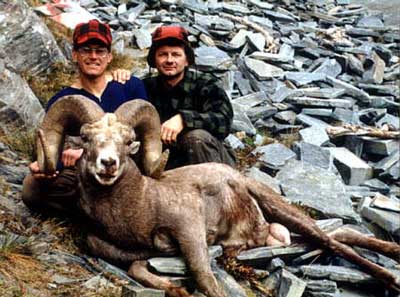
CYBER WAG is big horn hunting !

Cyber Wag-(computer generated Wild Ass Guess)


UPI is reporting another Cyber WAG siting. Although the computer modellers have not yet killed off any of the endangered big horn sheep, they have announced their intentions to go hunting.

Not only is the Cyber WAG, hunting down these poor creatures, whom they coldly refer to as "good subjects for a mathematical model" they are doing it in a most unsportsmanlike way.


The sheep, brought to Tiburon Island in 1975, are not at risk from disease or predators...

So they have these poor animals on this island where they will now unload their computer models on them in their continuing attempts to decimate various species. Will this madness ever end?

The modellers are holding nothing back when it comes to the big horn on this island. They are bringing in hunters from all over the world to ensure they kill these sheep.


Climate change is the only variable threat to the sheep, making them good subjects for a mathematical model aimed at predicting the effects of such change, Brook and fellow researchers from Germany, the United States and Mexico said. One part of the model simulates the effect of increased drought on the sheep's population, drought being a side-effect of climate change.


And in the end they admit their true intentions, the extinction of all endangered species in the world.


Because the calculations can be adapted to other species, the study should aid in the conservation of small populations of animals elsewhere on the planet, Brook said.


As we have shown over and over again, Cyber Wag will not stop until the entire world is destroyed by the modellers computer madness.


More...


May 26, 2009

CYBER WAG eats Tweedy ! Again.


(For the uninformed a CYBER WAG is a computer generated wild ass guess)

It is not unusual for our erstwhile climate modelers to be responsible for the potential deaths of countess species, not the least among them a
large portion of the human race. Their forecast have set off a bonanza of research (and the necessary funding) to investigate the potential impact of their computer model projections on everything from increased kidney stones to polar bear extinctions.

For some reason the CYBER WAG modellers find particular interest in going after birds, the rarer the better. We have reported on
just one case of this but the examples of the CYBER WAGs fetish for our feathered friends extinction have been reported in science journals world wide. The pace of extinctions is expected to increase as the Copenhagen Conference (the ritual pilgrimage of the CYBER WAGs coming in December) draws nearer.

Now the modellers and their well funded cohorts have set their eyes on the Hawaiian Islands. Actually not a bad idea, if you have to kill off species in the virtual make believe world why not do the real world investigation in paradise, right? Regardless they now have their eyes set on the already endangered Honeycreepers of Hawaii. Despite the name they actually are quite cute and we wish them well in escaping the clutches of CYBER WAG. Here from
Science Daily is the entire story of their eventual demise, but this brief excerpt is the obvious CYBER WAG death sentence of the Honeycreepers:


Unfortunately,” said study co-author, USGS scientist Dr. Dennis LaPointe, “this seasonal movement happens at the same time that mosquito populations soar at mid-elevations, which fuels high disease-transmission rates there. There’s a continuous source of disease-susceptible birds each fall.”
Although most disease transmission now occurs in these mid-elevation forests, this will change if the projected 3.6 degrees Fahrenheit (2 degrees Centigrade) raise in temperature occurs.
“With this kind of temperature change, about 60 to 96 percent of the high-elevation disease refuges would disappear,” said Atkinson. For example, available high-elevation forest habitat in the low-risk disease zone would likely decline by nearly 60 percent at Hanawi Natural Area Reserve on Maui to as much as 96 percent at Hakalau Forest National Wildlife Refuge on Hawaii Island. On other islands, such as Kauai, with lower elevations and no low-risk zones even now, predicted temperature changes would likely be catastrophic for remaining honeycreeper species.
“Right now, disease transmission in the mountains of Kaui is highly seasonal, but with temperature increases, disease would be able to be transmitted throughout most of the year,” said Atkinson.


So as we can clearly see our poor Honeycreeper's goose is cooked.


More...


May 18, 2009

delicate timing ?


One reads a paragraph like this from a story in the New York Times and it makes you wonder if the scientific community really does buy into that whole evolution theory stuff or much else in the geographical record for that matter.


"One concern about climate change is its potential for disrupting the delicate timing that exists within ecosystems. If warmer temperatures cause a bird to migrate earlier in the spring, for example, it might arrive before there are enough insects for food. "

"The delicate timing that exists within ecosystems" Oh my, I wonder what the delicate timing was when that meteor slammed into the Gulf Of Mexico and about wiped out life on earth? I guess all the tyrannosauruses had their watches set for the occasion.

But you have to love the title of the article :

Climate Change Poses Threat to Synchrony of Shrimp and Its Food

As if we didn't have enough to panic about with climate change, now we got Shrimp synchrony to worry about. I hear it's great with a touch of garlic though.


More...


Cyber WAG modellers are killing Polar Bears now!


Uh.. ....Well someday

The computer modellers are at it again. When will this ever end! It is bad enough that these gluttonous modellers suck vast amounts of scientific funding to destroy the planet in .....uh the future, but now they are directly targeting the poor cuddly Polar Bears!


You can read the entire forensic report of the murder here, but all you need to know is summarized in this confession of another dastardly use of Cyber WAG (computer induced wild ass guess) to decimate entire future generations of Polar Bears.


They coupled these models to projections of Arctic climate
changes
, especially forecasts of sea ice conditions. They calculated the interplay of all these factors – some 10,000 simulations – to estimate the probabilities of future polar bear population growth or decline. Through their study, Caswell, Hunter, and their colleagues were able to link Arctic sea ice directly to population growth


That's right buddy you get them before they get you!
More...


May 16, 2009

New Boss same as the old boss


FROM- IBD
Bear Necessity

Environment: Once again, the president finds it's not so easy to scrap the policies of his much-maligned predecessor. As with Gitmo and military tribunals, so it goes with offshore drilling and even Arctic wildlife.


"George W. Bush was right" is something you won't catch Barack Obama saying in public, but his administration is making the point, though quietly, through its actions.
In the latest nod to the previous president's realism, Obama's Interior Secretary Ken Salazar recently said he will retain a Bush administration rule limiting the scope of protection for the polar bear.
The rule keeps the bear's official "threatened" status from being used as a regulatory lever to limit greenhouse-gas emissions. Environmental groups wanted the new administration to scrap it in favor of a more aggressive approach. They're now forced to pursue their cause in court, just like in the old days.
Salazar left open the possibility of changing the rule later. He also insisted the administration "is fully committed to the protection and recovery of the polar bear." But any Interior secretary, of whatever political stamp, would say that.
The real message was unspoken. It goes something like this: Sure, the Arctic ice may be receding and polar bears may be losing habitat, but let's be realistic. Slapping a limit on CO2 emissions now — which is what the greens want — would wallop the economy and probably do little to save the bears. The greater necessity now is to get the country back to work. The bears can wait.

Salazar's announcement came shortly after the president signaled that he was open to more oil drilling on the Outer Continental Shelf. In a May 5 meeting with members of the House Energy and Commerce Committee, Obama was asked if he would reinstate an offshore-drilling moratorium that lapsed last year. He said he would not.

According to one of the lawmakers at that meeting, Rep. Gene Green, D-Texas, Obama "was fairly pointed in saying we need to have domestic production."

Last we checked, Obama was not being dissed as a tool of the oil companies for saying this. The Left still gives him a pass here, as it does in other cases where he seems resigned to follow Bush policies, at least for now.

His foot-dragging on closing the prison camp at Guantanamo has not provoked an outcry (though a decision to resume Bush-era military tribunals did give some human-rights activists heartburn).

Obama had issued an executive order to close Gitmo by next January. The order is just symbolic, however, without a concrete plan to close the camp and ensure that its remaining prisoners do not end up walking free in the U.S.

At this point, no such plan has been offered. Congress is moving ahead with a budget bill that sets aside no money for a shutdown. Rhetoric aside, the Obama policy on detainees in the war on terror is getting to look a lot like the policy he campaigned against.

Such is the power of facts on the ground and political necessities. Obama's willingness to lean in Bush's direction on some crucial issues is a sign of shrewdness and common sense. We welcome such realism.

Of course, if he were a new and untested conservative president, we'd be hearing much Big Media talk about how he's "growing in office" by moving toward the center. We'll say it even if no one else does, and we hope he grows a lot more.
More...


May 13, 2009

As goes GM so goes...the opossums?


I was quite disturbed and saddened yesterday to read that because of their probable bankruptcy, GM was considering moving out of Detroit, Michigan.

After all the money that I, my children, my grandchildren, my great grandchildren, my.. well you know what I mean. After all the money that taxpayers have invested in GM over the past few months I thought the least they could do is stay put.

But another article I came across shortly after has led me to believe that perhaps GM's departure has little to do with money at all. It is in fact about...you guessed it climate change.

Yes global warming may in fact be the culprit and I do not mean government CAFE standards either, actual Global Warming. As you can see from this article from the science blog site, GM will probably be relocating to Saskatton or points north.

Climate change driving Michigan mammals north

It is quite an article actually just chock full of details you would not suspect, a true nail biter of how intrepid researchers have determined that despite growing human population and most amazing of all increasing forest land. Yes I said that increasing forests -


"Clearly there's a lot more forest now than in the late 1800s and early 1900s, when logging and fires almost completely destroyed the forests of the northern Great Lakes region," Myers said. "But that doesn't work as an explanation for the patterns we see, because the species that are moving in and becoming more common are actually ones that do very well when forests are cut over."
No as you can clearly see other factors such as forest growth could not be responsible for rodent migration northwards,it must be climate change, GLOBAL WARMING. And here is how our well funded researchers determined this.


That leaves warming climate as the likely cause. But has such warming actually occurred in Michigan? To investigate, the researchers downloaded maximum and minimum daily temperatures from the National Climate Data Center for 16 weather stations in the Upper Peninsula, where changes in the small forest rodent community have been especially pronounced. They then calculated monthly averages for minimum and maximum daily temperatures for each year between 1970 and 2007 for each station and for the region as a whole.


Across all 16 sites, average annual minimum daily temperatures increased significantly over the 37-year period. Average annual maximum daily temperatures also rose, although not as dramatically.
I thought MY GOD Michigan must be cooking to drive both a once giant automaker and opossums from its lands. So I went to Google the source of all things good and holy and here is what I found


source The Midwestern Regional Climate Center (MRCC)

An amazing source for all kinds of details on climate in the Mid West. There are several items that jumped out at me when I looked at this map.

Why does it take so long for NOAA to adjust .... I mean update their records? Boy I can't wait until the Federal Government has all our medical records in their data banks-how about you?

Why given so many years of record keeping, the best in the world we are told, are the trends in so many adjoining states so different? I mean we are talking about trends here not actual temperatures. One would suspect that if the entire globe responds to carbon dioxide induced GLOBAL WARMING the same way, then adjoining states in the old US would at least have similar trends, as small as they appear to be.

How is it that climate change can be blamed for northern migration of mammals in a state that has cooled in the past century plus? Based on this Official Map, if you are worried about GLOBAL WARMING, you and the opossums ought to be moving to Michigan instead of away from it.

Why are the executives at GM making corporate policy based upon the migratory patterns of "possums" instead of building cars Americans want like SUVs uh I mean hydrogen, uh I mean electric cars.

Just goes to show what (funding) cherry picking uh analyzing data out of 16 weather stations out of hundreds in a state can get you.
More...


May 12, 2009

Now they ask?


FROM- BBC


Just how endangered is the polar bear?

US President Barack Obama has controversially opted to keep George Bush's rules on polar bear protection. In a nutshell, the Bush administration agreed to classify the bear as an endangered species, but specifically exempted protecting it from 'activities outside the bear's range, such as emission of greenhouse gases'.


If they'd gone with the letter of the Endangered Species Act, the US government could have been sued for failing to control the carbon emissions which are believed to be warming the Arctic and destroying the polar bear's natural habitat of sea ice. As Interior Secretary Ken Salazar put it: 'The Endangered Species Act is not the proper mechanism for controlling our nation's carbon emissions.' And he has a point.

More...
So far, so last week's news. The polar bear is the poster beast of climate change and as such is on the list of threatened species for nearly every country with Arctic territory. Sea ice has shown a shrinking trend and the concern is that if it disappears completely, so will the polar bear.


But actually how endangered is Ursus maritimus? The problem here is that they are fiendishly difficult to count. In a lifetime, each bear can range over tens of thousands of square kilometres of the coldest, most intensely hostile terrain on Earth. By necessity, counts are done by a number of inexact methods, including aerial survey, capture-recapture and anecdotal sightings.
Of the 19 sub-populations of polar bears known to exist, we think that five have declined, five are stable and two have increased, but tellingly seven populations have rendered insufficient data to make a call. Total numbers are pegged at around 20,000 - 25,000, which nonetheless represents a massive increase since unregulated hunting ceased in the Seventies.


As Bjorn Lomberg pointed out, if we want to protect polar bear populations, we could simply try shooting even fewer of them, at a saving of 250 or more bears a year.


Perhaps more importantly, we are forgetting that the polar bear is a tough and adaptable creature that fossil evidence shows has already survived a much warmer period than the one we're going through now. This is probably why there is little evidence to support the popular misconception that lots of polar bears are drowning.


The 'drowning' thesis was a speculative conclusion based on sightings of four carcasses 'presumably, drowned' seen floating in the Alaskan Beaufort Sea during aerial surveys in September 2004. You could just as easily speculate that they were killed by the big storm that preceded the survey, because when it comes to swimming, a predator like the polar bear knows its limits, even if we don't know ours.


May 9, 2009

Change you can believe in


FROM-THE FOUNDRY

Why Does President Obama Hate the Polar Bears?

Today the Obama administration’s Department of Interior announced that it would keep a Bush administration rule forbidding government scientists from considering global warming when protecting polar bears pursuant to the Endangered Species Act.

When the Bush Interior Department announced their rule, they were roundly criticized by the enviro-left. It will be interesting to see how they react to the Obama administration taking the same position.

More interesting is how the Obama EPA justified their decision. McClatchy reports:


On Friday, the Interior Department reluctantly agreed, saying that it’s scientifically impossible to use the Endangered Species Act to regulate greenhouse gases, which are contributing to the warming of the earth and the resulting melting of bears’ habitat in Alaska. The emissions from a cement plant in Georgia, for example, can’t be tied directly to the precipitous decline in polar ice, Salazar said.

But neither can the emissions from just one car tailpipe be tied directly to global warming. So by that same logic, the EPA has no business regulating carbon emissions pursuant to the Clean Air Act. If it is “scientifically impossible to use the Endangered Species Act to regulate greenhouse gases” than it is also scientifically impossible to use the CAA to regulate greenhouse gasses.

After all, The ESA is a far more powerful law than the CAA, especially if your aim is to shut down carbon emissions. Section 7 of the ESA requires all federal agencies to consult with either the U.S. Fish and Wildlife Service (FWS) or the National Marine Fisheries Services (NMFS) for “any action authorized, funded, or carried out.

In other words, every action funded by the federal government has the potential to be shut down by the ESA. All that billions of infrastructure funding in Obama’s $787 stimulus bill? It all would increase carbon emissions, so the ESA could kill it all.

No wonder Obama threw the polar bears under the bus.


More...


May 6, 2009

OOPS wrong story.


“The thing that I focus on is the need to give bears as much of a break as we can during this impending climate crisis,...."


FROM-NPR


Tracking Polar Bears, An Environmental Barometer


The threatened polar bear has become an icon for the potentially devastating effects of global warming. The animal depends on sea ice for its survival, and this ice is disappearing, no more so than in the Chukchi Sea — the remote stretch of ocean between Alaska and Russia.

U.S. biologists don't know much about the bears that live there, but they're trying to learn as much about the population as they can before their habitat melts away.
More...

One hundred miles from land in the middle of the Chukchi Sea, round sheets of ice are broken up occasionally by a strip of inky blue water. To the human eye, it looks like a starkly barren landscape. But to a polar bear, it is a rich environment to which they are brilliantly adapted.

Eric Regehr, a biologist with the U.S. Fish and Wildlife Service, crouches down next to a sedated bear to examine one of its paws.

"You can see they have very sharp hooked claws like that for gripping on the ice and for gripping onto their seal prey," he says. "And you can feel how sharp these are."

This is a relatively small bear, and Regehr guesses he is about four years old — an adolescent.

"He has pretty big feet, like a puppy — big feet they have to grow into," he says.

While the bear sleeps, Regehr learns as much as he can about him — he takes blood, hair and fat samples, and he measures his length and weight. This bear is about 7 feet tip to tail and weighs in at close to 700 pounds — tiny compared to many full grown males. And Regehr has weighed a lot of huge bears this year — one even set a springtime record in Alaska, at 1,266 pounds.

"He was borderline obese," Regehr says. "He was a very fat bear for this time of the year. If you looked at him in profile, his belly almost scraped the ground, so he was a really fat good-looking bear, and in general most of the bears have appeared quite healthy."

The bears may be in good shape now, but the ice that allows them to gorge on blubbery seals is retreating at an alarming rate. Regehr says the future for Alaska's polar bears is grim, and he's already seeing one potentially troubling sign — very few females with cubs.

The bear Regehr is studying today is the 39th he has examined this season. His last step is to draw that number with fur dye on the polar bear's back. Each bear is also outfitted with ear tags and a lip tattoo that will allow Regehr to track their progress if he captures them again next year.

It will take several seasons of study to understand how the polar bears in this region are reacting to their changing environment.

Rosa Meehan, who heads the marine mammal division of the U.S. Fish and Wildlife Service in Anchorage, says the knowledge will make it easier to help the bears through difficult times ahead.

"The thing that I focus on is the need to give bears as much of a break as we can during this impending climate crisis, in the hopes that we can get our hands on climate change and address it in a realistic fashion," Meehan says. "If we can do that, then there's hope that the environment will stabilize and come back, and we'll still have bears there to come back and repopulate."

Meehan says one idea is to set up land refuges where polar bears may be able to eek out a meager existence for a while. But, she says, that's a frightening possibility to consider for a species meant to live on the sea.


April 30, 2009

Catch of the day


Besides the obvious of what is so bad about increasing fish populations of so many species, I note they don't report any decreasing as they surely would have, had they found any. Is such an important oceanography institute such as Scripps unaware of the PDO? Or did they just choose to leave that bit of information out of the press release, as not being quite so catchy.

Does the actual report explain the PDO influence on ocean temperatures? Please note that in the story they call it climate driven ocean warming without mentioning that this is part of a natural cycle, leaving the impression intended or not that this is man made. If the now negative PDO causes a decrease in fish population, will this too be the result of climate change and wil they then produce another study funded by-?. Or is this all just another example of using the ever popular scare of climate change to scare the heathen humans from reeking haddock uh...havoc on the Earth? Inquiring minds want to know.


FROM-Yuba Net

Via- Tom Nelson


"a significant increase in the population of 25 fish groups from a cold period (1951-1976) to a warm one (1977-1998), "


Dramatic Climate Change-Driven Impacts Documented Across Marine Life Spectrum
Scripps-led study, the first of its kind, finds warming causes shifts in habitats of open-ocean fishes


By: Scripps Institution of Oceanography/UC San Diego

April 30, 2009 - In the first broad study of its kind, scientists at Scripps Institution of Oceanography at UC San Diego and their colleagues have found that the effects of climate change are being felt across a wide ensemble of sea life.

Their report, published in the journal Global Change Biology, describes climate-induced changes ranging from migration pattern alterations to key population shifts.

"This is the first evidence in the ocean that climate change can have dramatic effects on large-scale fisheries ecosystems," said Scripps Professor George Sugihara. "These are some very interesting consequences that people haven't really thought about. These warming events could actually cause a constellation of species that normally don't interact to begin to interact and that could have potentially large effects on what we think ought to be the natural ecosystem."


The study, led by Chih-Hao Hsieh while he was a student at Scripps Oceanography, and who is now at National Taiwan University, is based on data from the California Cooperative Oceanic Fisheries Investigations (CalCOFI), a program based at Scripps that has monitored the marine environment of the California Current for nearly 60 years. Hsieh, Sugihara and their coauthors used the CalCOFI database to decipher the sensitivity of fish habitats in response to climate-driven ocean warming.

To arrive at their results, the researchers studied quantities of larvae for 34 fish groups. Numbers and geographic locations of fish larvae -- a quantity known as "biomass" -- are indicative of the abundance of fish species. They compared that information with physical measurements, including water temperature.

Among their findings, the researchers describe a significant increase in the population of 25 fish groups from a cold period (1951-1976) to a warm one (1977-1998), including species such as dogtooth lampfish, longfin lanternfish, California lanternfish and Panama lightfish.More...
They also found that fish species that typically migrate vertically in the marine water column shifted geographically northward to colder waters, a change that wasn't seen in other fish that don't migrate as such in the water column. The authors speculate this may be because the upper layers of the water column warmed considerably more than deeper levels, leaving the bottom dwellers less impacted. Migrating species would have sensed the warming more readily and moved in response.

The researchers also discovered that groups that typically reside in the far open ocean shifted closer to shore between the cold and warm period, and species that normally reside in coastal areas moved even closer to shore.

"These sensitivities to climate can cause different fish species to start interacting," said Sugihara. "It's almost like seeing ocean invaders come into the coast and these ad hoc mixed ecosystems could potentially have large ecological and commercial consequences down the road."

"Open-ocean fishes that were rarely studied due to their low economic values may in fact provide important clues signifying how marine organisms are responding to climate variations," said Hsieh, now a professor at National Taiwan University. "The interactions found between oceanic and shallow water coastal species also imply that anthropogenic disturbances, for example fishing, could have profound indirect effects on other components of the marine ecosystem."

In addition to Hsieh and Sugihara, coauthors include Hey Jin Kim (Scripps Oceanography and Monterey Bay Aquarium Research Institute), William Watson (Southwest Fisheries Science Center) and Emanuele Di Lorenzo (Scripps graduate now at Georgia Institute of Technology).

The study was funded by NOAA Fisheries and the Environment program, the National Marine Fisheries Service, National Science Council's (Taiwan) Long-term Observation and Research of the East China Sea and National Taiwan Ocean University's Center for Marine Bioscience and Biotechnology

The Other Side Of The Story


This Episode brought to you by SPPI

Some things we know-and don't know-about Polar Bears

Susan J. Crockford, Ph.D.
Oct. 14, 2008

INTRODUCTION

Much of what you hear about polar bears these days - their status, their plight - is distilled from a literature dominated by studies done within very limited portions of the Arctic: those that are accessible to researchers. Logistical and technical difficulties prevent scientists in all disciplines from traveling to, and working within, the ever-changing sea ice that exists well offshore. As a consequence, the picture that gets painted of polar bear existence sounds more completely understood than it really is. Due to the nature of the beast and the habitat in which it lives, there is in reality a profound uncertainty regarding polar bear population status, some of its life history features and conditions of its habitat, and the status of its primary prey, the ringed seal. However, it is clear from their long-term success surviving within this habitat that the tight association polar bears and arctic seals have with moving sea ice gives them tremendous flexibility and adaptability to changing climatic conditions.

My purpose here is to address some of the bias that mars virtually all general information sources one might consult on polar bears and ice-dependent Arctic seals, in point form for easy reference. Most references cited here are available on request as pdf files. This document was compiled from several papers published on associated topics (Crockford 2004, 2006; 2008; Crockford and Frederick 2007; Crockford and Frederick, in review) and material collected in the course of reviewing the January 2007 draft of the Report for Congress on Polar Bears prepared by Library of Congress researcher Eugene H. Buck, filed April/07. This update incorporates information amassed since that date.

Note that in regard to ice:
1) pack ice and sea ice both refer to large sheets or broken chunks of ice that drift with the
currents and wind as the seasons change (Rigor and Wallace 2004) - most Arctic ice is sea ice
(Ferguson et al. 2000) and the ice edge is the southern-most limit of the drifting pack.
2) fast ice, grounded fast ice, landfast ice and shorefast ice all refer to ice attached to land,
although shorefast ice is perhaps the least ambiguous terminology.More.......

DISTRIBUTION AND STATUS OF THE POLAR BEAR

- Polar bears world-wide are divided into 19 subpopulations for management purposes (Figure 1).

- Two of these populations, genetically indistinguishable from each other (Cronin et al. 2006), occur within US territory
1) the Southern Beaufort Sea population (SB, shared with Canada, half in US territory) is
estimated at 1,526 animals (Regehr et al. 2007b, “1211-1841 at a 95% confidence interval”);
2) the Chukchi/Bering Sea population (CB, shared with Russia, half in US territory) is tentatively
estimated at 2,000 - no population survey has yet been done (Aars et al. 2006).

Figure 1. The nineteen designated polar bear subpopulation boundaries (courtesy IUCN Polar Bear Specialist Group, see Aars et al. 2006)

- Globally, less than one third of the nineteen populations are currently estimated as declining, more than one third are increasing or stable, while the remaining third have insufficient data available to estimate population trends: the SB population is currently declining, based on presumed consequences of some bears in poor condition, not an actual decline in numbers over time ( Regehr et al. 2007b; Rode et al. 2007), the CB trend is unknown (Aars et al. 2006).

- Four out of the five subpopulations listed as declining in 2006, as well as several others (including CB), are considered at risk from over-harvesting (i.e. hunting), not reduced sea ice (Aars et al. 2006).

- Some population estimates are based on “mark/recapture” methods, others on aerial survey; due to fog and cold, aerial surveys seldom extend beyond 125km north of the sea ice edge (e.g. Aars et al. 2006, 2008, Barents Sea), with at least one exception (Fischbach et al. 2007, Southern Beaufort Sea).
- The status of the polar bear in the central Arctic Basin (see Fig. 1 above), the largest of the nineteen designated regions, is completely unknown (Aars et al. 2006), although bears have been reported there (e.g. Van Meurs and Splettstoesser 2003).

DENNING AND OTHER LIFE HISTORY HABITS

- Most of what we know about polar bear biology is based on the easily-accessible animals of Western Hudson Bay (WHB), see references below, which comprise only 3-5% of the global population and are anomalous for a number of reasons (Aars et al. 2006; Dyck et al. 2007, 2008; Mauritzen et al. 2001; Regehr et al. 2007a; Schliebe et al. 2008; Stirling et al.1977):
1) WHB is the most second most southerly subpopulation worldwide, so their ice always melts earlier in the year than most of the others (however, the Southern Hudson Bay (SHB) subpopulation is the furthest south and its population has remained stable over the last 20 years (Aars et al. 2006).
2) WHB population is the most easily accessible and has been under scrutiny since the late 1960s.
3) WHB is the only subpopulation, out of the five considered to be declining, where the population trend is based on a statistically significant decrease in population estimates over time (Aars et al. 2006).
4) WHB is one of the most geographically constrained subpopulations, so they easily get trapped ashore - usually for about four months at a time - when summer sea ice retreats (however, this also happens to the SHB subpopulation, without an associated population decline).
5) most of the females prefer to den on land or shorefast ice rather than on offshore sea ice
(compared to the Southern Beaufort, where about 40-60% den offshore (Fischbach et al. 2007).

-Virtually the only areas studied in any detail for polar bears and ringed seals, are the coasts of Hudson Bay in Canada (e.g. Amstrup et al. 2007; Derocher et al. 2004; Ferguson et al. 2005; Holst et al. 1999; Lennox and Goodship 2008; Lunn et al. 1997; Regehr et al. 2007a; Stirling and Derocher 2007; Stirling et al. 2008a), the Beaufort Sea off Alaska and Northwestern Canada (e.g. Amstrup 1995; Frost et al. 2004; Regehr et al. 2007b; Schliebe et al. 2008; Stirling 2002; Stirling et al. 2007, 2008b), and the Svalbard region in the Barents Sea, off Norway (e.g. Aars et al. 2008; Derocher et al. 2002; Holst et al. 2001; Krafft et al. 2006; Labansen et al. 2007; Lydersen and Gjertz 1986; Mauritzen et al. 2001; Wiig et al. 1999). Some studies have also been undertaken in the Canadian Arctic Archipelago (e.g. Ferguson et al. 2000; Hammill and Smith 1991; Kelly and Wartzok 1996; Kingsley et al. 1985; Smith and Hammill 1981; Smith et al. 1991; Stirling and Øritsland 1995) and the Davis Strait/Baffin Bay region of Canada (e.g. Ferguson et al. 2000; Finley et al. 1983). Information on populations elsewhere in the Arctic, including regions north of Greenland and Russia, is very limited or nonexistent (e.g. Aars et al. 2006).

- Polar bears are capable of fasting for more than four months at a time while fully awake and mobile, regardless of the season (they do not need to den or hibernate as other bears do - only pregnant female polar bears hibernate over the winter in true bear fashion): as a consequence, polar bears are known to biologists as walking hibernators (Lennox and Goodship 2008; Stirling and Øritsland 1995).

- While polar bears that spend extensive time on land during the summer months (such as those in WHB) may fast for up to four months, previous research has shown (Stirling and Øritsland 1995) that bears in most regions are at their lowest body weight in spring (i.e. March). This suggests that winter fasting leading to starvation may be a more limiting factor for polar bears and this may be particularly true if winters are associated with development of especially thick shorefast ice. Such cold winters in the past, as occurred during the mid-1960s, mid-1970s, mid-1980s, and early 1990s, led to marked reductions in polar bear numbers (Stirling 2002; Stirling and Lunn 1997) due to dramatic declines in availability of young ringed seals. In Greenland, ringed seals are known to move offshore when shorefast ice becomes too thick for them to maintain their breathing holes (Vibe 1967).

- Over most of their range, most polar bears remain on the sea ice year-round or at most spend only short periods on land. Schliebe et al. (2008) found that from 2000-2005, on average 3.7% of all Southern Beaufort Sea polar bears in Alaska spent time on land between mid-September and the end of October. While nearshore-dwelling Davis Strait bears were found to spend two-three months on Baffin Island (Ferguson et al. 1997), polar bears in WHB are unique in routinely spending about four months on land from summer through fall (Regehr et al. 2007a; Schliebe et al. 2008).

- In October and November, male polar bears head out on the sea ice where they spend the winter. Pregnant females either seek sites on offshore ice, or on shorefast ice/shoreline areas (snow covered land), to dig large dens in snow where they give birth and spend the winter.

- Den locations chosen by female polar bears in the Southern Beaufort Sea region have varied since the early 1980’s: 62% of dens were on offshore sea ice from 1985-1994 but only 37% of dens were offshore from 1998-2004 (Fischbach et al. 2007). It is possible that world wide, the general pattern for polar bear dens is an almost equal number on offshore sea ice and shorefast ice/land (with WHBay being anomalous). Dens are known to be difficult to spot from the air (e.g. Ferguson et al. 1997).

- Polar bear females appear to have individual habitat and denning preferences: females do not require mainland or shorefast ice sites for denning but some individuals prefer them. (Mauritzen et al. 2001):
1) bears that choose “pelagic” habitats generally live on offshore drifting sea ice year round.
2) bears that choose “nearshore” habitats generally live on shorefast ice year round.

- When seasonal ice recedes north in summer, as it does every year in most areas, pelagic-dwelling bears stay on the drifting sea ice while nearshore-dwelling bears move to land. Both pelagic-dwelling and nearshore-dwelling individuals of both sexes are known in all subpopulations studied (Mauritzen et al. 2001; Ferguson et al. 2000; Schliebe et al. 2008).

- The fact that pelagic-dwelling bears not only exist but behave differently than nearshore-dwelling bears to reduced sea ice is critical to predicting how polar bears as a species might react to changes in ice conditions: unfortunately, we simply do not know how many bears den out of study range.

- While there is extensive evidence that virtually all Arctic marine mammal populations are negatively impacted by increased sea ice conditions (Stirling 2002; Laidre et al. 2008; Harington 2008), evidence for how these animals react to decreased sea ice is extremely limited, coming from extensive studies in the anomalous WHB region and a few short term studies in the southern Beaufort Sea. In other words, what we know for sure is that increased sea ice is associated with a decline in polar bear and ringed seal numbers; we don’t really know what impact decreased summer sea ice might have on polar bears and ringed seals that inhabit other regions of the Arctic.
- Computer models that predict extinction of polar bear populations within this century due to human-induced global warming (e.g. Derocher et al. 2004) do not take into account adaptations of bears and their prey to reduced sea ice extent (Armstrong et al. 2008; Bodkin et al. 2007), even though both bears and their prey have clearly done so in the past (e.g. Kochnev 2006; Vibe 1967). Such adaptation would likely involve living year round within the mobile offshore sea ice that is now beyond study range (wherever it occurs), without a shift to land.

- Even if substantial declines in polar bears and their prey do occur because of anthropogenic global warming, as predicted by Amstrup et al. (2007) and others (e.g. Laidre et al. 2008; Stirling and Derocher 2007), this does not doom them to extinction: many species have recovered from far more dramatic declines in population than predicted by even the most pessimistic scenarios conceived of by climate models, including humpback whales (Dalton 2008), gray whales (Reeves et al. 2002), northern fur seals (Reeves et al. 2002), Atlantic cod (Bigg et al. 2008), and sea otters (Doroff et al. 2003; Estes 1990), among others. Contrary to common biological assumption, small populations often retain sufficient genetic variation for significant recovery (e.g. Aguilar et al. 2004; Kaeuffer et al. 2007).

- Adaptation of a species is not the same as adaptation of individuals: the death of some individuals during changing conditions is likely inevitable but this does not mean the species (i.e. the entire population) is not adaptable (e.g. Grant and Grant 2002; Grime et al. 2008). Polar bear populations may have declined and recovered many times in the past in response to changing sea ice conditions, without us knowing.

PREY SPECIES DISTRIBUTION AND STATUS

- Survival of polar bears is dependent on available prey, which consists primarily of ringed seal, Phoca hispida and (depending on region and/or season) bearded seal, Erignathus barbatus (Derocher et al. 2002, 2004; Stirling and Øritsland 1995). They occasionally take walrus, Odobenus rosmarus and small whales (such as beluga, Delphinapterus leucas, and narwhal, Monodon monoceras) and scavenge large whale carcasses (such as bowhead, Balaena mysticetus).

- Ringed seals have a circumpolar distribution and are associated with ice year round. They give birth and mate on ice and are not known to haul out on land. Some ringed seals prefer to over-winter and give birth on shorefast ice while others live their lives well offshore in the drifting sea ice (Born et al. 2004; Davis et al. 2008; Ferguson et al. 2000; Finley et al. 1983; Wiig et al. 1999), similar to the known “pelagic-dwelling” and “nearshore-dwelling” preferences of individual polar bears (see discussion above). Ringed seals feed throughout the darkness of the Arctic winter and are available prey for polar bears wintering in the offshore pack ice (Kelly and Wartzok 1996).

- Most marine mammal researchers working in the Arctic assume that ringed seals breed primarily in shorefast ice habitats (e.g. Burns 1970; Derocher 2004; Frost et al. 2004; Hammill and Smith 1981, 1991; Holst et al. 1999, 2001; Kingsley et al. 1985; Krafft et al. 2006, 2007; Lydersen and Gjertz 1986; Smith and Hammill 1981; Stirling 2002; Stirling and Øritsland 1995), despite several well-documented studies that conclude a significant portion of all ringed seals must live and breed well offshore, out of study range (Born et al. 2004; Davis et al. 2008; Ferguson et al. 2000; Finley et al. 1983; Wiig et al. 1999).

- Ringed seals eat primarily young polar cod, Boreogadus saida, which live under the ice (e.g. Born et al. 2004; Labansen et al. 2007), although they eat other types of fish as well as the amphipods and small copepods (shrimp-like invertebrates) that polar cod themselves eat.

- Both polar cod and their prey live under ice of all types, including multi-year and first year drifting sea ice regardless of the ocean depth (Lønne and Gulliksen 1989): in other words, cod do not require ice that is positioned over shallow, continental shelf waters and therefore, neither do ringed seals or polar bears, contrary to common assumption (e.g. Derocher et al. 2004). While Arctic deep water is often assumed to be of low productivity (e.g. Fischbach et al. 2007), this has not be demonstrated. If offshore sea ice over deep water is suitable habitat for polar cod, it should be suitable for ringed seals and polar bears also. This assumption is supported by reports at the North Pole of “small fish” (estimated as 5-8cm, presumably young cod,) thrown up by ice-breakers, algal growth noted on the underside of broken ice, and the presence of ringed seal (Todd et al. 1992), as well as reports of polar bears themselves (Van Meurs and Splettstoesser 2003).

- As for polar bears, much of ringed seal habitat, especially the drifting sea ice that lies well offshore, has not been surveyed, leading to much uncertainty regarding population size and status of ringed seal: the current estimate used for the global population numbers for ringed seal is about seven million (Davis et al. 2008; Wiig et al. 1999; Nowak 2003; Reeves et al. 2002).

Although climate models predict that future summer pack ice declines will decimate polar bear populations (e.g. Laidre et al. 2008; Stirling and Derocher 2007), forecasting a loss of from 66% of the world total population by 2050 (Amstrup et al. 2007) to outright extinction (Derocher et al. 2004), such conclusions do not take into account the fact that polar bears can fast for more than four months when required and are capable of living entirely at sea, in the ice that lies well offshore where there are substantial numbers of seals, without ever setting foot on land. Nor do such dire prophecies take into account the kind of adaptability described by a Russian researcher: “our investigations on Wrangel Island have shown that the polar bear is a very plastic animal: it can rapidly change its way of life, spatial distribution and behavior according to new ecological conditions” Kochnev (2006:163).

HOLOCENE AND PLEISTOCENE HISTORY

-Polar bears evolved from brown bears (Ursus arctos) during the last Ice Age and while they are thus a relatively new species (no more than 200,000 years old, probably much younger), ringed seals and bearded seals have been around for at least two million years (Arnason et al. 1995, 2006; Davis et al. 2008; Kurten 1988; Harington 2008).

-Polar bears are close genetically to brown bears although they are a distinct species (Cronin et al. 1991; Talbot and Shields 1996). Mitochondrial DNA sequences of polar bear are closer to one particular population of brown bear from Southeast Alaska than some dogs are to wolves (Crockford 2004, 2006). Although we know polar bears can successfully interbreed with brown bears (Duff-Brown 2007), this reflects their recent common ancestry - it does not call into question their status as a distinct species or detract from their divergent ecological, morphological and physiological features (Crockford 2004, 2006; Cronin 2007).

-The polar bear survived two major warm periods over the last 11,000 years (The Holocene):
1) The Early Holocene. At the end of the last Ice Age, the Northern Hemisphere in particular
entered an extended period of rapid warming, with temperatures in Arctic regions eventually
reaching levels several degrees warmer than today. At that time, the sea ice above western
North America is known to have retreated substantially, allowing arctic species such as bowhead
whales and walrus to move northward into areas of the Canadian arctic they cannot reach today
(Dyke et al. 1999, Dyke and Savelle 2001; Fisher et al. 2006).

The Early Holocene Climatic Optimum peaked at about 11,000-9,000 years ago near Alaska and at 8,000-5,000 years ago near Greenland & northern Europe: in both areas, temperatures rose rapidly 10-150C to a point significantly warmer than present (about 2.50C warmer) in most places and up to 70C warmer in Northern Russia
(MacDonald et al. 2000)
about 5-100C of that warming
took place within 30 years or less
(Alley 2000; Bennike 2004; Dahl-Jensen et al. 1998; Jennings et al. 2002; Kaufman et al. 2004; Steffensen et al. 2008).
The rate of warming that took place in the early Holocene far exceeds any climate model predictions of warming over the rest of this century.

2) The Late Holocene. Another significant but shorter warm period occurred about 1000 years
ago, when arctic temperatures were slightly warmer than today. This warming, known as the
Medieval Warm Period, also triggered sea ice reductions in arctic regions and was accompanied
by significant reductions in Greenland glaciers, that created so much arable land that Viking
farms established in west Greenland were occupied for 400 years. During the Medieval
Warm Period, ca. 800-1200 A.D., temperatures in Greenland rose about 10C above modern levels
(Fagan 2000; Soon and Baliunas 2003), allowing establishment of Viking settlements in areas of
western Greenland that today are covered in glaciers; in Finland, pine forests existed further north than they do today, with temperatures ca. 0.50C warmer than present (Kultti et al. 2006).

- There is no evidence to suggest that ice in the Arctic Basin disappeared entirely during either the early or late Holocene warm periods or that any ice-dependent species disappeared: polar bears (and their known prey species, ringed seals, bearded seals and walrus) existed before the last Ice Age and significant populations of them remain today (although we don’t know how large any of the ancient populations actually were).

- Based on the evidence of extensive polar ice (Bradley and England 2008) and fossil remains of seals and polar bears found outside the Arctic, most Arctic populations appear to have been displaced south during the last Ice Age (Dyke et al. 1999; Harington 2008; Kurten 1988).
- Note that during previous Holocene warm periods mentioned above, skeletal remains of bowhead whales and walrus on shorelines mark the their prior distributions (Dyke et al. 1999, Dyke and Savelle 2001; Dyke and England 2003; Fisher et al. 2006): there are no bones of polar bears found amongst these (Art Dyke, pers. comm., 2007).

- Fossil and subfossil remains of polar bears (who presumably died of natural causes, not killed by humans) are exceedingly rare: there are exactly 6 (six) Pleistocene age specimens of polar bear worldwide (Harington 2001; Kurten 1988) and one major Holocene deposit from a natural trap cave on the Pribilof Islands, in the Bering Sea, that is about 4,500 years old (Veltre et al. 2008). More polar bear remains are found in Late Holocene archaeological deposits in the Arctic than in natural-death contexts, although they are still quite rare (e.g. Murray 2008; Harington 2001, 2008).

- In other words, the suggestion that polar bears would have moved to land during early Holocene warm periods (in response to reduced ice cover worldwide) is pure conjecture and not supported by any evidence. Virtually all polar bears must die on the ice where their remains sink to the bottom of the ocean: fossil finds are rare because the Arctic sea ice habitat is not conducive to discovery.

SEA ICE THICKNESS AND EXTENT (ESSENTIAL POLAR BEAR HABITAT)

- Many statements made regarding sea ice thickness in the Arctic do not acknowledge the incompleteness of this data: one frequently cited study (Laxon et al. 2003) surveyed (via satellite) only ½ of permanent sea ice and did not include ANY of the region in the central Arctic Basin (above 810 N).

-Another frequently cited reference (Lindsay and Zhang 2005) concludes that Arctic sea ice is experiencing a continual decline that cannot easily be reversed, but this is not a data-based paper - it is a model based on what is now considered old, substandard data from coastal submarine surveys.

- Sea ice thickness in the huge Arctic Basin region is based on very few actual measurements that have been extrapolated to represent the entire region and used in various climate models to predict future conditions (Rothrock et al. 2003; Yu and Rothrock 1996); ice extent data from satellites used in these models have been available only since 1979; these data are insufficient for assessing long-term trends.

- Limited coverage of some of these surveys, in addition to the fact that the models do not take effects of wind into account, have almost certainly led to overestimates of sea ice reduction and ice thinning (Holloway 2001; Holloway and Sou 2002): wind can temporarily concentrate ice in areas that are not surveyed.

Polar bears that live in regions of extensive sea ice routinely hunt on newly-formed ice that is less than 30 cm thick (about 1 ft.) and are quite capable of utilizing “thick” first year ice (more than 120 cm thick, or about 4 ft.) for over-wintering activities, including denning: they do not require thick multi-year ice (Ferguson et al. 2000). First year ice in March of this year was about 1.6m thick (NSIDC 2008).

- Recent predictions of future sea ice conditions, as they might impact polar bears, are adaptations of unverified “general circulation models” intended to forecast global temperatures (Amstrup et al. 2007; Armstrong et al. 2008; Koutsoyiannis et al. 2008). Such models are conditional on global temperatures being amplified by an hypothesized amount over the entire Arctic (Polyakov et al. 2002; Serreze and Francis 2006). None of these models take into account the fact that Arctic climate is subject to profound regional variation and influenced by a host of little-understood drivers of wind and weather patterns, including the Arctic Oscillation (e.g. Overland and Wang 2005; Polyakov et al. 2002) and Pacific Decadal Oscillation (Biondi et al. 2001; Newman et al. 2003), which are known to shift precipitously on decadal and multidecal time scales.

- Models of future climate change in the Arctic predict sea ice reductions to occur primarily in winter, while all observed sea ice changes so far reported have occurred in spring and summer (NASA 2007; NSIDC 2008; Overland and Wang 2005) and most of these reductions are not Arctic-wide but confined to the western Arctic (Rigor and Wallace 2004; Rigor et al. 2002).

- So far, there is no firm evidence that there has yet been “unidirectional” warming in the Arctic over the last 100 years (e.g. Fisher et al. 2006; Kahl et al. 1993), nor an unprecedented, irreversible decline in either sea ice extent or thickness (Holloway and Sou 2002) — neither is there firm evidence that an “Arctic amplification” effect is markedly and uniformly magnifying circumpolar Arctic temperatures (Polyakov et al. 2002; Serreze and Francis 2006).

- Note that the computer model results presented late last year (Amstrup et al. 2007), which forecast dramatic declines in polar bear numbers based on predicted reductions in seasonal sea ice thickness and extent due to human-generated increases in atmospheric CO2, have not yet been tested against even a single years worth of independent data.

References

Aars J, Lunn N J, and A.E. Derocher (eds). 2006. Polar Bears: Proceedings of the 14th Working Meeting of the IUCN/SSC Polar Bear Specialist Group, 20-24 June 2005, Seattle, Washington, USA. Occasional Paper of the IUCN Species Survival Commission 32. Gland (Switzerland) and Cambridge (UK): IUCN.
Aars, J., Marques, T.A., Buckland, S.T., Andersen, M., Belikov, S., Boltunov, A., and Ø. Wiig. 2008. Estimating the Barents Sea polar bear subpopulation size. Marine Mammal Science in press.

Aguilar, A., Roemer, G., Debenham, S., Binns, M., Garcelon, D., and R.K. Wayne. 2004. High MHC diversity maintained by balancing selection in an otherwise genetically monomorphic mammal. Proceedings of the National Academy of Sciences USA 101:3490-3494.

Alley, R. B.. 2000. The Younger Dryas cold interval as viewed from central Greenland. Quaternary Science Reviews 19:213-226.

Amstrup, S.C. 1995. Movements, distribution, and population dynamics of polar bears in the Beaufort Sea. Ph.D. dissertation,
University of Alaska, Fairbanks.

Amstrup, S.C., Marcot, B.G., and D.C. Douglas. 2007. Forecasting the rangewide status of polar bears at selected times in the 21st century. Administrative Report, U.S. Department of the Interior-U.S. Geological Survey, Reston, VA.

Armstrong, J.S., Green, K.C., and W. Soon. 2008. Polar bear population forecasts: a public-policy forecasting audit. Interfaces in press.

Arnason, U., Bodin, K., Gullberg, A., Ledje, C. and Mouchaty, S. 1995. A molecular view of pinniped relationships with particular emphasis on the true seals. Journal of Molecular Evolution 40:78-85.

Arnason, U., Gullberg, A., Janke, A., Kullberg, M., Lehman, N., Petrov, E.A., and R. Väinölä. 2006. Pinniped phylogeny and a new hypothesis for their origin and dispersal. Molecular Phylogenetics and Evolution 41:345-354.

Bennike, O. 2004. Holocene sea-ice variations in Greenland: onshore evidence. The Holocene 14: 607-613.

Bigg, G.R., Cunningham, C.W., Ottersen, G., Pogson, G.H., Wadley, M.R., and P. Williamson. 2008. Ice-age survival of Atlantic cod: agreement between palaeoecology models and genetics. Proceedings of the Royal Society B 275:163-172.

Biondi, R., Gershunov, A. and D.R. Cayan. 2001. North Pacific decadal climate variability since 1661. Journal of Climate 14:5-10.

Bodkin, D.B., Saxe, H., Araújo, M.B., Betts, R., Bradshaw, R.H.W., Cedhagen, T., Chesson, P., Dawson, T.P., et al. 2007. Forecasting the effects of global warming on biodiversity. BioScience 57:227-236.

Born, E.W., Teilmann, J., Acquarone, M., and F.F. Riget. 2004. Habitat use of ringed seals (Phoca hispida) in the North Water area (North Baffin Bay). Arctic 57:129-142.

Bradley, R.S., and J.H. England. 2008. The Younger Dryas and the sea of ancient ice. Quaternary Research 70:1-10.

Burns, J. 1970. Remarks on the distribution and natural history of pagophilic pinnipeds in the Bering and Chukchi Seas. Journal of Mammalogy 51: 445-454.

Cronin, M.A. 2007. Limitations of molecular genetics in conservation. Nature 447:638.

Cronin, M.A., Amstrup, S.C., and G.W. Garner. 1991. Interspecific and intraspecific mitochondrial DNA variation in North American bears (Ursus). Canadian Journal of Zoology 69:2985-2992.
Cronin, M.A., Amstrup, S.C., and K. T. Schribner. 2006. Microsatellite DNA and mitochondrial DNA variation in polar bears (Ursus maritimus) from the Beaufort and Chukchi seas, Alaska. Canadian Journal of Zoology 84:655-660.

Crockford, S J. 2004. Animal Domestication and Vertebrate Speciation: A Paradigm for the Origin of Species. Ph.D. dissertation. University of Victoria, Canada.

Crockford, S J. 2006. Rhythms of Life: Thyroid Hormone and the Origin of Species. Victoria, Trafford. www.rhythmsoflife.ca

Crockford, S.J. 2008. Be careful what you ask for: archaeozoological evidence of mid-Holocene climate change in the Bering Sea and implications for the origins of Arctic Thule. In Islands of Inquiry: Colonisation, seafaring and the archaeology of maritime landscapes. Pp. 113-131. G. Clark, F. Leach and S. O’Connor (eds.). Terra Australis 29 ANU E Press, Canberra.

Crockford, S. and G. Frederick. 2007. Sea ice expansion in the Bering Sea during the Neoglacial: evidence from archaeozoology. The Holocene 17:699-706.

Crockford, S. and G. Frederick. in review. Neoglacial distribution of North Pacific pinnipeds addresses fundamental questions about ringed seal and fur seal life history. In T. Braje and R. Torrey, eds. Sea Dogs of the North Pacific: The Archaeology and Historical Ecology of Seals, Sea Lions. University of California Press, Los Angeles.

Dahl-Jensen, D., Mosegaard, K., Gundestrup, N., Clow, G.D., Johnsen, S.J., Hansen, A.W., and N. Balling. 1998. Past temperatures directly from the Greenland Ice Sheet. Science 282:268-271.

Dalton, R. 2008. Whales are on the rise. Nature 453:433.

Davis, C.S., Stirling, I., Strobeck, C., and D.W. Coltman. 2008 Population structure of ice-breeding seals. Molecular Ecology 17: 3078-3094.

Derocher, A.E., Lunn, N.J. and I. Stirling. 2004. Polar bears in a warming climate. Integrative and Comparative Biology 44:163-176.

Derocher, A.E., Wiig, Ø., and M. Andersen. 2002. Diet composition of polar bears in Svalbard and the western Barents Sea. Polar Biology 25: 448-452.

Doroff, A.M., Estes, J.A., Tinker, M.T., Burn, D.M., and T.J. Evans. 2003. Sea otter population declines in the Aleutian
Archipelago. Journal of Mammalogy 84:55-64.

Duff-Brown, B. 2006. DNA test confirms hybrid bear in the wild. ABC News Internet Ventures, Associated Press. accessed Feb. 27, 2007. http://abcnews.go.com/Technology/wireStory?id=1951208

Dyck, M.G., Soon, W., Baydack, R.K., Legates, D.R., Baliunas, S., Ball, T.F., and L.O. Hancock 2007. Polar bears of western Hudson Bay and climate change: are warming spring air temperatures the “ultimate” survival control factor? Ecological Complexity 4:73-84.

Dyck, M.G., Soon, W., Baydack, R.K., Legates, D.R., Baliunas, S., Ball, T.F., and L.O. Hancock 2008. Reply to response to Dyck et al. (2007) on polar bears and climate change in western Hudson Bay by Stirling et al. (2008). Ecological Complexity in press.

Dyke, A.S., and J. England. 2003. Canada’s most northerly postglacial bowhead whales (Balaena mysticetus): Holocene sea-ice conditions and polynya development. Arctic 56:14-20.

Dyke, A.S., Hooper, J., Harington, C.R., and J.M. Savelle. 1999. The late Wisconsinan and Holocene record of walrus (Odobenus rosmarus) from North America: a review with new data from arctic and Atlantic Canada. Arctic 52:160-181.

Dyke, A.S. and Savelle, J.M. 2001. Holocene history of the Bering Sea bowhead whale (Balaena mysticetus) in its Beaufort Sea summer grounds off southwestern Victoria Island , western Canadian Arctic. Quaternary Research 55: 371-379.

Estes, J.A. 1990. Growth and equilibrium in sea otter populations. Journal of Animal Ecology 59:385-401.

Fagan, B. 2000: The Little Ice Age: How Climate Made History, 1300-1850. Basic Books.

Ferguson, S.H., Taylor, M.K., and F. Messier. 1997. Space use by polar bears in and around Auyuittuq National Park, Northwest Territories, during the ice-free period. Canadian Journal of Zoology 75:1585-1594.

Ferguson, S.H., Taylor, M.K., and F. Messier. 2000. Influence of sea ice dynamics on habitat selection by polar bears. Ecology 81:761-772.

Ferguson, S.H., Stirling, I. and P. McLoughlin. 2005. Climate change and ringed seal (Phoca hispida) recruitment in western Hudson Bay. Marine Mammal Science 21:121-135.

Finley, K.J,, Miller, G.W., Davis, R.A., and W.R. Koski. 1983. A distinctive large breeding population of ringed seal (Phoca hispida) inhabiting the Baffin Bay pack ice. Arctic 36:162-173.

Fischbach, A.S., Amstrup, S.C., and D.C. Douglas. 2007. Landward and eastward shift of Alaskan polar bear denning associated with recent sea ice changes. Polar Biology 30:1395-1405.

Fisher, D., Dyke, A., Koerner, R., Bourgeois, J., Kinnard, C., Zdanowicz, C., de Vernal, A., Hillaire-Marcel, C., Savelle, J., and A. Rochon. 2006. Natural variability of arctic sea ice over the Holocene. EOS, Transactions of the American Geophysical Union 87(28):273-280.

Frost, D.J., Lowry, L.F., Pendleton, G. and H.R. Nute. 2004. Factors affecting the observed densities of ringed seals, Phoca hispida, in the Alaskan Beaufort Sea, 1996-99. Arctic 57:115-128.

Grant, P.R., and B.R. Grant. 2002. Unpredictable evolution in a 30-year study of Darwin’s finches. Science 296:707-711.

Grime, J.P., Fridley, J.D., Askew, A.P., Thompson, K., Hodgson, J.G., and C.R. Bennett. 2008. Long-term resistance to simulated climate change in an infertile grassland. Proceedings of the National Academy of Sciences USA. 105:10028-10032.

Hammill, M.O. and T.G. Smith. 1991. The role of predation in the ecology of the ringed seal in Barrow Strait, Northwest Territories, Canada. Marine Mammal Science 7:123-135.

Harington, C.R. 2001. Annotated Bibliography of Quaternary Vertebrates of Northern North America. Toronto, University of Toronto Press.

Harington, C.R. 2008. The evolution of Arctic marine mammals. Ecological Applications 18 (Suppl.):S23-S40

Holloway, G. 2001. Is Arctic sea ice rapidly thinning? Ice and Climate News 1 (Sept):2-5.

Holloway, G. and T. Sou. 2002. Has Arctic sea ice rapidly thinned? Journal of Climate 15:1691-1701.

Holst, M., Stirling, I., and W. Calvert. 1999. Age structure and reproductive rates of ringed seals (Phoca hispida) on the northwest coast of Hudson Bay in 1991 and 1992. Marine Mammal Science 15:1357-1364.

Holst, M., Stirling, I., and K.A. Hobson. 2001. Diet of ringed seals (Phoca hispida) on the east and west sides of the North Water polynya, northern Bafffin Bay. Marine Mammal Science 17:888-908.

Jennings, A.E., Knudsen, K.L., Hald, M., Hansen, C.V. and Andrews, J.T. 2002. A mid-Holocene shift in Arctic sea ice variability on the East Greenland Shelf. The Holocene 12:49-58.

Kaeuffer, R., Coltman, D.W., Chapius, J.-L., Pontier, D., and D. Réale. 2007. Unexpected heterozygosity in an island mouflon population founded by a single pair of individuals. Proceedings of the Royal Society B 274:527-533.

Kahl, J.D., Charlevoix, D.J., Zaftseva, N.A., Schnell, R.C., and M.C. Serreze. 1993. Absence of evidence for greenhouse warming over the Arctic Ocean in the past 40 years. Nature 361:335-337.
Kaufman, Ager, T.A, Anderson, N.J., Anderson, P.M., Andrews, J.T., Bartlien, P.J., Brubaker, L.B., Coats, L.L., et al. 2004. Holocene thermal maximum in the western Arctic (0-1800W). Quaternary Science Reviews 23: 529-560.
Kelly, B.P. and D. Wartzok. 1996. Ringed seal diving behavior in the breeding season. Canadian Journal of Zoology 74: 1547-1555.

Keenlyside, N.S., Latif, M., Jungclaus, J., Kornblueh, L., and E. Roeckner. 2008. Advancing decadal-scale climate prediction in the North Atlantic sector. Nature 453: 84-88.

Kingsley, M.C.S., Stirling, I., and W. Calvert. 1985. The distribution and abundance of seals in the Canadian High Arctic, 1980-1082. Canadian Journal of Fisheries and Aquatic Sciences 42: 1189-1210.

Kochnev, A.A. 2006. Research on polar bear autumn aggregations on Chukotka, 1989-2004. In Aars J, Lunn N J, and A.E. Derocher (eds), Polar Bears: Proceedings of the 14th Working Meeting of the IUCN/SSC Polar Bear Specialist Group, 20-24 June 2005, Seattle, Washington, USA. Pp. 157-165. Occasional Paper of the IUCN Species Survival Commission 32. Gland (Switzerland) and Cambridge (UK): IUCN.

Koutsoyiannis, D., Efstratiadis, A., Mamassis, N., and A. Christofides. 2008. On the credibility of climate predictions. Hydrological Sciences 53:671-684.

Krafft, B.A., Kovacs, K.M., Frie, A.K., Haug, T., and C. Lydersen. 2006. Growth and population parameters of ringed seals (Pusa hispida) from Svalbard, Norway, 2002-2004. ICES Journal of Marine Science 63: 1136-1144.

Kraftt, B.A., Kovacs, K.M., and C. Lydersen. 2007. Distribution of sex and age groups of ringed seals Pusa hispida in the fast-ice Breeding habitat of Kongsfjorden, Svalbard. Marine Ecology Progress Series 335:199-206.

Kultti, S., Mikkola, K., Virtanen, T., Timonen, M., and M. Eronen. 2006. Past changes in the Scots pine forest line and climate in Finnish Lapland: a study based on megafossils, lake sediments, and GIS-based vegetation and climate data. The Holocene 16:381-391.

Kurtén, B. 1988. On Evolution and Fossil Mammals. Columbia University Press, New York.

Labansen, A.L., Haug, C., and K.M. Kovacs. 2007. Spring diet of ringed seals (Phoca hispida) from northwestern Spitsbergen, Norway. ICES Journal of Marine Science 64:1246-1256.

Laidre, K.L., Stirling, I., Lowry, L.F., Wiig, Ø., Heide-Jørgensen, M.P., and S.H. Ferguson. 2008 Quantifying the sensitivity of arctic marine mammals to climate-induced habitat change. Ecological Applications 18(2, Suppl.):S97-S125.

Laxton, S., Peacock, N., Smith, D. 2003. High interannual variability of sea ice thickness in the Arctic region. Nature 425:947-950.

Lennox. A.R. and A.E. Goodship 2008. Polar bears (Ursus maritimus), the most evolutionary advanced hibernators, avoid significant bone loss during hibernation. Comparative Biochemistry and Physiology Part A 149: 203-208.

Lindsay, R.W. and J. Zhang. 2005. The thinning of arctic sea ice, 1988-2003: have we passed a tipping point? Journal of Climate 18:4879-4894.

Lønne, O.J. and B. Gulliksen. 1989. Size, age and diet of polar cod, Boreogadus saida (Lepechin 1773), in ice covered
waters. Polar Biology 9:187-191.

Lunn, N.J., Stirling, I., and S.N. Nowicki. 1997. Distribution and abundance of ringed (Phoca hispida) and bearded seals (Erignathus barbatus) in western Hudson Bay. Canadian Journal of Fisheries and Aquatic Sciences 54:914-921.

Lydersen, C. and I. Gjertz. 1986. Studies of the ringed seal (Phoca hispida Schreber 1775) in its breeding habitat in Kongsfjorden, Svalbard. Polar Research 4:57-63.

Macdonald, G.M., Velichko, A.A., Kremenetski, C.V., Borisova, O.K., Goleva, A.A., Andreev, A.A., Cwynar, L.C., Riding, R.T., Forman, S.L., Edwards, T.W.D., Aravena, R., Hammarlund, D., Szeicz, J.M., and V.N. Gattaulin. 2000. Holocene treeline history and climate change across Northern Eurasia. Quaternary Research 53:302-311.
Murray, M.S. 2008. Zooarchaeology and arctic marine mammal biogeography, conservation and management. Ecological Applications 18 (Suppl):S41-S55.
Mauritzen, M., Derocher, A.E., and Ø. Wiig. 2001. Space-use strategies of female polar bears in a dynamic sea ice habitat. Canadian Journal of Zoology 79:1704-1713.

Newman, M., Compo, G.P., and M.A. Alexander. 2003. ENSO-forced variability of the Pacific Decadal Oscillation. Journal of Climate. 16:3853-3857.

Nowak, R.M. 2003. Walker’s Marine Mammals of the World. John’s Hopkins University Press, Baltimore.

NSIDC (National Snow and Ice Data Center). 2008. “A different pattern of sea ice retreat.” July 17, 2008.
http://nsidc.org/arcticseaicenews/index.html

NASA press release. 2007. “NASA Examines Arctic Sea Ice Changes Leading to Record Low in 2007.” Oct. 1, 2007.
http://www.nasa.gov/vision/earth/lookingatearth/quikscat-20071001.html

Overland, J.E. and M. Wang. 2005. The Arctic climate paradox: the recent decrease of the Arctic Oscillation. Geophysical Research Letters 32:L06701 doi:10.1029/2004G021752.

Polyakov, I.V., Alekseev, G.V., Bekryaev, R.V., Bhatt, U., Colony, R.L., Johnson, M.A., Karklin, V.P., Makshtas, A.P., Walsh, D. and A.V. Yulin. 2002. Observationally based assessment of polar amplification of global warming. Geophysical Research Letters 29(18):1878 (25-1 to 25-4) doi 10.1029/2001GL011111.

Reeves, R.R, Stewart, B.S., Clapham, P.J. and Powell, J.A. 2002. National Audobon Society’s Guide to Marine Mammals of the World. Alfred A. Knopf.

Regehr, E.V., Lunn, N.J., Amstrup, S.C., and I. Stirling. 2007a. Survival and population size of polar bears in western Hudson Bay in relation to earlier sea ice breakup. Journal of Wildlife Management 71:2673-2683.

Regehr, E.V., Hunter, C.M., Caswell, H., Amstrup, S.C., and I. Stirling. 2007b. Polar bears in the southern Beaufort Sea I: survival and breeding in relation to sea ice conditions, 2001-2006. Administrative Report, U.S. Department of the Interior-U.S. Geological Survey, Reston, VA.

Rigor, I.G. and J.M. Wallace. 2004: Variations in the age of Arctic sea ice and summer sea ice extent. Geophysical Research Letters 31:L09401.

Rigor, I.G., Wallace, J.M., and R.L. Colony. 2002. Response of sea ice to the Arctic Oscillation. Journal of Climate 15:2648-2663.

Rode, K.D., Amstrup, S.C., and E.V. Regehr. 2007. Polar bears in the southern Beaufort Sea III: stature, mass, and cub recruitment in relationship to time and sea ice extent between 1982 and 2006. Administrative Report, U.S. Department of the Interior-U.S. Geological Survey, Reston, VA.

Rothrock, D.A., Zhang, J., and Y. Yu. 2003. The arctic ice thickness anomaly of the 1990s: a consistent view from observations and models. Journal of Geophysical Research 108(C3) 3083:28-1 – 28-10.

Serreze, M.C. and J.A. Francis. 2006. The Arctic amplification debate. Climate Change 76:241-264.

Schliebe, S., Rode, K.D., Gleason, J.S., Wilder, J., Proffitt, K., Evans, T.J., and S. Miller. 2008. Effects of sea ice extent and food availability on spatial and temporal distribution of polar bears during the fall open-water period in the southern Beaufort Sea. Polar Biology 31:999-1010.

Smith, T.G. and M.O. Hammill. 1981. Ecology of the ringed seal, Phoca hispida, in its fast ice breeding habitat. Canadian Journal of Zoology 59:966-981.

Smith, T.G., Hammill, M.O., and G. Taugbøl. 1991. A review of the development, behavioural and physiological adaptations of the ringed seal, Phoca hispida, to life in the arctic winter. Arctic 44:124-131.
Soon, W. and Baliunas, S. 2003: Proxy climatic and environmental changes of the past 1000 years. Climate Research 23:89-110.

Steffensen, J.P., Andersen, K.K., Bigler, M., Clausen, H.B., Dahl-Jensen, D., Fischer, H., Goto-Azuma, K., Hansson, M., Johnsen, S.J., Jouzel, J. et al. 2008. High-resolution Greenland ice core data show abrupt climate change happens in few years. Science 321:680-684.

Stirling, I. 2002. Polar bears and seals in the eastern Beaufort Sea and Amundsen Gulf: a synthesis of population trends and ecological relationships over three decades. Arctic 55 (Suppl. 1):59-76.

Stirling, I. and A.E. Derocher 2007. Melting under pressure: the real scoop on climate warming and polar bears. The Wildlife Professional Fall:24-27.

Stirling, I., Derocher, A.E., Gough, W.A., and K. Rode. 2008a. Response to Dyck et al. (2007) on polar bears and climate change in western Hudson Bay. Ecological Complexity in press.

Stirling, I., Jonkel, C., Smith, P., Robertson, R., and D. Cross. 1977. The ecology of the polar bear (Ursus maritimus) along the western coast of Hudson Bay. Canadian Wildlife Service Occasional Paper 33, Edmonton.

Stirling, I. and Lunn, N.J. 1997. Environmental fluctuations in arctic marine ecosystems as reflected by variability in reproduction of polar bears and ringed seals. In Ecology of Arctic Environments, S. J. Woodin and M. Marquiss (eds), pp.167-181. Blackwell Science, Oxford.

Stirling, I., McDonald, T.L., Richardson, E.S., and E.V. Regehr. 2007. Polar bear population status in the Northern Beaufort Sea. Administrative Report, U.S. Department of the Interior-U.S. Geological Survey, Reston, VA.

Stirling, I. and N.A. Øritsland. 1995. Relationships between estimates of ringed seal (Phoca hispida) and polar bear (Ursus maritimus) populations in the Canadian Arctic. Canadian Journal of Fisheries and Aquatic Sciences 52:2594-2612.

Stirling, I., Richardson, E., Thiemann, G.W., and A.E. Derocher. 2008b. Unusual predation attempts of polar bears on ringed seals in the southern Beaufort Sea : possible significance of changing spring ice conditions. Arctic 61:14-22.

Talbot, S. L., and G.F. Shields 1996. Phylogeography of brown bears (Ursus arctos) of Alaska and paraphyly within the Ursidae. Molecular Phylogenetics and Evolution 5:477-494.

Todd, F.S., Headland, R.K., and N. Lasca. 1992. Animals at the North Pole. Polar Record 28:321-322.

Van Meurs, R. and J.F. Splettstoesser 2003. Farthest North Polar Bear (Letter to the Editor). Arctic 56:309.

Veltre, D.W, Yesner, D.R., Crossen, K.J., Graham, R.W., and J.B. Coltrain. 2008. Patterns of faunal extinction and paleoclimatic change from mid-Holocene mammoth and polar bear remains, Pribilof Islands, Alaska. Quaternary Research 70:40-50.

Vibe, Christian. 1967. Arctic animals in relation to climatic fluctuations. Meddelelser om Grønland. 170(5). C. A. Reitzels Forlag, Copenhagen.

Wiig, O., Derocher, A.E. and Belikov, S.E. 1999. Ringed seal (Phoca hispida) breeding in the drifting pack ice of the Barents Sea. Marine Mammal Science 15:595-598.

Yu,Y. and D.A. Rothrock. 1996. Thin ice thickness from satellite thermal imagery. Journal Geophysical Research – Oceans 101 (C11):753-778.

Contact:

Dr. Susan Crockford

Bio:
Susan Crockford (Ph.D., University of Victoria, Canada) is an evolutionary biologist with more than 30 years experience in the specialized field of archaeozoology and is a world-renowned expert in the identification and analysis of animal bone (including fish, birds and marine mammals) recovered from archaeological sites and animal digestive tracts. She is particularly interested in vertebrate evolution, especially of dogs, polar bears, and humans. She has written a book for non-scientists based on her dissertation topic ("Rhythms of Life: Thyroid Hormone and the Origin of Species") and in 2006, appeared prominently in the PBS NATURE documentary "Dogs That Changed the World." She has many peer-reviewed academic publications (see www.pacificid.com and www.rhythmsoflife.ca ) and recently published a paper with colleague Gay Frederick on the effects of climate cooling on marine mammal distributions in the North Pacific Ocean within the past 5,000 years (Sea ice expansion in the Bering Sea during the Neoglacial: evidence from archaeozoology. 2007. "The Holocene" 17:699-706). She runs a private research firm (Pacific Identifications Inc.) with two colleagues and holds an adjunct faculty position at the University of Victoria.