Pages

Showing posts with label clouds. Show all posts

August 13, 2014

Climate Change and the great ‘known unknown’


Despite declarations of certainty, the science of “climate change” is a great unknown.

Storm Clouds|Photo Credit J.D.Brown

The last in a three-part series; read part one and two.

Former Secretary of Defense Donald Rumsfeld famously coined the phrase “known unknowns.” He said:
There are known knowns; there are things we know that we know. There are known unknowns; that is to say, there are things that we now know we don’t know. But there are also unknown unknowns – there are things we do not know we don’t know.
Science pretty much operates in the “known unknown” realm. Occasionally but very rarely unknown unknowns reveal themselves out of the blue but for the most part science is an investigation of the known unknown of the physical universe.  When it comes to climate science and the “theory” of man-made global warming, the largest known unknown of all is clouds and the part they play in the Earth’s climate, specifically the effect they have on this modern-day menagerie called climate change.
In the previous article of this series we discussed  the possibility of a new explanation for the “modern warming period” which suggests that more intense  solar winds during periods of heightened solar activity block the natural and normal flow of cosmic rays bombarding the Earth’s atmosphere. It is proposed that these cosmic rays are responsible for the formation of or increased formation of clouds.
As Eigil Friis-Christensen has pointed out
The evidence has piled up, first for the link between cosmic rays and low-level clouds and then, by experiment and observation, for the mechanism involving aerosols. All these consistent scientific results illustrate that the current climate models used to predict future climate are lacking important parts of the physics.
Is this important? According to the UN’s IPCC, the supposed scientific gold standard on all things having to do with man-made global warming, it is the most important known unknown of all.  The IPCC admits that they do not have an understanding of clouds and more importantly, clouds are not being adequately modeled in their simulations – which are used as the basis for their alarmism.
From the IPCC’s Fourth Assessment Report (FAR).
It is believed that the overall effect of the feedback amplifies the temperature increase to 1.5 to 4.5°C. A significant part of this uncertainty range arises from our limited knowledge of clouds and their interactions with radiation.
Putting aside that “belief” is not proof, this “uncertainty” and “limited knowledge” of clouds is a very big deal. Putting aside the new research with cosmic rays, that the climate cult does not actually understand a critical component of the theory which they claim is conclusive is nothing short of fraud. Because if they do not understand clouds then they cannot really forecast the climate.
Dr. Roy Spencer explains:
The most obvious way for warming to be caused naturally is for small, natural fluctuations in the circulation patterns of the atmosphere and ocean to result in a 1% or 2% decrease in global cloud cover. Clouds are the Earth’s sunshade, and if cloud cover changes for any reason, you have global warming — or global cooling.
As with much of the climate change cult’s theory on global warming the obvious must be ignored in order that the elaborate house of cards of convoluted hypothesis and assumptions can be portrayed as being conclusive. But even the climate science community knows that they cannot ignore their own ignorance when it comes to clouds.
Again from the IPCC’s FAR report:
The modeling of cloud processes and feedbacks provides a striking example of the irregular pace of progress in climate science. Representation of clouds may constitute the area in which atmospheric models have been modified most continuously to take into account increasingly complex physical processes. At the time of the TAR clouds remained a major source of uncertainty in the simulation of climate changes as they still are at present.
As Klaus-Eckard Puls, Vice President of the European Institute for Climate and Energy (EIKE), has observed:
Only a few people in the climate discussion are aware that CO2 is not the main driver, and that most of the warming is assigned to the dubious amplification mechanism. CO2 by itself only has a warming potential of 1.1°C per atmospheric concentration doubling. It is only through the theoretical assumption of the up-to-now poorly understood amplification mechanism that the warming gets catapulted by the IPCC to 2.0-4.5°C per CO2 doubling, mainly through water vapour and clouds.
All the studies that are conducted, the warnings given, the policies enacted the entire edifice of climate changeology from windmills to ethanol, from polar bears to melting glaciers are dependent on that foundation being true. If not then everything is built on sand. If the unproven “amplification” component of the enhanced greenhouse effect theory is not valid, everything that has happened as the result of the theory is based on false science as is being shown by the 17 year pause in the projected warming......

Read entire article at BBN

August 5, 2009

A Copenhagen Consensus


Svensmark has a new paper and it is a doozy: Cosmic ray decreases affect atmospheric aerosols and clouds (full text PDF).


The major conclusion: “A link between the Sun, cosmic rays, aerosols, and liquid-water clouds appears to exist on a global scale…”


This paper confirms 13 years of discoveries that suggest a key role for cosmic rays in climate change. It links observable variations in the world’s cloudiness to laboratory experiments in Copenhagen showing how cosmic rays help generate atmospheric aerosols.


This is important, because it confirms the existence of a sun-earth atmospheric modulation mechanism for clouds and aerosols. It is seen in an event called a Forbush Decrease, which A Forbush decrease is a rapid decrease in the observed galactic cosmic raycoronal mass ejection (CME). It occurs due to the magnetic field of the plasma solar wind sweeping some of the galactic cosmic rays away from Earth. Here is what the Oulu Neutron Monitor plot looked like during such and event on May15th, 2005:

May 31, 2009

"UH OH!"

"It is no secret to savvy climate modelers that their models are not capable of accurately predicting future climate change."


FROM- Resilient Earth


Airborne Bacteria Discredit Climate Modeling Dogma

The formation of low-level clouds—clouds that have a cooling effect on Earth's climate—has vexed climate scientists for years. Current climate models treat cloud cover simplistically and make the assumption that cloud cover decreases as temperatures rise.

New data from a cloud sampling experiment indicates that biological material—bacteria, spores and plant material—may account for 1/3 of the airborne material involved in cloud formation. Furthermore, biological material can form clouds at much warmer temperatures than mineral dust. These new discoveries indicate that modelers have the effects of temperature on low cloud cover backwards, placing all model predictions in doubt.More...

Read Article here

May 2, 2009

Willful Blindness


"Maybe those in control of the research dollars are afraid of what might be found if the research community looked too closely at the satellite measurements. There are now billions — if not trillions — of dollars in future taxes, economic growth, and transfers of wealth between countries that are riding on the climate models being correct."

FROM- Roy Spencer PhD.


Climate Model Predictions: It’s Time for a Reality Check

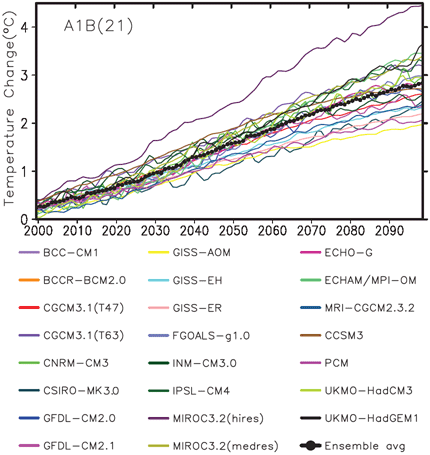
The fear of anthropogenic global warming is based almost entirely upon computerized climate model simulations of how the global atmosphere will respond to slowly increasing carbon dioxide concentrations. There are now over 20 models being tracked by the IPCC, and they project levels of warming ranging from pretty significant to catastrophic by late in this century. The following graph shows an example of those models’ forecasts based upon assumed increases in atmospheric carbon dioxide this century.


While there is considerable spread among the models, it can be seen that all of them now produce levels of global warming that can not be ignored.

But what is the basis for such large amounts of warming? Is it because we know CO2 is a greenhouse gas, and so increasing levels of atmospheric CO2 will cause warming? NO!…virtually everyone now agrees that the direct warming effect from extra CO2 is relatively small – too small to be of much practical concern.

No, the main reason the models produce so much warming depends upon uncertain assumptions regarding how clouds will respond to warming. Low and middle-level clouds provide a ‘sun shade’ for the Earth, and the climate models predict that those clouds will dissipate with warming, thereby letting more sunlight in and making the warming worse.

[High-altitude (cirrus) clouds have the opposite effect, and so a dissipation of those clouds would instead counteract the CO2 warming with cooling, which is the basis for Richard Lindzen's 'Infrared Iris' theory. The warming in the models, however, is now known to be mostly controlled by the low and middle level clouds – the “sun shade” clouds.]

But is this the way nature works?More... Our latest evidence from satellite measurements says “no”. One would think that understanding how the real world works would be a primary concern of climate researchers, but it is not. Rather than trying to understand how nature works, climate modelers spend most of their time trying to get the models to better mimic average weather patterns on the Earth and how those patterns change with the seasons. The unstated assumption is that if the models do a better job of mimicking average weather and the seasons, then they will do a better job of forecasting global warming.

But this assumption can not be rigorously supported. To forecast global warming, we need to know how the average climate state — and especially clouds — will change in response to the little bit of warming from the extra CO2. Indeed, the model that best replicates the average climate of the Earth might be the worst one at predicting future warming.

This fact gets glossed over – or totally ignored – as the IPCC dazzles us with the level of effort that has been invested in computer modeling of the climate system over the last 20 years. The IPCC can show how many people they have working on improving the models, how many years and how much money has been invested, how big and fast their computers are, and how many peer-reviewed scientific publications have resulted.

But unless we know how clouds change with warming, it is all a waste of time from the standpoint of knowing how serious manmade global warming will be. Even the IPCC admits this is their biggest uncertainty…so why is so little work being done trying to answer that question?

AN APPEAL TO THE DECISION MAKERS

We now have billions of dollars in satellite assets orbiting the Earth, continuously collecting high-quality data on natural, year-to-year changes in climate. I believe that these satellite measurements contain the key to understanding whether manmade global warming will be catastrophic, or merely lost in the noise of natural climate variability.

That is why I spend as much time as I can spare trying to understand those satellite measurements. But we need many more people working on this effort. Despite its importance, I have yet to meet anyone who is trying to do what I am doing.

To be fair, the modelers do indeed compare their models to satellite measurements. But those comparisons have not been detailed enough to answer the most important questions…like how clouds respond to warming.

The comparisons they have done have been confusing and inconclusive, which is part of the reason why they don’t rely on the satellite measurements very much. The modelers claim that the satellite measurements have been too ambiguous, and so they increasingly rely only upon the models.

But I will continue to assert (until I am blue in the face or die, whichever comes first) that their confusion stems from a very simple issue they have overlooked: mixing up cause and effect. The previous satellite observations that showed clouds tend to decrease with warming does not mean that warming causes clouds to decrease!

We have recently submitted to Journal of Geophysical Research a research paper that shows how one can tell the difference between cause and effect — between clouds causing a temperature change, and temperature causing a cloud change. And when this is done during the analysis of satellite data, it is clear that warming causes an increase in the sunshade effect of clouds. (While the data did suggest strong positive water vapor feedback, which enhances warming, that was far exceeded by the cooling effect of negative feedback from cloud changes.)

These results suggest that the climate system has a strong thermostatic control mechanism – exactly opposite to the way the IPCC models have been programmed to behave — and that the widespread concern over manmade global warming might well be a false alarm.

The potential importance of this result to the global warming debate demands a reexamination of all of the satellite data that have been collected over the last 25 years, with the best minds the science community can spare. Simply asserting that ‘Dr. Spencer does not know what he is talking about’ will not cut it any more.

We now have two papers in the peer-reviewed scientific literature that paved the way for this work (here and here), and so one can not simply dismiss the issue based upon some claim that we ‘skeptics’ do not publish our work.

I just presented our latest results at the NASA CERES Team meeting to about 100 attendees, and there were no major objections voiced to my analysis of the results. (CERES is the instrument that monitors how global cloud changes affect the energy balance of the Earth). I was pleased to see that there are still some scientists who are interested in the science.

Rather than simply asserting that I am wrong, why not take a fresh look at the data that have been collected over the years? Given the importance of the issue, it would seem to be the prudent thing to do. A red team-blue team approach is needed here, with the red team specifically looking for evidence that the IPCC has been wrong in their previous evaluation of the satellite data.

I suggested this years ago in congressional testimony, but one thing I’ve learned is that most congressional hearings are not designed to uncover the truth.

Maybe those in control of the research dollars are afraid of what might be found if the research community looked too closely at the satellite measurements. There are now billions — if not trillions — of dollars in future taxes, economic growth, and transfers of wealth between countries that are riding on the climate models being correct.

Scientific debate has all been shut down. The science of climate change was long ago taken over by political interests, and I am not hopeful that the situation will improve anytime soon. But I will continue to try to change that.


April 8, 2009

Cheetah it ain't


from Roy Spencer PhD

The 800 Pound Gorilla in the Climate System

The issue of global warming has so many facets that it has always been difficult to concisely state the objections we skeptics have to the theory (yes, ‘theory’) that our present warmth is caused by all of you consumers out there driving your SUVs and eating Big Macs. What follows is a demonstration of my main objection.

The claim that global warming is due to people is indeed a valid hypothesis. Human activity produces carbon dioxide, carbon dioxide in the atmosphere is increasing, and CO2 is indeed a greenhouse gas. Ergo….

But how often in science is it decided that the first hypothesis to come along will forever be the only one allowed? That is effectively what the United Nations Intergovernmental Panel on Climate Change (IPCC) has done.

Ever since the IPCC was formed twenty years ago, their intent has been to tie global warming to human greenhouse gas emissions. They have never seriously investigated potential natural sources of global warming…except to say they can’t think of any that are large enough to cause the warming.

They then run their climate models with tiny forcings, such as a tiny change in solar output, and then say, “See? Natural forcings can not explain warming…only increasing CO2 can!” This conclusion is then advertised with words like “this demonstrates that natural forcings can not explain global warming”.

As I keep emphasizing, though, this only shows how little we know about natural climate variability. The assumption that the climate system has always been in balance, with a constant temperature, until humans came along is just that: an assumption. There is no way to prove it because we do not have the global measurements needed to prove it...........