
Pages

March 11, 2009


from WUWT

March 10, 2009

Friedman: Climate-change doubters are 'crazy radicals'


entire article

» How do you convince skeptics, especially Western American conservatives, who doubt human links to climate change?

» There are few genuine skeptics, but many who claim they are do so simply because they dislike the solutions. Scientists support the theory with near unanimity. Those who ignore them are not conservatives, Friedman said, but "crazy radicals."


"Skeptics From Around The Globe"

JAPAN


Dr. Takeda Kunihiko, vice-chancellor of the Institute of Science and Technology Research at Chubu University in Japan


“CO2 emissions make absolutely no difference one way or another….Every scientist knows this, but it doesn’t pay to say so…Global warming, as a political vehicle, keeps Europeans in the driver’s seat and developing nations walking barefoot.”

Skeptics From Around the Globe

PORTUGAL


Professor Delgado Domingos, one of the leading Portuguese environment scientists-founder of the Numerical Weather Forecast Group


“Creating an ideology pegged to carbon dioxide is a dangerous nonsense…The present alarm on climate change is an instrument of social control, a pretext for major businesses and political battle. It became an ideology, which is concerning.”

Skeptics From Around the Globe

NEW ZEALAND


Dr. Geoff Duffy Professor of Chemical Engineering, Department of Chemical and Materials Engineering -Associate Dean Research, School of Engineering University of Aukland (New Zealand)


“Even doubling or tripling the amount of carbon dioxide will virtually have little impact, as water vapour and water condensed on particles as clouds dominate the worldwide scene and always will.”

Climate Change: Driven by the Ocean not Human Activity


Entire Paper

by
William M. Gray
Professor Emeritus, Dept of Atmospheric Science,
Colorado State University

..Recent GCM global warming scenarios assume that a slightly stronger hydrologic cycle (due to the increase in CO2) will cause additional upper-level tropospheric water vapor and cloudiness. Such vapor-cloudiness increases are assumed to allow the small initial warming due to increased CO2 to be unrealistically multiplied 2-4 or more times. This is where most of the global warming from the GCMs comes from – not the warming resulting from the CO2 increase by itself but the large extra warming due to the assumed increase of upper tropospheric water vapor and cloudiness. As CO2 increases, it does not follow that the net global upper-level water vapor and cloudiness will increase significantly. Observations of upper tropospheric water vapor over the last 3-4 decades from the National Centers for Environmental Prediction/National Center for Atmospheric Research (NCEP/NCAR) reanalysis data and the International Satellite Cloud Climatology Project (ISCCP) data show that upper tropospheric water vapor appears to undergo a small decrease while Outgoing Longwave Radiation (OLR) undergoes a small increase. This is opposite to what has been programmed into the GCMs. The predicted global warming due to a doubling of CO2 has been erroneously exaggerated by the GCMs due to this water vapor feedback.....

March 9, 2009

"Notable Quotes"


"The moment one has offered an original explanation for a phenomenon which seems satisfactory, that moment affection for his intellectual child springs into existence, and as the explanation grows into a definite theory his parental affections cluster about his offspring and it grows more dear to him...As this parental affection takes possession of the mind, there is a rapid passage to the adoption of the theory. There is an unconscious selection and magnifying of phenomena that fall into harmony with the theory and support it, and an unconscious neglect of those that fail of coincidence...

When these biasing tendencies set in, the mind rapidly degenerates into the partiality of paternalism. The search for facts, the observation of phenomena and their interpretation, are all dominated by affection for the favored theory until it appears to its author or its advocate to have been overwhelmingly established. The theory then rapidly rises to the ruling position, and investigation, observation, and interpretation are controlled and directed by it. From an unduly favored child, it readily becomes master, and leads its author whithersoever it will...

When the last stage has been reached, unless the theory happens, perchance, to be the true one, all hope of the best results is gone."

T.C. Chamberlain

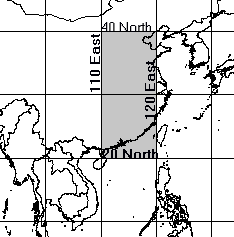
Huge Urban Heat Island UHI contamination in Hadley Centre-Jones-IPCC CRUT3 land temperature data over Eastern China


Errors in IPCC climate science

Now that the NASA-UAH satellite temperature data extends over a clear 30 years 1979-2008, this is a timely opportunity to check again the old IPCC canard that the various global temperature datasets are in agreement. In this case I compare the Hadley Centre CRUT3 land only data 1979-2008 with the NASA MSU LT data from University of Alabama at Huntsville, all data downloaded from the KNMI Climate Explorer.


For this grid-box over Eastern China 110 to 120 degrees East and 20 to 40 degrees North, satellites show the lower troposphere warms at 0.20 degrees per decade while the Hadley Centre land data warms at 0.46 degrees per decade. This suggests that there is 0.26 degrees per decade of urban warming in the Hadley Centre-IPCC data. A rate equivalent to 2.6 degrees per century.
This is twenty years after the UHI contamination in these Jones et al datasets was brought to the authors attention by Dr Fred Wood.

"Notable Quotes"


"Carbon is the building block for all life on earth. It provides all of the food and most the energy for the human race. Carbon dioxide is a tiny part of the atmosphere, yet it sustains all life on earth. It is NOT a pollutant. To be anti-carbon is to be anti-life and anti-human".
- Viv Forbes, Pasture Manager, Soil Scientist and Geologist

March 8, 2009

"Notable Quotes"


“Truth can only be arrived at by consideration and comparison of opposing ideas. Preventing such consideration is a suppression of truth.”

Al Gore, The Assault on Reason p11 paragraph 2

Last Week at the WSJ’s Eco:nomics conference in California

But he was challenged by Mr. Lomborg, the Danish skeptical environmentalist who thinks the world would be better off spending more money on health and education issues than curbing carbon emissions.

“I don’t mean to corner you, or maybe I do mean to corner you, but would you be willing to have a debate with me on that point?” asked the polo-shirt wearing Dane.

“I want to be polite to you,” Mr. Gore responded. But, no. “The scientific community has gone through this chapter and verse. We have long since passed the time when we should pretend this is a ‘on the one hand, on the other hand’ issue,” he said. “It’s not a matter of theory or conjecture, for goodness sake,” he added.



Well I guess suppression of the truth is not such a bad thing after all.

Chances of climate change accord 'are sinking'

We have good news and bad news. The good news is the wacky scientist probably won't succeed in totally destroying the global economy- The bad news is that they will instead push to geo-engineer the climate to save us from ourselves.


TIMES

Two leading climate scientists have broken ranks with their peers to declare that hopes of getting a meaningful deal on halting global warming this year are already lost.

Professor Kevin Anderson, director of the Tyndall Centre for Climate Change Research, and Professor Trevor Davies, one of the centre's founders, told The Times that it was time to start looking for alternatives to an international deal.

They made their comments on the eve of a three-day conference in Copenhagen this week in which thousands of climate change researchers will meet to discuss the latest discoveries in the field. The findings will be used in December when world leaders attend a UN summit, also in Copenhagen, to try to work out an international treaty on greenhouse gas emissions.

Professor Anderson and Professor Davies expect politicians at the summit merely to pay lip service to scientific evidence that greenhouse gas emissions need to be brought under control within a decade, if not sooner. They said that rather than wait for an international accord it was time now to consider what action could be taken.

“We all hope that Copenhagen will succeed but I think it will fail. We won't come up with a global agreement,” Professor Anderson said. “I think we will negotiate, there will be a few fudges and there will be a very weak daughter of Kyoto. I doubt it will be significantly based on the science of climate change.”

He is certain that negotiators will place a heavy reliance on technological solutions that have yet to be invented or proven, rather than recognise the scale and urgency of the problem. Professor Anderson believes that the severity of the likely impacts of climate change has been underplayed, and that to doubt that temperature rises could be limited to 2C is a political heresy.

He said that scientists had been held back from voicing their doubts. “The consequences of the numbers we come up with are politically unacceptable. It's difficult for people to stand up. To rock the boat significantly is difficult for them.”

Professor Davies, Pro-Vice Chancellor of the University of East Anglia (UEA), where the Tyndall Centre is based, shares this assessment and regards geoengineering schemes as a potential insurance policy.

The GeoEngineering Assessment and Research initiative (Gear) has now been set up at UEA to assess the projects that have been suggested. Among the geoengineering solutions that have been proposed are putting mirrors into orbit to reflect sunlight away from Earth, and encouraging the growth of plankton by pouring nutrients into the oceans.

“An increasing number of scientists are talking about Plan B now, the big, global geoengineering things,” Professor Davies said. “That's one of the reasons we've set up this centre - not that we think many of the aspects are sensible but because we think it's necessary to assess them.”

"Notable Quotes"


"The prospect of domination of the nation's scholars by Federal employment, project allocations, and the power of money is ever present and is gravely to be regarded.

Yet, in holding scientific research and discovery in respect, as we should, we must also be alert to the equal and opposite danger that public policy could itself become the captive of a scientific technological elite."


- Dwight Eisenhower speech, 1961

Skeptics From Around the Globe -Czech Republic

Note:
I was not going to use non-scientist in my "Around The Globe" profiles, certainly not politicians, even if he is the Czech President and former Prime Minister. He is also an economist which technically qualifies him as a scientist. Many of the members of the IPCC are economist including Dr. Rajendra Pachauri, the Chairman of the scientific organization, who along with ALGORE (a politician) accepted the Nobel Peace Prize for their work on global warming. So I guess Mr. Klaus is twice as qualified , since he is both an economist and a politician and unlike ALGORE an actual President no less :)


CZECH REPUBLIC

Vaclav Klaus, Czech Republic President

"Global warming is a myth and I think that every serious person and scientist says so. It is unfair to refer to the United Nations panel. IPCC is not a scientific body: it's a political institution, a kind of non-government organization with green flavor. It's not a forum of neutral scientists or a balanced group of scientists. Its members are politicized scientists who arrive there with one-sided sentiments and one-sided tasks. Also, it's an undignified practical joke that people don't wait for the complete report that will appear in May 2007 but instead react, in such a serious manner, to the summary for policy makers where all the "ifs" and "whens" and "buts" are scratched, erased, and replaced by oversimplified theses."


"I see another big problem in environmentalism and in its currently most aggressive form – global warming alarmism. This ideology has gradually turned into the most efficient vehicle for advocating extensive government intervention into all fields of life and for suppressing human freedom and economic prosperity."

March 7, 2009

The Other Side Of The Story


brought to you by- Watts Up With That ?

Basic Geology Part 3 - Sea Level Rises During Interglacial Periods

Guest post by Steven Goddard

One of the most cited “proofs” of global warming is that sea level is rising, as can be seen in the graph below.


http://sealevel.colorado.edu/current/sl_noib_global_sm.jpg

This is a nonsensical argument, because sea level would be rising even if temperatures were going down, as they have been since 2002. The main reason why sea level rises is because the equilibrium between glacial ice and temperature is out of balance, and has been for the last 20,000 years.


http://www.globalwarmingart.com/wiki/Image:Post-Glacial_Sea_Level_png

Note that from 15,000 years ago to 8,000 years ago, sea level rose about 14mm/year - which is more than four times faster than the current rise rate of 3.3mm/year, as reported by the University of Colorado. During the last ice age, sea level was so low that people were able to walk from Siberia to Alaska across the Bering Strait. One of the more stunning pieces of evidence of this is the remarkable similarity of appearance and culture between the indigenous peoples of Eastern Siberia and North America.
In 2002, the BBC reported that a submerged city was found off the coast of India, 36 meters below sea level. This was long before the Hummer or coal fired power plant was invented. It is quite likely that low lying coastal areas will continue to get submerged, just as they have been for the last 20,000 years. During the last ice age, thick glaciers covered all of Canada and several states in the US, as well as all of Northern Europe. As that ice melts, the water flows into the ocean and raises sea level


http://uk.encarta.msn.com/media_461527006/ice_extent_during_the_last_ice_age.html

The IPCC has stated that sea level may rise two meters this century, which would be a rate of 22mm/year, nearly seven times faster than current rates. Do we see such an acceleration? The simple answer is no. There has been very little change in sea level rise rates over the last 100 years, certainly nothing close to the immediate 7X acceleration which would be required to hit 2 meters.


http://www.globalwarmingart.com/images/thumb/0/0f/Recent_Sea_Level_Rise.png/700px-Recent_Sea_Level_Rise.png

Sea level is rising, and the abuse of this information is one of the most flagrantly clueless mantras of the alarmist community.

Even if we returned to a green utopian age, sea level would continue to rise at about the same rate - just as has done since the last glacial maximum.


-The end-

Anti-CO2 Campaign Like An Atom Bomb On U.S. Economy


By S. FRED SINGER

The CO2 wars have begun. Presumably following White House directions, the EPA is ready to issue an "Endangerment Finding" on carbon dioxide, paving the way for regulations to control CO2 emissions. But with over one million "major stationary sources," a full-blown application of the Clean Air Act would be the equivalent of an atomic bomb directed at the US economy — all without any scientific justification. Hence there is speculation that the White House strategy is to use the threat of EPA regulation to force Congress to take action.

The CO2 wars have begun. Presumably following White House directions, the EPA is ready to issue an "Endangerment Finding" on carbon dioxide, paving the way for regulations to control CO2 emissions. But with over one million "major stationary sources," a full-blown application of the Clean Air Act would be the equivalent of an atomic bomb directed at the US economy — all without any scientific justification. Hence there is speculation that the White House strategy is to use the threat of EPA regulation to force Congress to take action.

Is this just a bluff — and how will Congress respond, in view of the financial meltdown, failure of emission-trading in Europe, and Chinese refusal to cut CO2 emissions? The answer seems to be:

"Not this year!"

An endangerment finding that CO2 is detrimental to "health and human welfare" must be based on scientific facts — and they will certainly be disputed. Furthermore, in July 2008 the EPA issued an Advance Notice of Proposed Rulemaking and there have been many negative comments to which the EPA must respond — under threat of litigation.

So, proposed action by EPA is not a "done deal" and may only be an empty threat. Many in Congress understand these matters well — or should. With fossil fuels supplying over 85 percent of all energy in the US, there will be much hesitation before passing any CO2 legislation. Keep in mind also that the Senate once turned down Kyoto-like regulation by unanimous vote and recently defeated attempts to pass Cap & Trade bills to place national limits on CO2 emission — a costly method of rationing, even if emission permits can be traded.

Short of direct regulation by mandates, Cap & Trade is probably the worst possible scheme, involving not only reporting of emissions, monitoring, inspection, and punishment, but also special deals for favored industries and other parties. Some in Congress therefore like the idea of Cap & Trade, which does not sound like a tax but would cost even more. The White House estimate is $650 billion over an eight-year period. And of course, it would be an open invitation to lobby Congress for special favors: the "Lobbyists Full Employment Act of 2009."

One of the worst features of Cap & Trade is the idea of "soft caps," which would allow Congress to increase the yearly allowance if the price for permits seems too high. In essence, anyone who bought emission permits for future use could find his investment nullified by Act of Congress. This feature alone may scuttle the legislation.

Professional economists, in and out of the government, prefer a straight carbon tax to Cap & Trade: it is more transparent, easier to administrate, and less subject to abuse. But here too Congress can legislate exemptions — as it does for any other tax. For example, should fire departments and police departments pay a carbon tax on their fuel use? Should hospitals? Clergy? Department of Defense?

A carbon tax would of course represent a huge subsidy — not only to uneconomic biofuels, like corn-based ethanol, but also to nuclear energy. Environmental lobbies would object and soon argue for an all-encompassing energy tax — not just on fossil fuels. But of course, they would try to exempt biofuels, wind and solar.

Perhaps the only tax that makes sense is a tax on motor fuels, principally gasoline — even if one is not concerned about global warming. It would reduce the amount of driving, decrease oil use and imports, congestion and traffic deaths. It could be raised gradually, perhaps to the four-dollar level of last year, and kept there — independent of the price of crude oil. It could be made revenue-neutral and used to eliminate other regressive taxes.
But why reduce CO2 emission at all?

• CO2 is not a "pollutant." The best evidence we have from climate science shows that any warming from the emission of greenhouse gases is insignificant — contrary to claims by the UN-IPCC. See the NIPCC report, Nature Not Human Activity Rules the Climate, at www.sepp.org.
• The climate has not been warming since 1998 — in spite of steadily rising CO2 levels. But even if it were warming, reputable economists have shown that it would yield overall benefits. For details, see the NIPCC report.

• Finally, the level of CO2 is now largely controlled by emissions from China. But even if all nations were to cut emissions according to the Kyoto Protocol, CO2 levels would continue to rise, albeit at a slightly slower rate.

We conclude therefore that the drive to reduce CO2 emissions is not concern about climate. After all, there are no comparable efforts to limit the global emission of methane, a potent greenhouse gas; perhaps because methane comes from farming and cattle-raising, while CO2 is associated with energy production and industry, and therefore considered "bad."
Ultimately, ideology may be what's fueling the CO2 wars.

Atmospheric physicist S. Fred Singer is Professor Emeritus of Environmental Sciences at the University of Virginia and served as the founding director of the US Weather Satellite Service. He is the founder of the Science and Environmental Policy Project and author of "Unstoppable Global Warming Every 1500 Years".

March 6, 2009

Snails emit laughing gas


Worms are not alone! here


source

A new Danish scientific report says that snails and other small animals emit worrying amounts of laughing gas into the atmosphere.


A recent proposal from the Danish Tax Commission unsuccessfully proposed imposing a flatulence tax on ruminants because of their greenhouse gas emissions. That proposal was not part of the final tax reform agreement announced on Sunday.

Now, new Danish scientific research shows that small animals such as snails, worms, larvae and crustaceans emit large and worrying amounts of nitrous oxide – also known as laughing gas – into the atmosphere.

Nitrous oxide is a strongly destructive greenhouse gas some 300 times stronger than CO2. A Team of researchers from Århus University under the leadership of Assistant Professor Peter Stief has now shown that the worst producers of nitrous oxide are smaller animals in polluted water.

Cleaner water
“The problem is greatest where water is polluted with nitrogen. So efforts to develop a cleaner aquatic environment would not just affect de-oxygenation but also have an effect on the climate balance,” says Associate Professor Andreas Schramm of the Biological Institute.

Unfortunately, however, global developments are going in the opposite direction towards more intensive agriculture and an increased use of fertilisers which will increase the amount of nitrogen seepage.

“That means more polluted aquatic environments in which small animals emit large amounts of nitrous oxide into the atmosphere. This is not just a minor issue but a development that is increasingly important and is getting worse,” he tells Ritzau.


March 5, 2009


To Tell The Truth


If an honest man is wrong, after demonstrating that he is wrong, he either stops being wrong or he stops being honest.

- Anon

Have you ever made a mistake? Of course you have, we all have -many for most of us. For some people it is easy to admit a mistake once identified, for others it is more difficult. "To ere is human" they say but pride or even arrogance can certainly get in the way of admitting an error, even an innocent one. There are several ways you can deal with a mistake, believe me, I have tried them all.

First and best, as we all know, is to admit it and move on. Second you can deny it and move on, not as good obviously but it is a solution. The other is to lie about it and try to move on. The problem with this approach is that once you lie about a mistake, depending on the mistake, you could spend a great deal of time defending, covering up and even lying to cover up the original lie and mistake. Sort of that "tangled web we weave" theory. We can weave that web so thoroughly that we lose site of the original reality and in our attempt to justify it, as inevitably must happen in order to live with ones self we believe our lie.

Lies, as we all know, come in assorted forms, not necessarily just the telling or representation of a falsehood, but it can also be the neglect to correct a known falsehood, that old lie of omission rather than commission. We can also lie by just ignoring that which does not fit into our new accepted reality, the reality that was caused by our mistake, which we lie about in order to live with our self.

The famous American Geographer T.C. Chamberlain wrote:


"The moment one has offered an original explanation for a phenomenon which seems satisfactory, that moment affection for his intellectual child springs into existence, and as the explanation grows into a definite theory his parental affections cluster about his offspring and it grows more dear to him...As this parental affection takes possession of the mind, there is a rapid passage to the adoption of the theory. There is an unconscious selection and magnifying of phenomena that fall into harmony with the theory and support it, and an unconscious neglect of those that fail of coincidence...

When these biasing tendencies set in, the mind rapidly degenerates into the partiality of paternalism. The search for facts, the observation of phenomena and their interpretation, are all dominated by affection for the favored theory until it appears to its author or its advocate to have been overwhelmingly established. The theory then rapidly rises to the ruling position, and investigation, observation, and interpretation are controlled and directed by it. From an unduly favored child, it readily becomes master, and leads its author whithersoever it will...

When the last stage has been reached, unless the theory happens, perchance, to be the true one, all hope of the best results is gone."


A very good explanation of scientific pride. Make no mistake, a large portion of the scientific world and a majority of the climate science world is now heavily invested "parental affection" of man made global warming belief structure. There is no doubt that the entire climate science community has not only been extensively financed but it's very meaning defined by the global warming theory. Take this comment of one of the most respected climate scientist in the world, the first woman to receive a PhD. Dr. Joanne Simpson:


Since I am no longer affiliated with any organization nor
receiving any funding, I can speak quite frankly
….As a scientist I remain skeptical...The main basis of the claim that man’s release of greenhouse gases is the cause of the warming is based almost entirely upon climate models. We all know the frailty of models concerning the air-surface system."


Consider that quite apart from what she said about climate models, the fact that she was affiliated with an institution , a government institution no less NOAA, that received funding based upon climate change science, restricted her from speaking frankly about her true thoughts about global warming. She is now able to speak frankly about a subject which she is a renowned world expert, but felt constrained from so doing prior to her retirement.

Over and over again prominent scientist retire or get close to retirement from their various institutions or agencies and then they feel comfortable about expressing their true opinions. Here is another example, retired senior NASA atmospheric scientist Dr. John S. Theon had this to say.


"My own belief concerning anthropogenic climate change is that the models do not realistically simulate the climate system because there are many very important sub-grid scale processes that the models either replicate poorly or completely omit. Furthermore, some scientists have manipulated the observed data to justify their model results. In doing so, they neither explain what they have modified in the observations, nor explain how they did it. They have resisted making their work transparent so that it can be replicated independently by other scientists. This is clearly contrary to how science should be done. Thus there is no rational justification for using climate model forecasts to determine public policy."


Granted Dr. Theon has been retired from NASA for many years but the fact that his now so adamantly expressing them is striking. Dr Roy Spencer another former NASA scientist gives a possible explanation, on his web site he writes:


And now my old boss when I was at NASA (as well as James Hansen’s old boss), John Theon, has stated very clearly that he doesn’t believe global warming is manmade…and adding “climate models are useless” for good measure. Even I wouldn’t go quite that far, since I use simple ones in my published research. I remember the old days at NASA, when even John Theon was singing the same tune as most people at NASA were. Manmade global warming was a potentially serious threat, and NASA wanted Congress to fund new satellites to study the problem. It was a team effort to get that accomplished.


Global warming research was a relatively new field back then. Was Theon always skeptical, and just being a team player at the time? I don’t know. It could be that Dr. Theon, after watching 15 years of climate research go by, decided that he was no longer convinced that mankind was at fault for warming.


We all know that government agencies as well as most institutional entities do no willingly cut their own budgets. In fact it is a well know practice to spend every last dime of budgeted money so as not to lose funding the next year and to justify budget increases, it is one of many reasons why governments are so inefficient.

A scientist who is employed by an institution whose funding is directly tied to a particular outcome is wont to find fault in that outcome, particularly when it may jeopardize his/her own career and financial security. As Upton Sinclair once noted"It is difficult to get a man to understand something when his job depends on not understanding it."

Lest we think that scientist simply because they are scientist are beyond such mortal sins as manipulation and deceit for prestige and money consider what a current atmospheric scientist recently observed:


“Scientists who want to attract attention to themselves, who want to attract great funding to themselves, have to (find a) way to scare the public . . . and this you can achieve only by making things bigger and more dangerous than they really are.”-Petr Chylek

Not that all scientist in the climate and related fields are unscrupulous or even deceitful, they don't need to be. The belief in the Global Warming mantra is so prevalent that it is just a matter of accepting the dogma and not being a critical or skeptical observer which is the true mission of a scientist. This would be a lie of omission, failure to take due diligence to insure accuracy. As old T.C. so eloquently if pointedly observed "The search for facts, the observation of phenomena and their interpretation, are all dominated by affection for the favored theory until it appears to its author or its advocate to have been overwhelmingly established." Obviously this is not a new phenomena in the scientific community.

Even a casual observation of the science of global warming shows the bias towards predetermined outcomes and the tendency to make "things bigger and more dangerous than they really are."


Dr John Everett on his excellent web site make the following observation:


When reviewing impact assessments, look for bias. Often the authors think only of negative changes. This is not necessarily because of personal agendas (such as to assist animals, clean the air, or reduce the birth rate), but is primarily due to human nature. To guard against having a biased report, one should look for balance. Does the material articulate that things will be different and that there are pluses and minuses? There may well be more of one than another. Sometimes balance is reflected in the amount of text, or graphics made to illustrate impacts and often it is reflected in the number of negative versus positive impacts....

He then goes on to give examples and explain how they are being treated. I'll let the reader decide if the current state of scientific discourse on global warming has given us a balanced or even a fair representation of the risk versus rewards of the affects of global warming.

I fear that the process is so far down the road, that the interest of the scientific community is so vested in maintaining the current dogma, to demonizing opposing views and even stifling contrary research findings, the general public has little chance of receiving a fair airing of the truth.

Worse yet the policies being implemented by governments around the world based on shoddy and sometimes corrupted sciences will inevidably lead to civil unrest once the truth is ultimately exposed, which it ultimately will be. Because one thing we all learn about lies is that they are always ultimately exposed. That is a law of God or nature depending on your belief structure, that has been proven for longer than the denial of the cookie jare theft.

But until then we must take what is fed us from the scientist with a sceptisism that the science community is currently unable or unwilling to impose on itself.


"Basically, the problem is that the research community has gone so far along the path of frightening the life out of the man in the street that to recant publicly even part of the story would massively damage the reputation and political clout of science in general. And so, like corpuscles in the blood, researchers all over the world now rush in overwhelming numbers to repel infection by any idea that threatens the carefully cultivated belief in climatic disaster. "

Garth Paltridge


Jer

Two years of cooling has destroyed global warming consensus


from American Daily

Last June I found myself somewhere over Central America at about 37,000 feet in a 757, en route to the Andes Mountains in Peru for an annual missionary trek that I have been a part of since 1999. While getting a cup of coffee in the galley in the rear of the aircraft, I struck up a conversation with a Peruvian who wanted to know what a Gringo was doing traveling to his country for the eighth time in ten years. I explained that our treks through the mountains to visit different villages of indigenous Quechua often took us through passes or pasos de portachuelos at the edge of snow fields starting around 16,000 feet.

In ten or twenty years all the snow and ice will be gone from the Nevados of the Cordillera Blanca because of global warming, he said to me in Spanish.

So when I arrived a day later in the city of Huaraz in the Callejon de Huaylas, I was curious to see if in fact the glaciers had retreated and if the snow cover was reduced from prior years. What I learned was in fact, just the opposite—from my own photographs and from the testimonies of the people with whom I spoke over the next two weeks.

Despite the ‘consensus’ of scientists that we are told agree that global warming is a fact, I observed more snow on the mountains, the glaciers had seemingly grown in size, and the climate had become noticeably cooler. The locals—virtually all of them farmers—confirmed this. And last year was in fact the first year we had hiked through the Cordillera Negra—the more temperate and dryer range of the Peruvian Andes—and experienced cloudy days with wind-blown chilling rains.

Consensus is a dangerous thing. Remember the great scare over Y2K, when some of the most brilliant minds of our generation arrived at a “consensus” that predicted the end of the world at midnight on December 31, 1999?

In a similar vein we have the economic crisis of 2008—a grand mal version of the Bernie Madoff-Ponzi Scheme that duped some of the best minds of the finance world. The consensus of a majority of leading economists and bankers that included the then Treasury Secretary and the Chairman of the Federal Reserve was that the economy was sound only months before the world imploded.

As many governments of the world including the United States are poised to burden their citizens with a carbon tax, perhaps now would be a good time to reconsider whether the consensus is again very badly mistaken.


I am speaking about the consensus over anthropogenic (human-caused) carbon dioxide-induced global warming—or should I say what used to be called ‘global warming’ until the data that poured in over the last several years showing that the earth has cooled drastically has made its hysterical proponents employ the classic bait-and-switch use of the term ‘climate change’. Now any meteorological anomaly—can serve as ‘evidence’ for Apocalypse Now.

The consensus over climate change is largely based on suspect computer models that cannot predict the weather a week into the future let alone the state of the world’s climate decades from now. Much of the science is junk science and almost all of the data is subject to interpretation by humans many of which have their own ideologically driven agendas. This has been used to rally support from celebrities who along with the government are only too willing to help support the funding of pet research projects. There’s a religious, cult-like component requiring belief in “Gaia” or “Mother Earth” embraced by global warming proponent and billionaire Sir Richard Branson and movie director M. Night Shyamalan among others. And a complicit and largely science-challenged gaggle of mainstream journalists is all-too willing to cooperate in the cause-celebre.

Climate change should neither portend the end of the world nor should it come as a surprise to anyone familiar with the Earth’s climate history. There have been long epochs of warmer climate on the earth during the Medieval Warm Period, for example, which spanned 400 years from 1000-1400, and decades of colder climate such as the Little Ice Age, which spanned from the 16th to the mid-19th centuries.

It seems a touch arrogant for us humans to presume that because we have witnessed minor warming during the 20th century that this is unusual or worrisome. The book of Genesis reminds us: “While the earth remains, seedtime and harvest, cold and heat, winter and summer, and day and night shall not cease.” Who is to say that a slightly warmer earth would not be beneficial to mankind? During the Medieval Warm Period, infant mortality rates shrank throughout Europe as swamps dried up and the population of mosquitoes—vectors for a number of fatal diseases—shrank markedly.

My observations in the Peruvian Andes last June have been born out by a number of other scientists.

David Deming a geophysicist and Adjunct Scholar at the National Center for Policy Analysis and an Associate Professor of Arts and Sciences at the University of Oklahoma, writing in the Washington Times on December 10 stated, “…The last two years of global cooling have nearly erased 30 years of temperature increases. To the extent that global warming ever existed, it is now officially over. This year began with a severe spell of winter weather in China.

Observers characterized it as the largest natural disaster to hit China in decades. By the end of January, blizzards and cold temperatures had killed 60 people and caused millions to lose electric service. Nearly a million buildings were damaged and airports had to close. Hong Kong had the second-longest cold spell since 1885. A temperature of 33.6 degrees Fahrenheit was barely higher than the record low of 32 degrees F set in 1893. Other countries in Asia also experienced record cold…”

But not even colder than normal weather can dissuade the ‘climate-change’ fear mongers. After Nature published the results of a computer model showing that nearly the entire Antarctic continent had not cooled over the past 50 years, as the real-world observational data showed, but had warmed instead, Christopher Monckton, Chief Policy Adviser for the Science & Public Policy Institute commented that the analysis in the ‘warming Antarctic’ paper, “depends not on actual temperature measurements, nor on other observations from the real world, which unequivocally show that Antarctica has been cooling for half a century, but on statistical ‘interpolation’ of made-up data between the rather sparse observations from Antarctic research stations.”

Ironically, the point may be moot. Fred S. Singer, President and Founder of Science and Environment Policy Project explains, “Not long ago we learned that a cooling Antarctica was ‘consistent with’ greenhouse warming and thus the skeptics were wrong. So a warming Antarctica and a cooling Antarctica are both ‘consistent with’ model projections of global warming. Our foray into the tortured logic of ‘consistent with’ in climate science raises the perennial question, what observations of the climate system would be inconsistent with the model predictions?”

Deroy Murdock, a columnist with the Scripps Howard News Service, explained in December that the year 2008 was the coldest since 1997. With the winter of 2008-2009 barely underway, Murdock listed among other meteorological phenomena; an 8-inch snowstorm in New Orleans, a half-inch of snow in Malibu, three-inches in Las Vegas and snow across southern Brazil. He also cited temperature data showing that last summer was the third-coldest on record for Anchorage, Alaska causing a 13.5% expansion of Arctic sea ice—an area about the size of the state of Texas.

Murdock asked Dr. Martin Hertzberg, a physical chemist and retired Navy meteorologist, “So, is this all just propaganda concocted by Chevron-funded, right-wing, flat-Earthers?” Hertzberg’s answer was interesting. “As a scientist and life-long liberal Democrat, I find the constant regurgitation of the anecdotal, fear-mongering clap-trap about human-caused global warming to be a disservice to science.”

Murdock quotes from a letter written to British members of Parliament last October from Imperial College of London astrophysicist and long range forecaster Piers Corbyn: “Global Warming is over, and Global Warming Theory has failed. There is no evidence that CO2 drives world temperatures or any consequent climate change…According to official data in every year since 1998, world temperatures have been colder than that year, yet CO2 has been rising rapidly.”

He adds, “That evening, as the House of Commons debated legislation on so-called ‘global warming,’ October snow fell in London for the first time since 1922.”

Gregory J. Rummo

Gregory J. Rummo has an M.S. in chemistry. He is a businessman, syndicated columnist and the author of two books; “The View from the Grass Roots,” and “The View from the Grass Roots, Another Look.” Contact him through his website, http://GregRummo.com/

March 4, 2009

Burping Worms May Contribute to Climate Change

From Fox News

Aquatic animals that feed on lake and stream bottom sediments burp out small amounts of nitrous oxide, a potent greenhouse gas, a new study finds.


While the biological emissions from these critters pales in comparison to the nitrous oxide emitted by fossil fuel burning, their contribution could increase as more and more nitrogen-rich fertilizer runs off into lakes, streams and seas, the authors of the study said.


Nitrous oxide (N2O) is more commonly known to anyone who has sat in the dentist's chair as laughing gas.

In the atmosphere it is a powerful greenhouse gas, packing about 310 times the punch as the same weight of carbon dioxide (though carbon dioxide is still the bigger driver because there is much more of it).


Studies of soil-dwelling earthworms had showed that the creepy crawlies emitted nitrous oxide because of the nitrogen-converting microbes they gobbled up into their guts with every mouthful of soil.

Peter Stief, of the Max Planck Institute for Marine Microbiology in Germany, and his colleagues noticed that no one had ever looked for similar nitrous oxide emission in aquatic animals, so that's where they turned their attention.

"We were looking for an analogy in the aquatic system," Stief said.

The researchers found that in a variety of aquatic environments, animals that dug in the dirt for their food did indeed emit nitrous oxide, thanks to the bacteria in the soil they ate, which "survive surprisingly well in the gut environment," Stief told LiveScience.

The team's findings are detailed in the March 2 issue of the journal Proceedings of the National Academy of Sciences.

The nitrous oxide given off by these so-called filter feeders has little global impact of course.

"We're not expecting a new catastrophe," Stief said.

But on the scale of an individual lake or stream, "the difference can be huge," Stief said — as much as an 8-fold difference between situations where animals were and were not present.

Nitrate from fertilizer runoff can exacerbate the situation because those bacteria that end up in animal guts love to feast on it.

Increased nitrogen levels can also favor algal blooms, which suck up all the oxygen in the water. This could cause a shift in the ecosystems subjected to runoff, favoring the species that are more tolerant to oxygen depletion, which also tend to be the nitrous oxide emitters.

Because these species tend to be at the bottom of the food chain, any shifts in species abundance can cascade up the food chain, Stief noted.

The findings don't mean that animals will be to blame for any future increases in nitrous oxide, because the pollution would fuel their emissions ultimately comes from humans.

"We have not discovered that the animals represent an environmental problem," Stief said.

The research was supported by a European Union Marie Curie Fellowship, the Danish Research Agency and Aarhus University, Denmark.


March 3, 2009

The Other Side Of The Story


Climate alarmists generally refer to current temperatures as being both unprecedented and unnatural, due to what they claim is anthropogenic-induced global warming, caused primarily by mankind's CO2 emissions. They further contend that this "unnaturalness" is most vividly expressed throughout the Arctic. We here investigate this claim within the context of the past five glacial-interglacial cycles, based on scientific studies conducted in this climatically-sensitive part of the world.


Beginning with the current interglacial or Holocene, Darby et al. (2001) developed a 10,000-year multi-parameter environmental record from a thick sequence of post-glacial sediments obtained from cores extracted from the upper continental slope off the Chukchi Sea Shelf in the Arctic Ocean. As they describe it, they uncovered evidence that revealed "previously unrecognized millennial-scale variability in Arctic Ocean circulation and climate," along with evidence that suggested that "in the recent past, the western Arctic Ocean was much warmer than it is today." More specifically, they say that "during the middle Holocene the August sea surface temperature fluctuated by 5°C and was 3-7°C warmer than it is today," and they report that their data revealed "rapid and large (1-2°C) shifts in bottom water temperature," concluding that "Holocene variability in the western Arctic is larger than any change observed in this area over the last century." And since there is no evidence the air's CO2 concentration was either higher or fluctuating wildly during this period (it was, in fact, lower and very stable) something else had to have been responsible for the significantly warmer and more variable climate of that time and place, which suggests there is no compelling reason to invoke the historical increase in the air's CO2 content as the cause of the less dramatic temperature increase of the past century.


Four years later, Miller et al. (2005) summarized the main characteristics of the glacial and climatic history of the Canadian Arctic's Baffin Island since the Last Glacial Maximum by presenting biotic and physical proxy climate data derived from six lacustrine sediment cores recovered from four sites on Baffin Island, after which the paleoenvironmental implications of the new data were combined with the findings of prior studies to develop a regional picture of climatic conditions during deglaciation, the subsequent Holocene thermal maximum, the onset of Neogolaciation and its intensification in the late Holocene. This work revealed, in their words, that (1) "glaciers throughout the Canadian Arctic show clear evidence of Little Ice Age expansion, persisting until the late 1800s, followed by variable recession over the past century," that (2) wherever the Little Ice Age advance can be compared to earlier advances, "the Little Ice Age is the most extensive Late Holocene advance," and, in fact, that (3) "some glaciers remain at their Little Ice Age maximum." And because the Little Ice Age in the Canadian Arctic spawned the region's most extensive glacial advances of the entire Holocene, and because many of the resulting glaciers persisted into the late 1800s, with some still remaining at their maximum Little Ice Age extensions, it is only to be expected that the region should be experiencing a significant warming as the planet recovers from the global chill of this coldest phase of the entire Holocene, independent of whatever the air's CO2 concentration may be doing concurrently, since the atmosphere's CO2 concentration had absolutely nothing whatsoever to do with the planet's descent into this coldest of its Holocene climatic phases.


Two years later still, and also working with sediment cores recovered from three mid-Arctic lakes on the Cumberland Peninsula of eastern Baffin Island in the Canadian Arctic, Frechette et al. (2006) employed radiocarbon dating of macrofossils they contained, together with luminescence dating, to isolate and study the portions of the cores pertaining to the interglacial that proceeded the Holocene, which occurred approximately 117,000-130,000 years ago, reconstructing the past vegetation and climate of the region during this period based on pollen spectra derived from the cores. This work revealed that "in each core," as they describe it "last interglacial sediments yielded remarkably high pollen concentrations, and included far greater percentages of shrub (Betula and Alnus) pollen grains than did overlying Holocene sediments." And they say that "from applications of both correspondence analysis regression and best modern analogue methodologies, we infer July air temperatures of the last interglacial to have been 4 to 5°C warmer than present [our italics] on eastern Baffin Island," which warmth was greater than that of any interval within the Holocene. Giving even more weight to their results, they say their temperature reconstruction is "directly comparable to both earlier qualitative estimates (LIGA Members, 1991; Bennike and Bocher, 1994), as well as more recent quantifications from ice core (NGRIP Members, 2004) and pollen (Andreev et al., 2004) analyses."


In a companion study, Francis et al. (2006) analyzed midge remains found in cores recovered from two of the same Baffin Island lakes (Fog Lake and Brother of Fog Lake) for which Frechette et al. analyzed pollen spectra, reconstructing lake water temperatures and mean July air temperatures for both the Holocene and the prior interglacial period. This work also revealed, in their words, that "reconstructions at both [lake] sites indicate that summer temperatures during the last interglacial were higher than at any time in the Holocene, and 5 to 10°C higher than present [our italics]."


Last of all, the 25 authors of a major review paper (CAPE-Last Interglacial Project Members, 2006) present, in their words, "quantitative estimates of circum-Arctic Last Interglaciation (LIG) summer air and sea-surface temperatures reconstructed from proxy records preserved in terrestrial and marine archives," including beach morphology, beetles, benthic foraminifera, chironomids, coccoliths, δD, δ18O, dinocysts, insects, invertebrates, Mg/Ca ratio, mollusks, nanofossils, needles, ostracodes, planktic foraminifera, plant microfossils, pollen, soils, spores, tephra, and treeline position. And they report that "quantitative reconstructions of LIG summer temperatures suggest that much of the Arctic was 5°C warmer during the LIG than at present [our italics]." With respect to the impacts of this warmth, they say that Arctic summers of the LIG "were warm enough to melt all glaciers below 5 km elevation except the Greenland Ice Sheet, which was reduced by ca 20-50% (Cuffey and Marshall, 2000; Otto-Bliesner et al., 2006)." In addition, they note that "the margins of permanent Arctic Ocean sea ice retracted well into the Arctic Ocean basin and boreal forests advanced to the Arctic Ocean coast across vast regions of the Arctic currently occupied by tundra."


Clearly, if there is anything strange or unusual about current Arctic temperatures -- as the world's climate alarmists are fond of claiming when spinning their biosphere-threatening global warming scenarios -- it is that they are so much lower than what they were during the maximum warmth of the current interglacial and, even more so, the prior interglacial. And if the Arctic behaves anything like the Antarctic in this regard, one can extend this comparison back in time through three more interglacials, all of which were also warmer than the current one (Petit et al., 1999; Augustin et al., 2004.).


Given this vast perspective, it is truly amazing that with so much more CO2 currently in the air (40-50% more), it is currently so much colder than it was during the peak warmth of the current interglacial and the four interglacials that proceeded it. Furthermore, it should be evident to everyone that all of the planet's many current life forms had to have fared just fine during these much warmer interglacials ... else, of course, they wouldn't be here today!

Complete Original Article From Co2 Science

Skeptics From Around the Globe -Canada


CANADA

Dr.Frederick A. Michel, Director Earth Sciences & Environmental Science, Carleton University


"We could all die tomorrow, or return to the Stone Age and global warming would continue unabated. It is a natural phenomenon to which the human contribution is negligible."


A Mystery


On the one hand climate continues to confound scientist, they can not explain this unexpected cold period, but on the other hand they know exactly what is going to happen once this unknown, unexpainable cold period ends,,,,,,,,,,got it? I've got an idea, get off your computer and look up in the sky!

Global Warming: On Hold?


Michael Reilly, Discovery News March 2, 2009 --
For those who have endured this winter's frigid temperatures and today's heavy snowstorm in the Northeast, the concept of global warming may seem, well, almost wishful.

But climate is known to be variable -- a cold winter, or a few strung together doesn't mean the planet is cooling. Still, according to a new study, global warming may have hit a speed bump and could go into hiding for decades.
Earth's climate continues to confound scientists. Following a 30-year trend of warming, global temperatures have flatlined since 2001 despite rising greenhouse gas concentrations, and a heat surplus that should have cranked up the planetary thermostat.

"This is nothing like anything we've seen since 1950," Kyle Swanson of the University of Wisconsin-Milwaukee said. "Cooling events since then had firm causes, like eruptions or large-magnitude La Ninas. This current cooling doesn't have one."

Instead, Swanson and colleague Anastasios Tsonis think a series of climate processes have aligned, conspiring to chill the climate. In 1997 and 1998, the tropical Pacific Ocean warmed rapidly in what Swanson called a "super El Nino event." It sent a shock wave through the oceans and atmosphere, jarring their circulation patterns into unison.

How does this square with temperature records from 2005-2007, by some measurements among the warmest years on record? When added up with the other four years since 2001, Swanson said the overall trend is flat, even though temperatures should have gone up by 0.2 degrees Centigrade (0.36 degrees Fahrenheit) during that time.

The discrepancy gets to the heart of one of the toughest problems in climate science -- identifying the difference between natural variability (like the occasional March snowstorm) from human-induced change.
But just what's causing the cooling is a mystery. Sinking water currents in the north Atlantic Ocean could be sucking heat down into the depths. Or an overabundance of tropical clouds may be reflecting more of the sun's energy than usual back out into space.

"It is possible that a fraction of the most recent rapid warming since the 1970s was due to a free variation in climate," Isaac Held of the National Oceanic and Atmospheric Administration in Princeton, New Jersey wrote in an email to Discovery News. "Suggesting that the warming might possibly slow down or even stagnate for a few years before rapid warming commences again."
Swanson thinks the trend could continue for up to 30 years. But he warned that it's just a hiccup, and that humans' penchant for spewing greenhouse gases will certainly come back to haunt us.

"When the climate kicks back out of this state, we'll have explosive warming," Swanson said. "Thirty years of greenhouse gas radiative forcing will still be there and then bang, the warming will return and be very aggressive."


Or not, I love that line 'It is possible that a fraction of the most recent rapid warming since the 1970s was due to a free variation in climate," in other words the vast majority of the less than .3 degree in warming over the past thirty or so years is our SUV's the fraction of that fraction is.......natural, they got that figured out but don't know why it's been so unexplainable cold lately. Hey got some swamp land down here for all you believers >
Photo by me


March 2, 2009

IS THAT REAL FUR?


Part of the mass demonstration against global warming in Washington DC. She looks as if she could use a hot Latte from Starbucks.

WARMIST OF THE WORLD UNITE!


Pelosi Snowed-Out of Global Warming Rally


Wow what a disapointment, maybe the Prez will put on his boots and chopper on over as a stand in, I mean if the Speaker of The House is OK supporting an illegal demonstration at a Federal property why not the POTUS? He could lock arms with the demonstrators and surround the coal plant to keep snow plows out! Set a good example I always say.


March 1, 2009

Scientists urged to step to plate on climate politics

from USA Today

Money and politics, the stuff of social science, now drive global warming, and climate science needs to get with it, a National Research Council report suggests.
"Demand is growing for credible, understandable and useful information for responding to climate change," says the report, called Restructuring Federal Climate Research to Meet the Challenges of Climate Change. The report, released Thursday, calls for "transformation" of climate science to emphasize the climate's influence on food, economics and public health....


They already are

The Other Side Of The Story

Time for another episode of


THE OTHER SIDE OF THE STORY


Similarities with our Present World

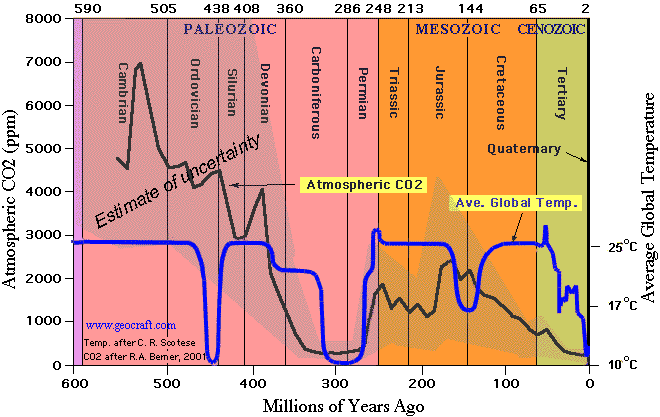
Average global temperatures in the Early Carboniferous Period were hot- approximately 20° C (68° F). However, cooling during the Middle Carboniferous reduced average global temperatures to about 12° C (54° F). As shown on the chart below, this is comparable to the average global temperature on Earth today!

Similarly, atmospheric concentrations of carbon dioxide (CO2) in the Early Carboniferous Period were approximately 1500 ppm (parts per million), but by the Middle Carboniferous had declined to about 350 ppm -- comparable to average CO2 concentrations today!

Earth's atmosphere today contains about 380 ppm CO2 (0.038%). Compared to former geologic times, our present atmosphere, like the Late Carboniferous atmosphere, is CO2- impoverished! In the last 600 million years of Earth's history only the Carboniferous Period and our present age, the Quaternary Period, have witnessed CO2 levels less than 400 ppm.

Global Temperature and Atmospheric CO2 over Geologic Time


Late Carboniferous to Early Permian time (315 mya -- 270 mya) is the only time period in the last 600 million years when both atmospheric CO2 and temperatures were as low as they are today (Quaternary Period ).


There has historically been much more CO2 in our atmosphere than exists today. For example, during the Jurassic Period (200 mya), average CO2 concentrations were about 1800 ppm or about 4.7 times higher than today. The highest concentrations of CO2 during all of the Paleozoic Era occurred during the Cambrian Period, nearly 7000 ppm -- about 18 times higher than today.

The Carboniferous Period and the Ordovician Period were the only geological periods during the Paleozoic Era when global temperatures were as low as they are today. To the consternation of global warming proponents, the Late Ordovician Period was also an Ice Age while at the same time CO2 concentrations then were nearly 12 times higher than today-- 4400 ppm. According to greenhouse theory, Earth should have been exceedingly hot. Instead, global temperatures were no warmer than today. Clearly, other factors besides atmospheric carbon influence earth temperatures and global warming.

from Climate and the Carboniferous Period

Uh OH!

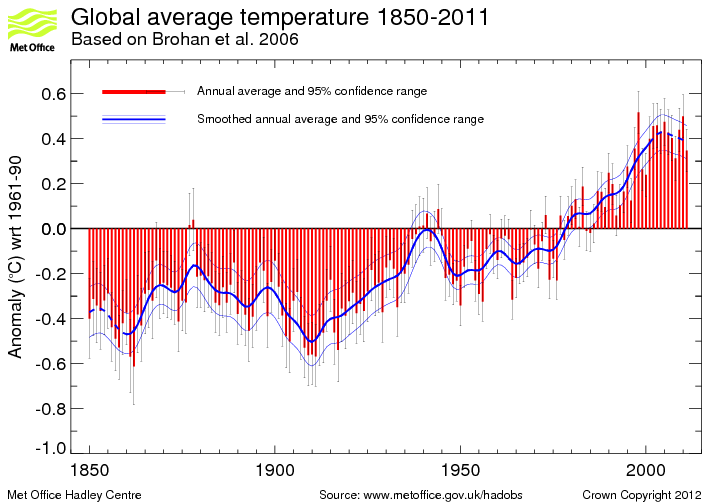
From The Blackboard-UK Met Office Fact 2: Temperatures are continuing to rise

Sign of the Times


SOCIALIST UNITY

Campaign Against Climate Change Trade Union Group -2nd Trade Union Conference


The huge social and economic changes that are needed to dramatically reduce carbon emissions are of vital interest to trade unionists, as are the methods by which they can be achieved. This conference is a chance to engage and debate with each other on these crucial issues. Campaigners and researchers from the trade union movement will address a series of workshops on a variety of related issues.

We are also hosting three forums to examine crucial debates for those concerned about the environment. The discussions around the future for nuclear power, coal and aviation are controversial ones within our movement. We hope that these debates will help clarify the issues for delegates.

As the world looks forward to the signing of the Kyoto Treaty’s replacement later this year, our closing plenary will look at proposals for a new treaty and how trade unionists can support and join the international protests calling on world governments to sign a climate treaty that will have social justice at its heart.