Pages

Showing posts with label carbon credits. Show all posts

December 27, 2010

CARB's Carbon Capers

FROM-The American Thinker


S. Fred Singer

In a nearly unanimous vote, the California Air Resources Board (CARB) just approved a statewide cap-and-trade scheme to limit emissions of CO2 from six hundred major industrial plants, starting in 2012.  Proposition 23 on the California ballot, defeated in November, was an attempt to at least delay the state's Cap-and-Trade law, AB-32, until California's record unemployment eased.  However, the slanted description appearing on both the official Voter Guide and the ballot, written by then-State Attorney General Jerry Brown and his office, the well-funded "No-on-23" campaign, and some very heavy media bias, had Californians believing that Prop. 23 would thwart efforts to curb air pollution -- i.e., smog.  So Prop 23 went down in flames, threatening hundreds of thousands of jobs, and perhaps a million.

The "Cooler Heads" blog relates that the adopted regulation is more than three thousand pages long, but most of the details have yet to be worked out.  CARB rushed to meet a December 31 deadline set by the 2006 legislation that authorizes CARB to reduce the state's greenhouse gas emissions to 1990 levels by 2020.  In order to protect California business from out-of-state competition, CARB will (initially) allocate emissions credits (aka energy-rationing coupons) for free.  The European Union Emissions Trading Scheme (ETS) is the only precedent for free allocation of carbon credits; it resulted in windfall profits for politically connected industries and higher electricity prices for consumers.


Not surprisingly, the New York Times approves of the scheme: "[AB32] will put the state far ahead of the rest of the country in energy reform."


The regulations, if they go into effect, will create the largest market for carbon trading in the country.  (Ten states including New York, New Jersey, Delaware, Maryland, and the New England states are participating in a less extensive system known as the Regional Greenhouse Gas Initiative, which covers only electric utilities.)


By the time the CARB program takes effect in 2012, California regulators plan to have created a framework for carbon trading with New Mexico, British Columbia, Ontario, and Quebec -- some of its partners in the Western Climate Initiative.  But as long as Congress and the Obama administration shun cap and trade, California, instead of being the forerunner of a national movement, will remain part of a far-flung archipelago of states and provinces participating in a small carbon market. 


Mary D. Nichols, CARB's chairwoman, said, "We are well aware that we in California are on a different path from many other states in our willingness to be at the front" of the cap-and-trade movement.  An idea of her mindset comes from a speech at the University of Rhode Island in November 2008, where she mentioned California's efforts on climate change:

We know that the economic crisis we will face from unmitigated climate change could dwarf [sic] anything we have ever seen. That alone is a compelling enough reason to take swift action. But there's another reason also, which is that developing a new clean energy economy that drives and rewards investment and innovation, creates jobs and serves as the engine for sustainable economic growth is exactly what we need at a time like this.
Transportation and utility industry representatives see Nichols' push on climate-change regulation in California as evidence of an ingrained pro-regulatory bias.


I recollect Nichols as a former assistant EPA administrator in the Clinton years, under Carol Browner.  In testimony to Congress in 2000, on phasing out the chemical fumigant methyl bromide (of great economic importance to agriculture but suspected of causing damage to the ozone layer), she claimed benefits of 32 trillion dollars!  And no one questioned how she arrived at this wild number.  A more reasonable value, I argued in my opposing testimony, would be zero benefits: There was no evidence of MeBr, with an atmospheric lifetime of only a few months, reaching the stratosphere; no evidence of a bromine-caused ozone depletion; and no evidence from ground-level monitoring stations of any increase in cancer-causing solar UV.


Among the industries immediately affected by the CARB rules will be producers of cement, which requires an industrial process in which the release of carbon dioxide is an integral part.  Steve Regis, vice president of CalPortland, said in an interview, "We feel like we're really exposed because 60 percent of our direct emissions are from the process -- nothing we can do about them."  The re-engineering of that process, Regis said, would entail major costs, if it is even possible.  He added that some California plants had recently shut down and moved their production out of state.


The midterm elections turned into a sweeping repudiation of the Democrats' failed status quo -- except, that is, in California, says Investor's Business Daily.  With the exception of the governor's office, California has been a virtual one-party state since the 1960s.  Now, thanks to decades of anti-business policies promulgated by a series of left-leaning legislatures, its economy and finances are a mess, and it is hemorrhaging jobs, businesses, and productive entrepreneurs to other states.


How bad has it gotten in the erstwhile Golden State?  Consider:


  • Some 2.3 million Californians are without jobs, making for a 12.4-percent unemployment rate -- one of the highest in the country.
  • From 2001 to 2010, factory jobs plummeted from 1.87 million to 1.23 million -- a loss of 34 percent of the state's industrial base.
  • With just 12 percent of the U.S. population, California has almost a third of the nation's welfare recipients; meanwhile, 15.3 percent of all Californians live in poverty.
  • The state budget gap for 2009-2010 was $45.5 billion, or 53 percent of total state spending -- the largest in any state's history.
  • Unfunded pension liabilities for California's state and public employees may be as much as $500 billion -- roughly 17 percent of the nation's total $3 trillion at the state and local level.


This disaster has been building for decades.  In the end, only the voters of California could have changed things.  But on Tuesday, November 2, they opted for more of the same governance.  Empowering CARB regulation will only make conditions worse.

S. Fred Singer is professor emeritus of Environmental Sciences at the University of Virginia and former director of the U.S. Weather Satellite Service.  A fellow of the Independent Institute and the Heartland Institute, he has authored books and monographs on energy policy and climate change -- most recently,Unstoppable Global Warming-Every 1500 Years (with Dennis T. Aver

December 21, 2010

Global Warming Policies and the Perverse Incentives They Create

FROM-Heritage Foundation

Money is a powerful incentive. When it comes to global warming, governments all over the world have created policies that intend to reduce greenhouse gas emissions but have led to fraud, scams, black markets, and increased emissions. Mark Schapiro of Reuters reports on the unintended consequences of European companies offsetting their carbon dioxide emissions by paying the Chinese to destroy a much more potent contributor to warming:

In order to offset their own greenhouse gases, companies and utilities in Europe that are subject to the emission limits of the Kyoto Protocol have been paying vastly inflated prices to Chinese companies to destroy hfc 23, and in the process have been providing the Chinese government with hundreds of millions of dollars in tax revenue to compete against Europe’s own “green” industries. European concern about this practice was a major source of contention during last week’s climate negotiations in Cancun, as the U.N. attempted to defend the integrity of the multi-billion-dollar global carbon offset market.

And in an odd twist, the incentives offered through the U.N.’s Clean Development
Mechanism (CDM) also appear to be stimulating production of an ozone-depleting refrigerant gas that has been landing in the U.S. black market. Investigations by the U.S. Environmental Protection Agency (EPA) and U.S. Customs and Border Protection have led to the conviction of several smugglers who have illegally imported the ozone-depleting refrigerant, hcfc 22, into the U.S. for sale to trucking companies, supermarkets, automotive supply shops, and other large-scale users of refrigerant gases. The illegal refrigerant is significantly cheaper than non-ozone-depleting refrigerants permitted in the U.S., a price discrepancy triggered partially by the large overpayments to Chinese firms that have led to an ample supply of hcfc 22 on the international black market.

That black market completes a global circuit unique to the era of climate change: From China’s industrial zones, the credits for the greenhouse gases—bought and sold as commodities on the global carbon markets—flow to European companies that need them to continue polluting at home, while the underlying ozone-depleting gas responsible for creating those credits flows to American companies seeking discounted refrigerants.

If you need any more indication that these policies are more about seeking profit than protecting the environment, China’s Deputy Director of its Clean Development Mechanism fund threatened to release the hfc gases into the atmosphere if United Nations removed the gas as an acceptable credit. Shapiro also details how the credit program is increasing the production of other potent greenhouse gas emissions:

The offset credits paid to Chinese and Indian companies to eliminate the former, according to CDM Watch, have actually stimulated increased production of the latter—the ozone-depleting refrigerant hcfc 22, which is itself a potent greenhouse gas. CDM Watch has compiled records showing that companies in China and India have significantly increased production of hcfc 22 in order to receive funds to incinerate the byproduct gas, hfc 23.

This becomes an even bigger deal when governments implement policies that promote carbon-free, uncompetitive sources of energy. In the United Kingdom, for instance, David Cameron is reversing Margaret Thatcher’s privatized energy market in favor of a more state-controlled system with the possibility of a price floor on carbon dioxide. The plan would prematurely shut down older power plants in favor of a massive government spending project to increase the use of nuclear, wind, solar, and biofuels to meet carbon reduction targets. It’s an undertaking that cannot be done without government guarantees, says the regulator Ofgem. Ernst and Young projects the transition will cost $316 billion—a cost that will show up in consumers’ energy bills and later through higher taxes to cover the government’s investment.

And all this cost is for what? There won’t be any noticeable difference in emissions, and companies can pretend to go green and pretend to adhere to rules while others collect serious cash. Yet politicians in the U.S. are pulling wool over their own eyes when it comes to the facts, fraud, and inefficiencies of green policies in other parts of the world.

June 25, 2010

The Problem With Cap and Trade

FROM- The American Spectator

By C. Boyden Gray

The pending climate legislation that has spent so many months languishing in Congress was stripped of its initial momentum by the deep worldwide recession, the administration's failure in Copenhagen to get commitments from China sufficient to allay concerns about continued job migration from the U.S., the scandal over some of the science, and the struggle over health care reform. But the principal reasons for the demise -- the huge tax and trading boon to the banking industry in Wall Street and London -- deserve some further scrutiny.

The sponsors of so-called cap and trade legislation claimed that it was based on the hugely successful acid rain cap and trade program put into effect by the 1990 Clean Air Act Amendments (CAAA). As will be discussed more fully below, this characterization is highly inaccurate, because the Waxman-Markey bill and Senate counterparts created a $3 trillion tax and commodities market where the CAAA had done nothing of the sort. This feature of the climate legislation hurt its electoral chances by allowing Republicans accurately to portray the bills as a huge tax while scaring off at least half a dozen centrist Democratic senators worried about having to contain another Wall Street derivatives meltdown because of the proposed pollutive materials commodities market.

As criticism of the tax intensified over the course of the last year, climate bill sponsors responded by promising the return of the allowance revenues to taxpayers and by erecting a whole set of new financial protections parallel to the current financial reform effort. This triggered understandable skepticism -- since if the money were truly to be returned to its source there would be no point in collecting it in the first place. Moreover, there would also be no need for financial protections, unless there were something else going on. It's the "something else" that is really at the heart of the problem and that deserves further examination.

That "something else" has to do with the only true short-term beneficiaries of the whole exercise -- namely the bankers and traders of London and Wall Street who were ready to collect huge profits from trading carbon under the proposed legislation. The junior senator from New York put it best in an October 21, 2009, op-ed in the Wall Street Journal, where she said that as a result of the legislation, the "financial market [was] poised to deliver significant growth." She explained that the "carbon permits [under the climate bills] could quickly become the world's largest commodities market, growing to as much as $3 trillion by 2020," and that "New York's financial talent, expertise and institutions are uniquely suited" to run this new market.

Acknowledging the need to address the regulatory aspects of a new set of derivative trading, Sen. Kirsten Gillibrand observed that "Congress should integrate carbon trading into comprehensive financial reform," but she cautioned that the derivatives contracts should be allowed to be customized and not forced to be standardized and thus made fully transparent in any new regulatory structure. Finally, she noted that it was essential to the "ultimate benefit for New York that the market for carbon-emission permits is internationally integrated."

London was equally enthusiastic. Carbon could become "one of the fastest-growing markets ever, with volumes comparable to credit derivatives inside of a decade," said the head of emissions trading at Merrill Lynch's offices in London. According to another promotional article, London already "trades more carbon than any other city in the world," thanks to the European Emissions Trading System (ETS) set up by the EU after the Kyoto Treaty. As a result of carbon trading requirements, said the article, "carbon emissions are bound to become the world's biggest market....this is a bull market and great to invest in."

The Times of London further quoted a leading London trader as saying that "Europe will be the centre of the global market as a result of taking the lead....London is the leading centre and will remain so for years to come. The preparation has taken place here, and other financial centres are not so advanced...."

It is entirely true that climate leadership originated in Europe, especially in the UK, where much of the scandal over possibly manipulated science has also been centered. Given this background, it is hard to believe that ordinary greed did not trigger the rush to create an unnecessary windfall for traders. But the resulting backlash against bankers who stood to profit from cap and trade could have been easily avoided by actually following the model the measure's advocates said they were copying.

As noted, the White House and the sponsors of the Waxman-Markey legislation passed last year prominently asserted that their proposals were based on the successful acid rain cap and trade program by the CAAA in 1990. But the acid rain reduction and other successes based on it did not involve the impossibly complicated $1 trillion auction/tax/allowance reallocation scheme that Waxman-Markey features, as a result of the political logrolling necessary to secure the close 219-212 House vote.

To the contrary, all previous cap and trade programs have been based on an annual reduction of allowances initially allocated on the basis of an average of previous emissions that were well documented -- a simple formula that has been totally abandoned by Waxman-Markey.

Moreover, no one ever accused the acid rain program (or any of the others) of giving away "free" allowances, despite the lack of an initial auction for the permits. There was in fact nothing "free" about any of it, because utilities had to start reducing their acid rain emissions from day one, ultimately having to spend billions ($6 billion in the case of Duke Energy alone) to meet the requirements. But without a huge float of auctioned allowances, there were no financial machinations, and with no revenues collected, no political fights over revenue distribution that have so poisoned the current climate debate.

The acid rain program was itself based in part on a similarly successful -- and auction -- free-trading system established in 1982 to accelerate the phase-out of lead in gasoline. The next pro-posal after the 1990 CAAA was RECLAIM, which was established in 1994 by California and which successfully initiated nitrogen oxide and sulfur oxide trading within the state -- again without an auction.

Subsequently, the EPA established successful trading programs for nitrogen oxide in the eastern U.S. and later, during the George W. Bush administration, for sulfur oxide in the Clean Air Interstate Rule (CAIR) intended to achieve a further 70 percent reduction beyond the original 50 percent cut in the 1990 CAAA. There were no auctions for these successful programs. (The U.S. Court of Appeals for the District of Columbia Circuit subsequently questioned the legality of the CAIR trading system, which is now being revised.)

Supporters of the carbon dioxide auction have frequently cited the European ETS as the real reason auctions are necessary. The first phase of the ETS did not use an auction and over-allocated the allowances, producing utility windfalls and carbon dioxide prices so low as to be meaningless. But the proximate reason for the problem was that there was no reliable baseline emissions data, as we have had for decades in the case of utilities here in the U.S.

The European Commission has corrected this mistake for the second (and successful) phase that is now in effect -- but without an auction, it must be quickly noted. There are proposals to launch a 60 percent auction for the third phase, but that auction would probably be discretionary with the member states, which may not impose them for many of the same reasons militating against an auction in the U.S.

To be sure, the Waxman-Markey legislation tries to avoid the trillion-dollar tax implications of a 100 percent auction by temporarily seeking to provide "free" allowances to coal and natural gas customers. But these allowances will have to be auctioned to the emitters anyway, and there is no guarantee that the proceeds will actually get into the hands of those who have to pay the tax.

Over time, in any event, the system would revert to a 100 percent auction to provide trillions of dollars in revenues for unrelated budget proposals (and triggering protectionist import tariffs to curb trade with nations that have not imposed the same tax). One can understand the desire for deficit-reduction revenues. But they should not come out of a climate change program, which will be costly even without auctions and the success of which depends on the cap reduction level, not on the revenues collected. (Indeed, one group that has pushed for an auction, U.S. Climate Action Partnership, stresses that emission reductions under cap and trade are the same whether an auction is used or not.)

The superior efficiency of emission trading markets has been demonstrated over and over again. But the efficient reduction of carbon emissions need not depend on the levy of a huge tax or the establishment of the biggest commodities market ever created, and benefits of the trading should go to the public, not Wall Street or London.


More...

March 24, 2010

Viva La France


France abandons plans to introduce carbon fuel tax over competition fears

FROM-Daily Mail

France today abandoned all plans to introduce a carbon fuel tax aimed at combating global warming.

The policy u-turn will be viewed as a huge disappointment to the green lobby around the world.
Many had hoped that if a major western economy like France took the lead in taxing harmful emissions, then other countries would follow suit.
But the scrapping of the tax plan was announced by Prime Minister Francois Fillon who said it could only be introduced across Europe so as to 'avoid harming the competitiveness of French companies'.
He told a meeting of MPs in Parliament that the priority for the country was getting its stagnating economy working again following the international financial crisis.
Last year President Nicolas Sarkozy said a tax on the use of oil, gas and coal would make his country one of the greenest in the world.
It was provisionally set at pounds 15 per per tonne of emitted carbon dioxide (CO2), and would apply to homes as well as businesses.
Mr Sarkozy said money from the new tax - which would amount to some pounds 4billion a year - would be spent on green initiatives.
But there was stiff opposition from across the political spectrum, with critics saying the tax was just a ploy to boost ailing state finances.
In polls, two-thirds of French voters said they were opposed to the new levy, fearing they would struggle to pay higher bills. The government was forced to amend its proposals after they were rejected by the high court in December.
The court ruled then that too many exemptions created inequalities and unfairly placed the burden of cuts on a minority of consumers.
Its ruling prompted the government to respond with fresh safeguards for businesses, but now it was has been scrapped altogether.
The climbdown comes during a disastrous period for Mr Sarkozy and his ruling UMP party, who have just been roundly beaten by the Socialist opposition in regional elections.

Mr Fillon told the meeting of MPs today that the government's priorities were now 'growth, jobs, competitiveness and fighting deficits'.


More...


February 4, 2010

Farmer Knows Best


The dark side of going green.


FROM-The Weekly Standard
BY Blake Hurst

Tarkio, Missouri

Kathleen Merrigan, deputy secretary of agriculture and an organic and sustainable food expert, has announced an initiative entitled “Know Your Farmer, Know Your Food.” Sixty-five million dollars will be spent “to begin a national conversation to help develop local and regional food systems.”

America, it seems, has been operating at a knowledge deficit when it comes to farmers, and farmers lack the social skills to close the gap between eaters and producers of food. Still, one can only imagine what a Know Your Farmer program designed by government will involve. As I survey the farmers living around me, it’s clear we need some sort of sensitivity training, memberships at the local gym, nose hair trimmers, and a new barber. Most of us have been farming for decades (the average American farmer is 58) and are working land that has been owned by family members for generations. Yet any quick perusal of the current literature about agriculture would indicate that our days of farming are numbered. In the current jargon: We are not sustainable.

Local food is seen as a good thing because it travels a short distance from farm to consumer. This cuts the production of greenhouse gases, is presumed to guarantee freshness, and connects consumers with “their” farmer. “Food miles,” the number of miles food travels to your table, has become an important metric, and marketers are trumpeting their allegiance to local producers.

This is mostly harmless, and farmers will benefit if they can capture some slightly larger percentage of the food dollar by selling at the farm gate or through a local USDA-subsidized farmer’s market. I love showing people my farm, will talk with anybody about agriculture, and am more than willing to “know” my consumer. Even so, I imagine the experience will be a letdown for her. I’m sure to disagree with most of the views a typical Whole Foods/farmers’ market customer holds about what they eat. The opportunities for confrontation are legion, and maybe some of that $65 million should be set aside for arbitration as foodies find out what “their” farmers actually believe about food production.

In an important article in PERC Reports, published by the Property and Environment Research Center, Pierre Desrochers and Hiroko Shimizu demonstrate that the concept of “food miles” ignores the advantages that fertile land and agreeable climate give some producers. If my corn yield is 200 bushels an acre, while farmers in Tennessee achieve half that yield from comparable inputs, then I can afford to ship my crop a greater distance.

The PERC authors use the example of strawberries grown in California, where the climate is near perfect for the crop, and strawberries grown in Canada in greenhouses that must be heated in winter. In December, strawberries from California can be shipped to market in Canada with less total energy use than the locally grown crop. The food miles are greater, but the carbon footprint is smaller. True believers in the local food movement, of course, simply stop eating strawberries in winter. Their devotion is admirable, but a winter diet of freshly dug turnips and stored potatoes is hardly interesting. If we concentrate production of each crop in the areas best suited for it, we’ll leave more acres for trees, recreation, and other environmental goods. There are perfectly defensible reasons both for shopping locally and for dispersing production, but protecting the environment isn’t one of them.

Local food isn’t always fresher, either. The cooperatives that collect, process, and distribute milk schedule pickups according to the size of the dairy. Driving a truck from the plant to the farm is expensive, so large dairies’ milk is picked up daily, while smaller dairies may only see the milk truck a couple of times a week. Here in Missouri, milk reaches the store more quickly from the large dairies in the Southwestern states than it does from small local dairies. If Missouri consumers want to support local dairies, and I hope they do, their milk won’t always be as fresh as milk that has traveled farther. As Desrochers and Shimizu point out, most food miles are clocked on the trip home from the supermarket. That truck delivering milk holds thousands of gallons. Most consumers buy one gallon at a time. The five-mile trip home from the supermarket is the most carbon-intensive trip your morning’s milk will make.

Our family is enjoying the last of a side of beef we bought from a local farmer. He raised the cow on his small farm, took it to a small meat processing plant, and delivered the meat to our door. We had a nice visit, farmer to farmer, family to family. The beef is tender, cut the way we like it, and we were pleased to support a local grower. The food miles traveled by our beef were minimal. In fact, the carbon footprint of that heifer was about as small as could be, since she was fattened on corn. That’s right, corn-fed cows emit about half the greenhouse gases cattle fattened on grass emit, because corn is a more concentrated feed than grass, the cattle reach market weight faster, and less land is used per pound of food produced. If carbon footprint is your guide, better to buy beef fattened in one of those feedlots in Western Kansas and shipped cross country to your grocery store than to purchase locally raised grass-fed beef. Then again, it’s probably a given that people truly concerned about energy use and environmental costs have already excised beef from their diet. I appreciate their dedication, envy their self-control, and wish them a long life. A life without beef will seem very long, indeed.

Sixty-five million dollars isn’t much these days, a mere drop in the ocean of stimulus bills and health care reform. It’s not even much compared with the subsidies we traditional farmers receive, and it would be hypocritical to begrudge the local and sustainable movement its chance at rent seeking from Washington, a game that farmers have played successfully for years. If the only reason for the program were to encourage small farmers as a bit of social engineering, then few would object. The damage done here, however, is to truth. The program will not reach its environmental goals. It will only help certain consumers feel good about themselves.

Implicit in the argument about local production is the assumption of market failure. People worried about food miles want to control the energy expended to bring them food, but they value not at all the land necessary to produce it or the farmer’s labor to grow it and get it to market. To make food more local is to replace technology with more farmers and more land. Petroleum, it is assumed, will soon run out, but labor and land are cheap and easily increased. Sustainability advocates believe the costs of alleged global warming and other environmental damage from conventional agriculture are greater than the present economic contribution of all the prospective farmers who will leave their occupations and move to small, local, sustainable farms. Not only that, but they fail to account for the additional acres of land needed for the new farms.

Are these assumptions true? It may be that productive land and human capital will become ever more dear, while we continue to find new ways to improve our energy supplies. Organic advocates like Merrigan spend a lot of time asking for more labeling, telling the consumer where food was produced, how it was produced, what it might contain, and even who produced it. But all food already has a label that serves as a pretty good proxy for the resources used in its production. It’s called the price.

Blake Hurst is a farmer in Missouri.


More...


January 17, 2010

Carbon credits a scam to be feared


FROM-Toronto Sun

By LORRIE GOLDSTEIN,

With everyone from Lloyd’s of London to Rolling Stone magazine warning about the global financial scam heading our way with the international trading of carbon dioxide emissions, you have to ask yourself:

When are our politicians going to acknowledge it? When are they going to stop pretending “there’s nothing to see here, folks” and that we should all move along?

When are Prime Minister Stephen Harper, Liberal Leader Michael Ignatieff, NDP Leader Jack Layton, the Bloc Quebecois and premiers like Ontario’s Dalton McGuinty and Quebec’s Jean Charest, going to admit the obvious?

That is that the looming cap-and-trade market in carbon dioxide emissions Canada will soon be dragged into - fuelled by carbon credits - is a financial disaster waiting to happen.

How many multi-billion-dollar fraud investigations by police into Europe’s five-year-old cap-and-trade market, the Emissions Trading Scheme (ETS), where up to 90% of the trading is suspect in some countries, is it going to take?

How many allegations of corruption, profiteering and fraud in the UN’s ironically-named Clean Development Mechanism, which generates carbon credits?

Last week, Daniel Golding, a risk analyst with Lloyd’s of London insurer Chaucer Syndicates Ltd., warned clients on the company’s website (www.lloyds.com), that “the potential collapse of the carbon credit market” is one of the biggest risks facing investors in 2010 and beyond.

As the Lloyd’s publication 360 Risk Insight put it: “On the subject of cutting CO2 (carbon dioxide) emissions, Golding is concerned that carbon credits are being packaged into increasingly complex financial products, similar to the 'shadow finance’ around sub-prime mortgages which triggered the recent economic crash.” Got that? Golding added carbon credit trading, while providing a cash bonanza for industry, doesn’t lower emissions.

“As recession slashes output,” he warned, “companies pile up permits they don’t need and sell them on. The price falls, and anyone who wants to pollute can afford to do so. The result is a system that does nothing at all for climate change but a lot for the bottom lines of mega-polluters.” In July, 2009, award-winning U.S. journalist Matt Taibbi, writing in Rolling Stone, warned in his exhaustive article, The Great American Bubble Machine, how powerful U.S. investment bank Goldman Sachs, which has lobbied hard for carbon trading, is poised to profit from it in the same way it did during The Great Depression, the tech stock bubble, the housing bubble, the oil bubble and the $700-billion US, tax-funded bailout of many of the same money houses whose trading practices helped crash the global economy.

Read Taibbi’s piece for yourself, widely available on the Internet, starting with his description of Goldman Sachs as “a great vampire squid wrapped around the face of humanity, relentlessly jamming its blood funnel into anything that smells like money.” Goldman Sachs responded Taibbi’s piece is “an hysterical compilation of conspiracy theories,” that it rejects his assertion “we are inflators of bubbles and profiteers in busts” and that the firm is “painfully conscious of the importance in being a force for good.” Be that as it may, based on the real-world experience of cap-and-trade, if our governments are hell bent on putting a price on carbon dioxide emissions, a carbon tax would be better, with 100% of the money returned to taxpayers in income tax cuts.

Finally, we should outlaw carbon credits, which are a scam.


More...


January 11, 2010

I'll sell them mine


I am still flabbergasted that the world, the Europeans in particular, is fixated on the idea of making carbon dioxide a commodity. Of course as we have pointed out before it isn't really carbon dioxide that they are making a commodity but rather the absence of carbon dioxide which they wish to sell back and forth. In an effort to do my part I will sell them all my non carbon emissions at a discount rate. I'll begin by auctioning off all the emissions I will not emit by not driving twenty four hours a day and then we'll work on my non flight time. Always willing to do my part to save the planet.

But seriously, is the EU seriously considering bailing out...uh air.


FROM- NYT

Should Europe Intervene to Support the Price of Carbon?

The price for emitting carbon in the European Union — already weak because of the recession — fell further in the wake of the Copenhagen climate conference.

Carbon traders had bet that European leaders would tighten emissions quotas during the conference, which would have driven up the price for permits. Disappointed by emissions reduction offers made by China and the United States at the meeting, however — and fearing that tighter quotas would send industries fleeing to less regulated parts of the world — Europe’s leaders backed away from the plan.

But experts say this highlights a fundamental problem in Europe’s carbon market: the price of has never been high enough for long enough to force utilities and factories to invest in new and cleaner equipment — the goal of the system in the first place.

The question now is, should regulators step in to shore up prices?


Faced with the price of carbon drifting even lower in coming months, the European Commission could seek to buy up surplus credits, or to set a minimum price. Some versions of carbon legislation in other parts of the world, including in the United States, would aim to use such a “floor price” to counter volatility and ensure continuing investment in low-carbon technologies and processes.

But the European Commission has said it wants to avoid intervening in the market — not least because it would face continuing pressure to do so again in the future. That could make investors question the fairness and reliability of a market open to political meddling.

And experts now say that the carbon price in coming months will mostly depend on whether coal-dependent industrialized nations like the United States and Australia redouble their efforts to introduce similar systems.

James Emanuel, the commercial director of CantorCO2e, an environmental brokerage based in London, warned last week that if those efforts fail in countries like the United States and Australia, the E.U. will have very little incentive to tighten its caps on emitters, and prices could continue to languish at the current low levels.

“There are only voluntary commitments in the Copenhagen Accord, and it was particularly disappointing to see the time frame for a legally binding deal stripped from the final draft,” Mr. Emanuel said.

“That leaves the threat hanging over the price of carbon because of real uncertainty that we will ever see a single global carbon market to drive cleaner technologies,” he said.

More...


December 30, 2009

Stupid is as stupid does.....

...the Oregon Way


H/T Helliogenic Climate Change
FROM- The Oregonian

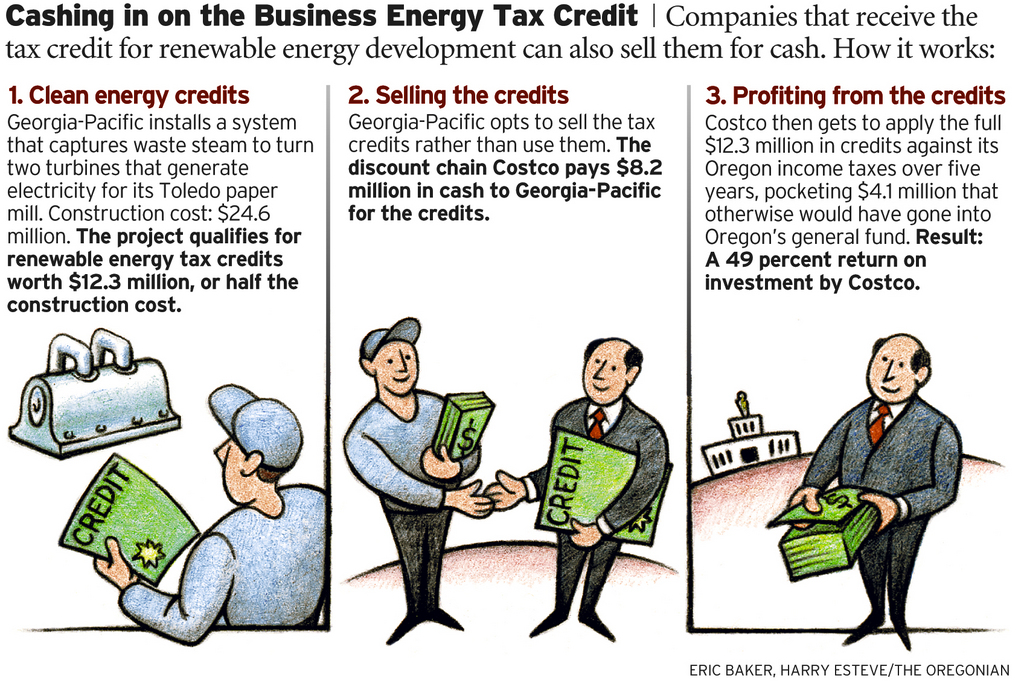
Walmart, others make money on Oregon's energy tax credits

When Oregon started handing out jumbo tax subsidies for renewable energy projects two years ago, one of the biggest beneficiaries was also one of the world's richest corporations -- Walmart.

No, the retail giant hasn't branched to solar panels or wind turbines.

Instead, Walmart took advantage of a provision in Oregon's Business Energy Tax Credit that allows third parties with no ties to the green power industry to buy the credits at a discount and reduce their state income tax bills.

More
Read The Oregonian's earlier coverage of the Business Energy Tax Credit.State records show Walmart paid $22.6 million in cash last year for the right to claim $33.6 million in energy tax credits. The cash went to seven projects, including two eastern Oregon wind farms and SolarWorld's manufacturing plant in Hillsboro. In return, Walmart profits $11 million on the deal because that's the difference between what it paid for the tax credit and the amount of its tax reduction.

The loser in the transaction is Oregon's general fund -- which pays for public schools, prisons and health care programs -- because the state is out the full $33.6 million in tax revenues.

Walmart isn't alone. An analysis by The Oregonian shows Costco and U.S. Bank, which also rank among the nation's top 200 wealthiest businesses, have made millions by buying up energy tax credits to cut their Oregon tax bills. Dozens of other companies and hundreds of individual Oregon taxpayers also have cut their tax bills by buying up the tax credits.

"It's so convoluted," says Eric Fruits, an adjunct economics professor at Portland State University who has studied Oregon's energy incentives. "You've got all these dollars swirling around. Everyone is trying to grab them as fast as they can."

The pass-through option "turns what would otherwise be an incentive to make energy investments into a windfall that may not have anything to do with energy," Fruits says. More...

Program under fire


For years, Oregon has subsidized renewable energy and energy conservation projects by granting tax credits, which can be used as a dollar-for-dollar reduction on state income tax bills. The pass-through practice was put in place in 2001 as a way to allow government agencies and nonprofit organizations to take advantage of the subsidies. Since those groups don't pay state taxes, the credits are worthless unless they can be sold to a third party.

The ability to sell the credits also allowed start-up companies with no Oregon tax liability to leverage upfront cash for their green energy projects.

The tax credits, known as BETC, or "Betsy," have come under increasing fire this year because the cost to taxpayers skyrocketed. It went from about $10 million in 2007 to an estimated $167 million in the 2009-11 biennium at the same time the economic recession hammered other areas of the state budget.

A previous investigation by the newspaper showed state officials intentionally downplayed the estimated cost of the program before the 2007 Legislature voted for substantial increases to the maximum subsidies. The newspaper's latest analysis also found:

Walmart, Costco and U.S. Bank, which top the list of energy credit buyers, shelled out a combined $67 million to avoid paying $97 million in Oregon income taxes.

Walmart and others are making money on projects that were closed, went belly up or never produced the energy or energy savings they initially claimed.

Out-of-state corporations and others looking for tax breaks are claiming an increasing share of the money that is supposed to pay for clean energy and conservation.


Weyerhaeuser/Walmart


The head-scratching nature of the subsidy program perhaps is best illustrated by a case study of what happened at the former Weyerhaeuser Paper Mill in Albany.

Weyerhaeuser, based in Federal Way, Wash., received $3.3 million in Oregon energy tax credits in 2008 for rejuvenating a biomass plant that burned wood waste for heat and steam, and for capturing much of the heat to dry paper. The company, which apparently didn't need the tax offset, turned around and sold the credits to Walmart for $2.3 million in cash.

Walmart then gets to deduct the full $3.3 million from its Oregon income tax bill over five years for a payback of $1 million. But there's a twist.

Last year, International Paper bought a number of Weyerhaeuser mills, including the one in Albany. And last week, I-P shut down production at the Albany mill as part of a corporate cost-saving plan.

The end result: The mill no longer produces nor saves the energy for which it got the tax credits. Walmart, however, retains the full benefit of the subsidy.

Walmart, which ranked second to Exxon this year on the Fortune 500 list, shouldn't be cast as the bad guy, says Karianne Fallow, a spokeswoman for the Arkansas-based company. Oregon officials asked Walmart to become a "pass-through partner," Fallow says.

"The state approached us with this investment offer and we participated in the opportunity," Fallow says. The tax benefits were clear, she says, but bringing green jobs and companies to Oregon "is very much a goal that we support."


Legislative overhaul


Similar examples abound.

FUSP, a Portland wood recycling company, garnered $2.6 million in tax credits last year and sold them to 17 individual investors for $1.9 million in cash. The money, according to a company official, was used to buy grinding equipment and other machinery that turns old wood into new lumber and pallets.

Shortly after the credits were issued, the housing market crashed. The equipment now sits idle in a lumberyard in Turner, outside Salem. The 17 investors, however, continue to receive the tax break.

"The problem is, we're taking taxpayer money that is supposed to be accomplishing energy efficiency or power generation and instead we're putting it into the financial market," says Jody Wiser, who leads a watchdog group that wants changes to the energy subsidies. A better way, Wiser suggests, would be to give clean energy or energy conservation companies outright grants, thereby saving millions that wind up in the hands of investors.

Corporations doing business in Oregon took a keener interest in the tax credits after the 2007 expansion of the program, which upped the maximum incentives to $20 million for solar facilities and $10 million for wind farms. State records show the amount of tax credits bought by third parties shot up to $152 million -- more than triple the amount of the previous year.

Gov. Ted Kulongoski and state energy officials say they recognize problems with the energy tax credits and are working to overhaul the program when state lawmakers convene for a short session in February. Among the targets of the overhaul is the pass-through option.

"The governor believes there's been a public value to the program," says Anna Richter Taylor, Kulongoski's spokeswoman. "That said, he also is very supportive of efforts to align the rate better with other public investment portfolios."

The current rules allow third parties to buy the tax credits at about 67 cents on the dollar and take the tax breaks over five years. For most, that means an annualized rate of return of about 10 percent – a rate that far exceeds what most people are getting on short term investments, such as bank CDs. Acting state Energy Department director Mark Long is pushing for a rate that would be more in line with other types of market investments -- about 3.5 percent a year.

"That means more money goes to the actual project," rather than to the investors who buy the tax credits, Long says.

-- Harry Esteve


December 26, 2009