Pages

Showing posts with label historical. Show all posts

December 13, 2012

Aboriginal climate change


The entire premise of man made climate change is that we, mankind, because of our modern industrial lifestyle, have altered the natural order of the climate system and this is bad. It is so bad that mankind needs to do something to fix what we have done and stop what we are doing.

More and more however it seems that the climate change academia complex is undermining their own case for the very premise which is the foundation of their theory, not to mention their considerable tax payer funding. It is easy to see how this happens, academics knowing there is a honey pot of money for any research having to do with climate change combined with their undying faith in the reality of man made climate change conduct studies which to an objective observer actually undermines their case but to the academics it acts as another warning to the uniformed public..

The other day I pointed to a report of a study on how climate change had helped lead to the downfall of the Mayan Empire. The authors seemed not to realize that their findings went a long way towards undermining the "man made" ingredient of the entire theory. Everything that the alarmist community is trying to "sell" society is dependent on the idea that what we are experiencing or will experience is unprecedented and of course man made. So when they do studies which show that conditions in the past were as bad or worse than what we are experiencing or forecast to experience a reasonable person would ask how have we impacted the climate if the climate has always acted this way?

Again we have another example of a study disproving "man made" climate change out of the University of Queensland called Ancient culture affected by climate (emphasis mine)
Associate Professor Hamish McGowan from UQ's School of Geography, Planning and Environmental Management said the studies in the north west Kimberley have shown there was a rapid change in climate around 5,500 years ago.
If their could be rapid change in climate 5,500 years ago in aboriginal Australia doesn't that sort of put a damper on the whole unprecedented not to mention man made claims of todays far less dramatic events? If you want to talk about some serious climate "disruption" consider this:
“Our research shows that the likely reason for the demise of the Gwion artists was a mega-drought spanning approximately 1,500 years,....
A mega drought  lasting 1500 years without benefit of modern society's fossil fueled input? is that even possible? What would cause such a thing?
...brought on by changing climate conditions that caused the collapse of the Australian summer monsoon,”
If naturally occurring changing climate conditions could cause such havoc, I would consider a 1500 year long drought severe, why are our modern day soothsayers so convinced that we are responsible for far less dramatic climate change?

Just another  example of pre-industrial severe climate change, far exceeding anything which sends the alarmist community into apocalyptic tizzydom.

December 9, 2012

The Mayan Calender....sort of.


When I originally read about this study from Penn State I thought this is obviously just another case of academics using the climate change milk train to get funding for a study-which it probably is. But once I read it and gave it some more thought it is apparent that far from promoting the alarmist view of climate change, it actually goes a long way in discrediting it.

Consider just the lead of the story:
Penn State researchers find links between climate change and political, human impacts in ancient Maya
In just that one sentence the foundation for the alarmist view of man made climate change is seriously undermined. To begin with it is obviously not the position of proponents of man made climate change that mankind was responsible for climate change when the Mayan Empire existed and flourished. Yet here we are right off the top admitting that what can only be natural climate change had an impact on humans.

What kind of climate change did this "international team of archaeologists and earth science researchers" discover that so disrupted ancient mankind?

February 7, 2011

And your point is?


This is one of those articles where you ask, why given the writers obvious predetermined conclusions, did he write it? Before I get into the actual article I thought the picture that is with the article (below) a bit strange. Actually the picture is fine it is the description that was posted with the picture that seems a bit unusual. The article is from I, Science, the Science magazine of Imperial College

Tree rings, like these, are rings made of tree
Climate change – history’s invisible foe
When it’s cold, do you get grumpy? Ill? Hungry? A sudden urge to emigrate? Well, according to a study published in this week’s Science journal, that’s nothing new: changes in climate have been causing Europeans to migrate, starve, die of horrible diseases and invade our neighbours – the ultimate expression of grumpiness – since the Iron Age. 
Scientists from universities in Switzerland, Germany and Austria analysed tree rings in wood dating back 2500 years. Their results provide the first glimpse of what the weather was like for our distant ancestors on a yearly basis and show that changes in temperature coincided some of the most disrupted years of human history.
Now I know what you are thinking, here is an article blaming global warming for past calamities. Well you would be wrong.

European trees create new rings once a year – there’s a period of woody growth during the spring and summer which stops when the tree loses its leaves. The rings vary in width according to temperature: when the summer is warmer, the tree grows more and its ring that year is wider
.
The paper’s authors studied oak samples taken from wells and wetlands across Europe and, while they weren’t able to measure exact temperatures, by looking at the relative ring widths they could find out when temperature was rising and falling. It’s been suggested that temperature changes impact on societies; affecting water supply, food production and human health – an idea that’s strongly supported by the paper’s results. 
The first major dip in tree ring width, at around 350BC, lasted for around 100 years and coincides perfectly with the Celtic expansion, when the Celts spread out from what is now Austria to populate lands as far away as Scotland, Bulgaria and Southern Spain. The second big drop occurred at around 50BC, just as Julius Caesar was busy invading Britain.
I will not get into the science of tree ring proxies, simply because I have only a poor layman's knowledge of the subject, but do make note of the writer's asertion which I believe to be true, "while they weren’t able to measure exact temperatures, by looking at the relative ring widths they could find out when temperature was rising and falling."

The most sustained cooling started in the 3rd century AD and lasted for 300 years – a time when the Barbarian Invasions were causing serious headaches for the Western Roman Empire and hundreds of thousands of people were on the move in what’s known as the Migration Period. 
Famine struck Europe between 1315 and 1317 when crops failed for three successive summers. Millions of people starved to death or succumbed to disease and stricken survivors resorted to infanticide and cannibalism. The period has been described as the ‘Little Ice Age’ and the tree rings show a sharp temperature drop. 
This unfavourable climate continued until the mid 14th century and may have been instrumental in weakening the overall health of Europeans, leaving them vulnerable to the worst plague in history – the Black Death. More recent drops correlate with the 30 Years’ War and the Modern Migration.
By now, you may be thinking that cold equals bad and warm equals good, so why should we be worried about global warming?
No, actually I was not thinking that, because any student of history knows "cold equals bad and warm equals good" which is also the main reason I settled in Florida. What I really am asking myself is why, with all the evidence to that fact, do nincompoops vilify a warmer climate. But this being the age of unreason, even while writing articles about the perils of a colder climate the author needs to warn us of the perils that await us:
The events described here coincide with relatively small fluctuations. In the data from the tree rings, there is not a single point between 500 BC and 1900 where temperatures deviate away from the average by more than two degrees. However, the late 20th data show temperatures rising to 3 degrees above average. 
Europeans have never seen heat like this. We could be in for a bumpy ride.
A couple of final observations here. Note  that the article does not document the events that coincide with periods of warmth, had they done so the contrast might have been too much for the author to deny.

The other point is this comment " In the data from the tree rings, there is not a single point between 500 BC and 1900 where temperatures deviate away from the average by more than two degrees. However, the late 20th data show temperatures rising to 3 degrees above average."  How is it possible to determine data with such precision when in the very beginning we were told "they weren’t able to measure exact temperatures." 


Shazam! In the short distance of a one page article science has suddenly gone from being unable to determine exact temperatures from tree rings to being able to determine that the data shows the late 20th century was 3 degrees above average, Well how do you determine an average when you can not determine temperatures from tree rings?

I guess the question remains, why on Earth did they write this article,,,,,Oh I know, so that despite evidence to the contrary, evidence in their very own article they just wanted to warn the world "We could be in for a bumpy ride." Which based upon their article is only true if the climate is cooling, which is probably true.

January 4, 2010

Global Warming - 1880s Style!


FROM-Louisville Economic Policy Examiner

During the evening hours of January 3rd, I was sitting in my living room thinking about how cold I had been all day long and actually throughout the entire New Years holiday weekend. I flipped my TV over to the Weather Channel just so I could see what the current temperature was here in Louisville when something else caught my eye.

The current temperature was 19 degrees with a high for the day of 26 and a low of 7. Those temperatures were well below Louisville’s average high and low for this date of 41 and 26 degrees. But what really caught my eye was the fact that the record low for January 3rd was -10 degrees in the winter of 1879 and the record high was 70 degrees in the winter of, wait for it, 1880!

At first I thought the figures provided for the record high and low must be a mistype, but then I confirmed them on the Weather Channel’s website. So in a one-year span of time from 1879 to 1880, the low to high temperature swung a total range of 80 degrees! Now that is some serious climate change right there!!!

It certainly makes the .5 or so degree change in the Earth’s temperature over the past decade which Al Gore has been warning us about seem rather miniscule, doesn’t it? It also makes me wonder if there were any ‘Algorederthals’ back then trying to scare the world’s population with tales of Manbearpigs and other forms of apocalyptic destruction of the Earth if something was not done to combat those wild temperature swings.

And if so, it would be curious to know if real scientists like Thomas Edison and Alexander Graham Bell combated those warnings with actual facts rather than hype and scare tactics. Certainly Charles Darwin, who died just two years later in 1882, would have spoken up and noted that the changes in the temperatures from one January 3rd to the next were simply a part of the natural evolutionary cycles of the Earth – just like those which had existed for all of the January 3rds which had occurred prior to the years of 1879 and 1880.

Something else that struck me about the data from the Weather Channel website was the dates when record high temperatures occurred for the month of January. According to the global warming alarmists, the past decade has been the hottest in history. However, in looking at the data, there are only two dates (January 2nd in 2006 and 5th in 2007) when the hottest temperatures were achieved since the year 2000. That is the same number as those achieved prior to the year 1900 (January 3rd in 1880 and 11th in 1890). How can that be???

Now the global warming alarmists could note that many of the record lows occurred prior to 1900 whereas none of them have since 2000. However, what the data really shows to me is that there are years when temperatures are colder and years when temperatures are warmer. But there does not seem to be a clear-cut pattern of the temperatures drifting permanently in either direction and there is even less evidence that any change in temperatures is caused by human activities.

I have noted as much in a previous article, but now this data actually makes me feel even more resolute in my assertions. Plus, I have to admit that I am slightly more inclined to have more faith in the pre-1900 data because back then most likely there were not people like Gore and other Algoredethals trying to use global warming scare tactics to earn personal profits or research grant monies. After all, the IPCC (Intergovernmental Panel on Climate Change) did not even exist at that time.

All I know is that according to my programmable thermostat (which shuts down my furnace overnight and while I am at work, to all the modern-day Algorederthals out there), my furnace has had to run for over 7 hours each day this weekend just to keep my house at a decent temperature. Personally, I am hoping that a good dose of global warming will arrive in the Louisville area before my next gas bill does!

Rob Binsrick

More...


April 28, 2009

Some Like it Hot


In an earlier post I discussed the possibility of the Earth going through a cool down rather than a continued warming period and how this could find us unprepared. Since that original post back in 2007, the Sun has remained quiet and more and more people are beginning to take notice and express concern for this possibility.

As I have mentioned before, I pretty much ignored the global warming debate for years because I had read a wonderfully informative article by Thomas Gale Moore called "Why Global Warming Would be Good for You" It never really registered with me that this entire global warming thing would become a movement not based on science but on an agenda. I just assumed that global warming would eventually be recognized as a good thing.

Here are some of the key points that Dr, Moore made in what I still consider a very likely outcome should we experience global warming.


More...


Climate affects principally agriculture, forestry, and fishing. Manufacturing, most service industries, and nearly all extractive industries are immune to climate shifts. Factories can be built in northern Sweden or Canada or in Texas, Central America, or Mexico. Banking, insurance, medical services, retailing, education and a wide variety of other services can prosper as well in warm climates (with air-conditioning) as in cold (with central heating). A few services, such as transportation and tourism, may be more susceptible to weather. A warmer climate will lower transportation costs: less snow and ice will torment truckers and automobile drivers; fewer winter storms -- bad weather in the summer has less disruptive effects and is over quickly -- will disrupt air travel; a lower incidence of storms and less fog will make water transport less risky. Hotter temperatures will leave mining and the extractive industries largely unaffected; they might even benefit oil drilling in the northern seas and mining in the mountains. .....
As I said the entire article made common sense to me. Living in Florida and knowing that people naturally migrate to warmer weather when they can, if warmer weather should migrate to them it seems like a good thing for a variety of reasons, as Moore further explained:


....A warmer climate would produce the greatest gain in temperatures at northern latitudes and much less change near the equator. Not only would this foster a longer growing season and open up new territory for farming but it would mitigate harsh weather. The contrast between the extreme cold near the poles and the warm moist atmosphere on the equator drives storms and much of the earth's climate. This difference propels air flows; if the disparity is reduced, the strength of winds driven by equatorial highs and Arctic lows will be diminished....
Again made sense to me, longer growing seasons and a more temperate climate in northern latitudes seems like something to be desired rather than feared. He explains something you never hear in today's hysteria driven science and media mantra on climate change, the positive aspects. Including the benefits of increased CO2 levels to crop growth, an overall increase in precipitation etc.

He also explains the historical record of warmer climates on human history, here is a sample:


In Europe, the Optimum period produced an expansion of civilization with the construction of cities and a technological revolution. The Bronze Age replaced the New Stone Age.[78] The more benign climate with less severe storms encouraged travel by sea.

Trade flourished during this warm period. People from ancient Denmark shipped amber along the Atlantic coast to the Mediterranean. As early as 2000 B.C., the Celts apparently were sailing from Cornwall and Brittany to both Scandinavia and southern Italy. Astrological monuments built around this time, such as Stonehenge, indicate that the skies were less cloudy than now.
[79]


With the glaciers in the Alps during the late Bronze Age being only about 20 percent of the size of the ice in the nineteenth century, merchants made their way through the Brenner Pass, the dominant link between northern and southern Europe. Northern Europeans exchanged tin for manufactured bronze from the south. Alpine people mined gold and traded it for goods crafted around the Mediterranean. Baltic amber found its way to Scotland.

During the warm period prior to 3000 B.C., China enjoyed much warmer temperatures. In particular midwinters were as much as 9deg.F hotter and rice was planted a month earlier than is now common.
[80]

Bamboo, valued for food, building material, writing implements, furniture and musical instruments, grew much farther north -- about 3deg. in latitude -- than is now possible.[81] Chinese archaeologists have found evidence in a district near Sian that the climate5,000 to 6,000 years ago was warmer and wetter than the present.....

.....Written records confirm that the warmer climate brought drier and consequently healthier conditions to much of Europe. Robert Bartlett, citing H.E. Hallam in Settlement and Society, quotes the people of Holland who invaded Lincolnshire in 1189 that "because their own marsh had dried up, they converted them into good and fertile ploughland."[118] Moreover, prior to the twelfth century German settlers on the east side of the Elbe frequently named their towns with mar, which meant marsh, but later colonists did not use that suffix. Bartlett's explanation is that the term had gone out of use, but an alternative one is that the warmer climate had dried up the marshes.[119]


With a more pleasant climate people spent longer periods outdoors; food supplies were more reliable. Even the homes of the peasants would have become warmer and less damp. The draining or drying up of marshes and wetlands reduced the breeding grounds for mosquitoes that brought malaria. In all the infant and childhood mortality rate must have fallen spawning an explosion in population....


...The Mediterranean flourished in the twelfth century. Christian and Moslem lands achieved great brilliance. Cordova, Palermo, Constantinople and Cairo all thrived, engendering great tolerance for contending religions......


On and on he documents the historical record of the positive historical record of a warmer climate. I highly reccomend reading the entire paper which is quite long but I believe a far better assesment to a warmer world than what we get today from the relentless mind numbing drum beat of negativity so popular in our age of eco-warrior scientist.

This I compare to and article by James Marusek about the dangers of a solar minimum. Unlike the purveyors of the CO2 hypothesis he lays out in part the historical record of what has happened during times of solar minimums. This is not the mythical projections of climate models but the actual known consequences of a quiet sun. I will post the entire summary for you in order to consider the alternatives.


A taste of the cold weather due to a quiet sun.

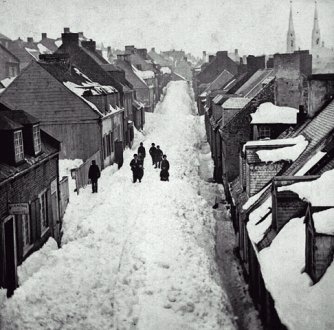
Evidence of the Mississippi River, Ohio River, Allegheny River, Delaware River and Hudson River freezing and of very harsh winters.

Recent periods of quiet sun were the Dalton Minimum (1790-1830 A.D.), the Maunder Minimum (1645-1715 A.D.) and the Spörer Minimum (1420 to 1570 A.D.). The Maunder Minimum and Spörer Minimum were solar Grand Minima and each were individually referred to as the Little Ice Age.

A few decades after the Dalton Minimum

In the spring Eliza, a slave, carrying her young son, fled from Kentucky by crossing the Ohio River on foot. The river was “swollen and turbulent, great cakes of floating ice were swinging heavily to and fro in the turbid waters.” She leaped from one chunk of ice to the next until she reached freedom on the Ohio shore. [Source: Uncle Tomʼs Cabin. Harriet Beecher Stowe lived in Cincinnati, Ohio from 1832 to 1850. In 1851, she wrote “Uncle Tomʼs Cabin”. Her life in Ohio was intertwined in this work of fiction.]

During the Dalton Minimum
The Hudson River at the New York Harbor froze, enabling people to walk across the ice from Manhattan to Staten Island. The Hudson froze over completely during particularly brutal winter of 1779/1780, when the surface was solid for five weeks straight and the British rolled cannons over the ice. In 1821, taverns were constructed in the middle of the river to offer warmth and refreshment to pedestrians...

..Early settlers routinely waited till winter to cross the frozen Mississippi river in their wagon trains. In 1799, George Frederick Bollinger led a group of early pioneers from North Carolina to establish early settlements in Missouri. They hoped to cross their largest obstacle, the Mississippi River, on the ice, frozen solid in mid-winter. They arrived on the east bank of the Mississippi river opposite St. Genevieve in late December, pitched camp and explored potential river crossings. St. Genevieve is located about a hundred miles downstream from St. Louis. Daily the thickness of the ice was measured and then on December 31, a chopped hole in the ice indicated thickness well over two feet. The next day the settlers successfully drove their heavy loaded wagons across the river. [Source: “The Bollinger Migration to the Louisiana Territory”, part of "Bollinger Collection" compiled by Orena Bollinger in 1984.]

...From 1803 to 1806, Captains Lewis and Clark lead a transcontinental expedition to explore the greater Northwest. During the winter of 1804/1805, the explorers set up a winter base camp near the Big Knife River near what is today the town of Bismarck, North Dakota. The winter was bitterly cold. There were 6 days with temperatures of -30oF or lower. These occurred in 1804 on December 12 (-38 degrees F), December 17 (-45 degrees F), December 18 (-32 degrees F), in 1805 on January 10 (-40 degrees F), January 11 (-38 degrees F), and January 13 (-34 degrees F). Compare this to the current low temperatures of Bismarck, North Dakota in which only one day in the past decade fell below -30 degrees F. On January 15, 2009 the temperature fell to -44 degrees F. [Sources: (1) The Journals of the Expedition under the Command of Captains Lewis and Clark, (2) Weather Underground for Bismarck, ND]

Between the Dalton Minimum and the Maunder Minimum
December 1776 was a desperate time for George Washington and the American Revolution. During the night of December 25, Washington led his small Continental army of 2,400 troops from Pennsylvania across the Delaware River made dangerous and barely navigable by huge chunks of ice. Once across they launched a surprise attack on the Britain's Hessian mercenaries at Trenton, New Jersey, capturing 1,000 prisoners and seizing muskets, powder, and artillery...

..In Boston, Massachusetts on February 22, 1772, Anna, a young school girl, writes in her diary “Since about the middle of December, we have had till this week, a series of cold and stormy weather - every snow storm (of which we have had abundance) except the first, ended with rain, by which means the snow was so hardened that the strong gales at northwest soon turned it, and all above ground to ice.” In some streets about town this mixture of ice and snow is 5 feet thick. On March 11, she writes that the snow is now 7 feet deep in some places around her house[Source: “Diary of a Boston School Girl” written by Anna Green Winslow from 1771-1773, edited by Alice Morse Earle in 1894.]...

...Just before the opening battles of the French and Indian War in December 1753, George Washington, then 21 years old, crossed the Allegheny River. In their first attempt, Washington and a guide used a raft to cross the ice-choked river and this ended in disaster as Washington was knocked overboard in deep water and saved himself only by catching the raft as it swept by. The severe cold that night froze their clothes and the guide's fingers. The river also froze, however, allowing them to walk across on the ice the next morning. Soon they reached the safety of an English trader's settlement.

During the Maunder Minimum
During the Great Frost of (1683–1684) in England, the River Thames was completely frozen for two months, the ice was 11 inches thick at London. Sea ice was reported along the coasts of southeast England, and ice prevented the use of many harbors. The sea froze, so that ice formed for a time between Dover and Calais, joining England and France. The Thames was recorded to have frozen over at London during the years: 1649, 1655, 1663, 1666, 1667, 1684, 1695, 1709, and 1716....

...During the Little Ice Age, growing seasons in England and Continental Europe generally became short and unreliable, which led to shortages and famine. These hardships were nothing compared to the more northerly countries: Glaciers advanced rapidly in Greenland, Iceland, Scandinavia and North America, making vast tracts of land uninhabitable. The Arctic pack ice extended so far south that several reports describe Eskimos landing their kayaks in Scotland. Finlandʼs population fell by one third, Icelandʼs by half, the Viking colonies in Greenland were abandoned altogether, as were many Inuit communities.

During the Spörer Minimum
By 1518, early explorers made significant progress in probing and surveying the New World. They described North America as a “land of frozen seas, horrid, barren and scarcely habitable for cold”. “In the New World, cold predominates. The rigor of the frigid zone extends over half of those regions which should be temperate by their position. Countries where the grape and the fig should ripen, are buried under snow one half of the year; and lands situated in the same parallel with the most fertile and best cultivated provinces in Europe, are chilled with perpetual frosts, which almost destroy the power of vegetation.” [Source: The History of the Discovery and Settlement of America by William Robertson, 1826]

Again I recommend you read the entire article which is quite chilling, but the comparisons between the two could not be more stark. If indeed we are headed into a period of global cooling not only will our world be a much less friendly place to live but because of the obsession over global warming we now will be less prepared to handle it .

One wonders that should the Rivers Thames and Hudson freeze over in the next few years, will our eco-warrior scientist peer review papers explaining that your frozen breathe is to blame.